
Industry Insights
The Intelligent Grid: How AI is Powering a Sustainable Future
Balancing the grid, predicting renewable output, and optimizing infrastructure: How AI is the key to a cleaner, more efficient energy sector.
Read MoreAI infrastructure planning now connects compute demand with power, water, storage, network capacity, workload flexibility, and local resilience.
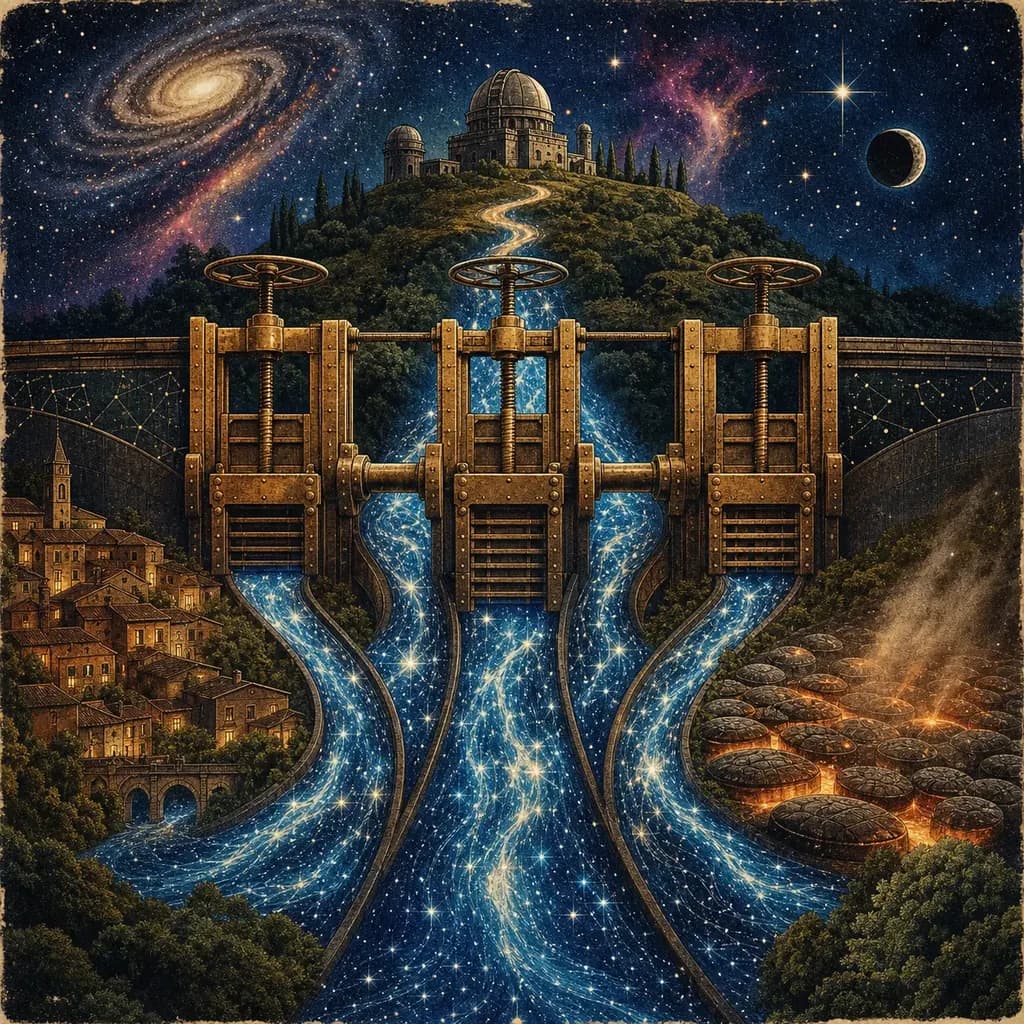
An AI data center is not an isolated box of accelerators. It joins an electrical grid, water system, fiber network, land-use plan, equipment supply chain, labor market, emergency-response system, and community. A capacity plan that starts and ends with rack count can optimize the server room while making the overall project slower, more expensive, or less reliable.
The scale is material but uncertain. The International Energy Agency's 2025 Energy and AI report estimated that data centers used about 415 TWh, or 1.5% of global electricity consumption, in 2024 and projected roughly 945 TWh in 2030 in its base case. The IEA emphasizes that local impacts can be much larger than the global share because facilities cluster. In the United States, Lawrence Berkeley National Laboratory's 2025 update models a central estimate of 11.8% of national electricity use in 2030, with a scenario range of 9.5% to 15.3%. These are scenarios, not meter readings from the future. Hardware efficiency, deployment pace, inference demand, utilization, cooling, and grid constraints can all move the outcome.
Responsible planning therefore needs a range, an operational envelope, and a public account of who bears the cost and risk.
A utility cannot plan from “50,000 GPUs.” It needs the electrical behavior at the point of interconnection. Translate the compute roadmap into:
Separate workload classes. Interactive inference has tight latency and availability requirements. Batch inference, model evaluation, data preprocessing, and some training can move in time or location, but flexibility is not free. Checkpoint boundaries, data locality, network cost, service commitments, equipment utilization, and researcher schedules constrain it.
Build the forecast from useful work rather than purchased hardware alone: training runs, tokens served, requests at each latency class, stored data, experiments, and resilience target. Then model utilization and failure. An accelerator reservation is not the same as full electrical draw, and a theoretical peak is not the same as coincident facility peak.
The energy-aware computing guide explains software-level controls such as model routing, batching, caching, quantization, and scheduling. These belong in infrastructure planning because they can change the physical load before concrete is poured.
Grid capacity is location- and time-specific. A region may have annual energy while lacking a substation, transformer, transmission path, short-circuit capacity, or firm supply at the requested node. “Powered by renewables” does not answer whether the facility can connect or operate during a constrained hour.
Request a joint study with the utility or system operator covering network upgrades, protection, harmonics, reactive power, ramp behavior, contingency performance, energization sequence, and realistic equipment lead times. Define which assumptions trigger restudy when campus scale or phasing changes.
The IEA estimates that grid constraints could delay around 20% of planned global data-center capacity to 2030 and notes that transmission in advanced economies can take four to eight years. Its energy-security analysis recommends siting near available grid capacity and exploring operational flexibility. That estimate is scenario-dependent, but the planning lesson is durable: a connection date is not secured by ordering servers.
Avoid speculative duplicate interconnection requests. Provide milestone evidence, deposits, and updated forecasts as local rules require. Publish who pays for dedicated and shared upgrades and how underused reserved capacity is treated. In the United States, FERC's work on large co-located loads illustrates that allocation, reliability, and jurisdiction are active policy questions; a recent FERC fact sheet on PJM rules should not be generalized to every market.
“We can curtail” is not an operating capability until it has a dispatch signal, controller, workload policy, measurement baseline, recovery plan, and commercial agreement.
Classify flexibility:
For each service, declare response time, sustainable duration, minimum load, rebound behavior, availability window, and verification method. A 15-minute battery response and a four-hour training deferral are different grid products.
Run drills. Measure requested versus delivered reduction, time to response, workload loss, recovery peak, emissions, and customer impact. Beware rebound: thousands of deferred jobs restarting together can create a second peak. The microgrids and storage guide covers islanding and storage architecture, but a microgrid does not remove the need for utility coordination or environmental permits.
Distinguish physical supply from contractual claims. A power-purchase agreement can finance renewable generation and support an accounting claim; it does not mean the facility consumes that generator's electrons every hour. Report the local grid mix, contractual instruments, additional generation, and time matching separately.
The IEA projects renewables to meet nearly half of additional global data-center electricity demand through 2030 in its base case, while gas and coal together still meet more than 40% of the increase. Its energy-supply chapter distinguishes physical electricity supply from operators' contractual mix. That distinction prevents an annual renewable-energy certificate from being presented as proof of hourly carbon-free operation.
Evaluate a portfolio:
Do not assume announced nuclear, geothermal, gas, or renewable projects will arrive on the desired schedule. Model delay, cancellation, fuel constraints, and transmission. On-site generation can shorten one dependency while creating others, including fuel delivery, air permits, local pollution, and stranded assets.
Power Usage Effectiveness (PUE) is total facility energy divided by IT equipment energy. The U.S. Department of Energy's data-center design guide warns that PUE does not describe the efficiency of the entire data center. It says nothing by itself about model usefulness, hardware utilization, grid carbon intensity, or water stress.
Use a balanced scorecard:
Metrics can be gamed. Energy per token may improve while total tokens surge. PUE may improve when a power-hungry model raises the IT denominator. A smaller model may save energy but reduce answer quality and increase retries. Always pair the efficiency numerator with useful outcome, total volume, and service quality.
Cooling choices trade electricity, water, cost, climate suitability, and resilience. Evaporative cooling can reduce electricity in some conditions while consuming water. Air cooling can reduce direct water consumption while increasing power demand. Reclaimed water can reduce potable demand but needs infrastructure and quality management.
Model hourly and seasonal conditions, not a global water coefficient. Report direct on-site use and relevant indirect water associated with electricity separately. Identify basin stress, drought restrictions, competing users, discharge temperature, treatment chemicals, and emergency operating mode.
The decision should involve the water utility and local stakeholders early. A low annual average can hide a summer peak that coincides with community scarcity. Publish design demand, actual use, and variance after operation.
The local bargain should be explicit before commitments are irreversible. Disclose the project phases, expected peak and annual electricity demand, water source, backup generation, noise, traffic, land use, construction and permanent employment assumptions, tax treatment, resilience investments, and decommissioning responsibility.
Explain cost allocation:
Avoid quoting job counts without distinguishing temporary construction, vendor, and permanent roles. Measure local hiring and supplier spend after launch. Create a public complaint and incident channel with response targets.
Infrastructure can improve local resilience when investment is deliberately shared—for example, a substation upgrade or storage contract designed with the utility. It can also concentrate noise, air pollution, water demand, and financial risk. “AI growth” is not an allocation principle.
A disciplined decision process has five gates:
Demand gate: workload range, useful-work forecast, flexibility classes, and software efficiency reviewed.
Site gate: grid, fiber, water, land, hazard, workforce, permitting, and community alternatives compared.
Interconnection gate: study scope, upgrade responsibility, milestones, energization range, and restudy triggers accepted.
Operating gate: cooling, backup, storage, dispatch, cyber-physical controls, and emergency procedures tested.
Public-performance gate: forecast versus actual demand, water, emissions, flexibility, jobs, incidents, and costs reported.
At each gate, update the scenario model. Do not carry a single early estimate through procurement as if uncertainty vanished. Establish stop or resize criteria when interconnection, water, cost, or workload assumptions change materially.
For threats that cross software and physical operation, use the critical-infrastructure risk guide to define isolation, manual fallback, incident command, and supplier dependencies.
Not automatically. It can reduce marginal emissions or congestion in some grids, but data transfer, idle hardware, deadlines, rebound peaks, and the actual marginal generator matter. Measure the specific schedule against a baseline.
No. PUE measures facility overhead relative to IT energy. It does not capture useful output, total demand, water stress, embodied impact, or the electricity supply.
Sometimes they can defer or reduce a specific constraint, but duration, cycling, interconnection rules, and growth matter. Size storage against a modeled service and test it.
No. Classify latency, availability, checkpoint, security, and data-locality constraints. Commit only the flexibility that operations can reliably deliver.
Forecasts have wide uncertainty and should not be combined as if their geographies, definitions, years, or scenarios were identical. Electricity regulation and cost allocation are jurisdiction-specific. Water and emissions results depend strongly on site, hour, cooling design, and accounting boundary.
Balancing the grid, predicting renewable output, and optimizing infrastructure: How AI is the key to a cleaner, more efficient energy sector.
Read More
A source-checked analysis of Rubin Ultra’s possible HBM cut—and what capacity, bandwidth, yield, software, and system economics mean for AI infrastructure.
Read More
Energy-aware AI design reduces waste by optimizing model size, hardware, batching, caching, routing, and where inference runs.
Read MoreThis article is part of our reference library. For current analysis see the briefing, and for practical guides browse the blog.