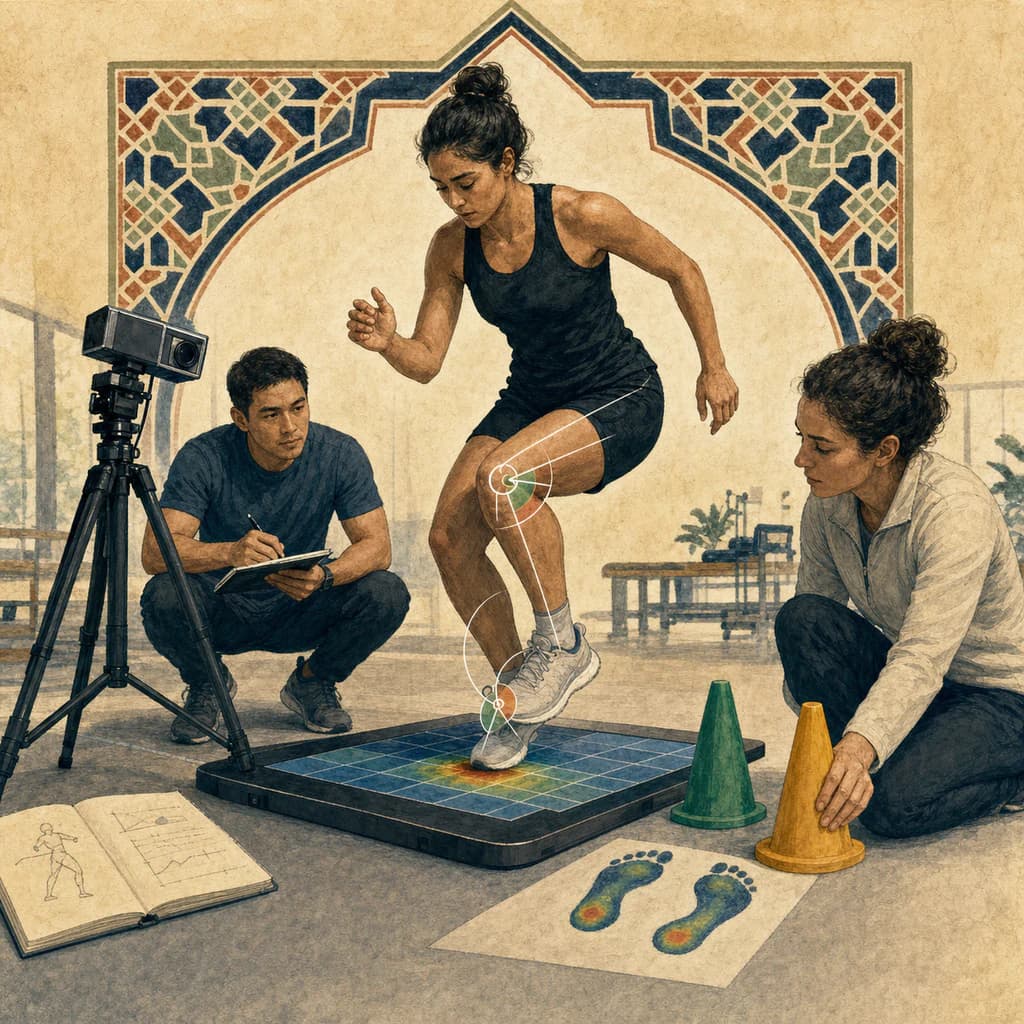
AI can estimate body landmarks from video, count repetitions, summarize training logs, and support consistent technique coaching. It cannot see every joint force through one phone camera, diagnose an injury from posture, or guarantee hypertrophy by generating a complicated program.
The credible product is a bounded measurement and coaching system. It tells users what the sensor observed, how accurate that estimate was for the specific movement and setup, and when a trainer, physiotherapist, or physician should take over.
1. Set the intended use and medical boundary
Define the user, exercise, environment, sensor, output, and decision. A general-fitness tool might count squats or flag that the knees moved differently between repetitions. A clinical product that diagnoses pathology, predicts injury, or directs rehabilitation requires different evidence, professionals, and potentially regulation.
The FDA’s January 2026 General Wellness: Policy for Low Risk Devices describes nonbinding US policy for low-risk products intended to maintain or encourage a healthy lifestyle and unrelated to disease diagnosis or treatment. It does not clear a specific fitness app or make every camera-based health claim “wellness.”
Maintain a claims register. “Estimated knee angle during this camera setup” is different from “unsafe knee mechanics” or “ACL injury risk.” Marketing, onboarding, alerts, and coach dashboards should use the same bounded language.
2. Standardize capture before improving the model
Many errors are capture errors. Define camera height, distance, orientation, frame rate, lighting, floor markings, full-body visibility, clothing guidance, calibration object, exercise tempo, warm-up, and number of trials.
Provide a live quality check for occlusion, blur, missing feet, camera tilt, another person in frame, and inadequate depth. If requirements fail, ask for recapture rather than returning a confident score.
For home use, instructions must work in small spaces and with ordinary devices. Test low-end phones, narrow fields of view, varied backgrounds, head coverings, assistive devices, loose clothing, and different body shapes. A studio-only protocol should not be marketed as universal smartphone analysis.
3. Understand the biomechanics pipeline
A typical markerless pipeline:
- detects two-dimensional keypoints in each frame;
- estimates depth or combines multiple camera views;
- maps keypoints to an anatomical or musculoskeletal model;
- estimates joint centers, angles, events, and sometimes kinetics;
- aggregates repetitions and compares them with a rule or reference;
- produces a cue with confidence and capture-quality context.
Every transformation adds assumptions. Image keypoints are not joint centers. Joint angles are not joint moments. Estimated muscle activation is not an electromyography measurement. A physics model can enforce consistency, but its body segments and constraints may not match the individual.
The model should expose intermediate quality flags so a coach can distinguish a true movement pattern from an occluded ankle or tracking swap.
4. Use original validation research at the measured scope
A 2026 study on the validity of smartphone-based markerless motion capture compared OpenCap with optical motion capture in 41 participants across eight dynamic tasks. It reported stronger agreement for sagittal-plane patterns, systematic offsets for some angles, and much higher normalized errors for out-of-plane kinematics.
This is controlled validation research for a named system, sample, setup, tasks, and outputs. It does not establish clinical equivalence for every movement, phone, population, or single-camera app. It does demonstrate why a product should publish metric-level errors instead of saying “lab-grade 3D analysis.”
When adapting a research system, match camera count, calibration, processing, and task definitions. Small protocol changes can materially change accuracy.
5. Design leakage-safe evaluation
Split by participant, session, camera, location, and time—not random video frames. Hold out movements and execution styles if the product claims broader generalization. Include fatigue, speed, different ranges of motion, partial occlusion, and technically imperfect repetitions.
Compare with task-appropriate references:
- marker-based motion capture for kinematics;
- force plates for ground-reaction forces and jump events;
- validated timing or displacement tools for performance metrics;
- qualified human raters for coaching categories, with inter-rater agreement;
- clinical assessment only when the product has a clinical intended use and protocol.
Report joint-angle RMSE, bias, Bland–Altman limits, waveform similarity, event timing error, repetition-count precision and recall, test-retest reliability, missing-output rate, and capture rejection. Correlation alone can be high despite unacceptable systematic error.
6. Build coaching from observable, changeable signals
Cues should be specific, limited, and tied to the measured view: “The bar path moved forward relative to your foot in three of five captured repetitions” is better than “Your form is bad.” Offer one or two changes, a demonstration, and a retest.
Avoid rigid universal geometry. Limb proportions, mobility, exercise variation, load, goal, and comfort change the appropriate technique. Pain, dizziness, sudden weakness, neurological symptoms, or suspected injury should stop the automated coaching flow and direct the user to appropriate professional help.
Use the authority principles in AI human-approval design for trainer dashboards. A coach should see video, signal quality, estimated metric, history, and uncertainty and be able to dismiss or correct the cue.
7. Generate programs within evidence-based constraints
Program generation should begin with training age, available equipment, schedule, preferences, relevant limitations, and a clearly stated goal. Use a rule-based safety envelope for exercise selection, volume changes, progression, recovery, and contraindications; let AI help sequence or explain choices inside that envelope.
The ACSM’s 2026 resistance-training position-stand summary emphasizes training major muscle groups at least twice weekly, gradual progression, adherence, and that complex techniques are often optional for healthy adults. It summarizes a professional evidence review, not a regulation or individualized prescription.
The US Physical Activity Guidelines for Americans provide population guidance, including muscle strengthening. They do not determine a safe program for a specific medical condition. High-risk users need qualified assessment.
8. Personalize with response, not imagined biology
Useful personalization comes from completed sessions, load, repetitions, perceived exertion, recovery, discomfort, preferences, and measured progress. Update gradually and keep a changelog. Let users reject substitutions and state why.
Do not infer hormonal state, injury, body composition, or recovery from a face or movement score without validated measurement. Avoid training recommendations based on race, body shape, or other proxies. Where wearables contribute heart rate or sleep estimates, preserve their uncertainty.
The approach in AI for athlete monitoring and sports biotechnology applies here: monitoring supports decisions but should not become diagnosis or coercive surveillance.
9. Measure product value and safety
A balanced fitness scorecard includes:
- capture success and rejection by device and environment;
- measurement error by movement, plane, joint, speed, and subgroup;
- repeatability across sessions;
- cue precision, coach agreement, and user comprehension;
- proportion of cues that produce a measurable change on retest;
- program adherence, completion, and voluntary substitution;
- strength, endurance, mobility, or skill outcomes matched to the goal;
- pain, adverse-event, and inappropriate-escalation reports;
- privacy requests and video-deletion completion;
- trainer override and correction rates.
Engagement and streaks are not health outcomes. A safe system may recommend rest, stop sending cues, or refer the user away from the app.
10. Anticipate predictable failure modes
Occlusion, foreshortening, motion blur, mirror images, camera movement, loose clothing, unusual equipment, floor contact, and left-right swaps can corrupt pose estimates. Depth ambiguity makes out-of-plane motion difficult from one view. Models can mistake a mobility adaptation for an error or learn gym background and camera position instead of biomechanics.
Program models can increase volume too quickly, repeat the same tissue stress, ignore exercise order, or hallucinate equipment. Recommendation loops may interpret adherence to an easy plan as proof that it is optimal. Body-image language can worsen anxiety or disordered exercise.
Use capture gates, task-specific confidence, out-of-distribution detection, hard progression limits, prohibited advice, coach review, and an immediate “stop analysis” control.
11. Protect video and biometric data
Workout video can reveal face, home, location, disability, companions, and health information. Minimize retention, crop or abstract where possible, encrypt, restrict access, log viewing, and make deletion easy. Separate model-training consent from use of the service.
On-device inference can reduce transfer and should be evaluated using the practices in AI on-device privacy. It does not prevent leakage from backups, analytics, exported clips, or model updates.
Never use employee or athlete data for discipline, selection, or contract decisions without explicit governance, proportionality, and appropriate legal and ethical review. Voluntary consumer coaching and institutional surveillance are not the same use case.
12. Govern models, content, and professionals
Maintain versions for pose model, anatomical model, exercise definition, cue library, program rules, and user-facing claims. Record training and validation populations, excluded conditions, devices, task limits, and rollback triggers.
Biomechanists, trainers, clinicians, safety specialists, accessibility experts, privacy staff, and representative users should review according to intended use. A language model may draft a cue, but approved content rules and clinical escalation language should be locked and tested.
Monitor after every phone OS, camera, model, or exercise-library update. Visual consistency does not guarantee numerical consistency.
13. Roll out from lab replay to bounded coaching
First reproduce published or internal validation on the exact deployment pipeline. Next run shadow analysis during sessions and compare with reference systems and qualified raters without showing cues.
Pilot one exercise, camera configuration, and low-risk metric with a small representative cohort. Predefine acceptable error, capture-failure threshold, adverse-event review, and rollback. Keep manual logging and current coaching available.
Expand one variable at a time—new phone, movement, environment, or population—and revalidate. Do not generalize a sagittal-plane squat result to multiplanar cutting, rehabilitation, or injury prediction.
14. Release checklist
Before launch, verify:
- intended use, population, exercise, sensor, and medical boundary are explicit;
- capture protocol and quality rejection work on target devices;
- each output names the underlying signal and transformation;
- people, sessions, devices, and environments are held out in evaluation;
- metric-level bias, error, reliability, and failure are acceptable;
- cues are observable, changeable, and stoppable;
- program generation stays inside reviewed progression and safety rules;
- pain and clinical escalation language is clear;
- video consent, retention, training use, access, and deletion are tested;
- marketing does not equate pose estimation with diagnosis or injury prevention.
AI can widen access to movement feedback and make coaching more consistent. It becomes useful fitness infrastructure when it measures honestly, coaches conservatively, protects intimate video, and knows when the camera cannot answer the question.
Source notes
Sources checked on 2026-07-30:
- FDA General Wellness: Policy for Low Risk Devices is January 2026 nonbinding US guidance; it does not clear a specific fitness or biomechanics product.
- Liang et al., smartphone markerless-motion validation is original 2026 controlled research on a named system, 41 participants, and eight tasks; its plane- and task-specific errors limit generalization.
- ACSM 2026 resistance-training position-stand summary summarizes professional consensus for healthy adults; it is not regulation or personal medical advice.
- Physical Activity Guidelines for Americans, second edition is US population guidance, not an individualized biomechanics or rehabilitation protocol.