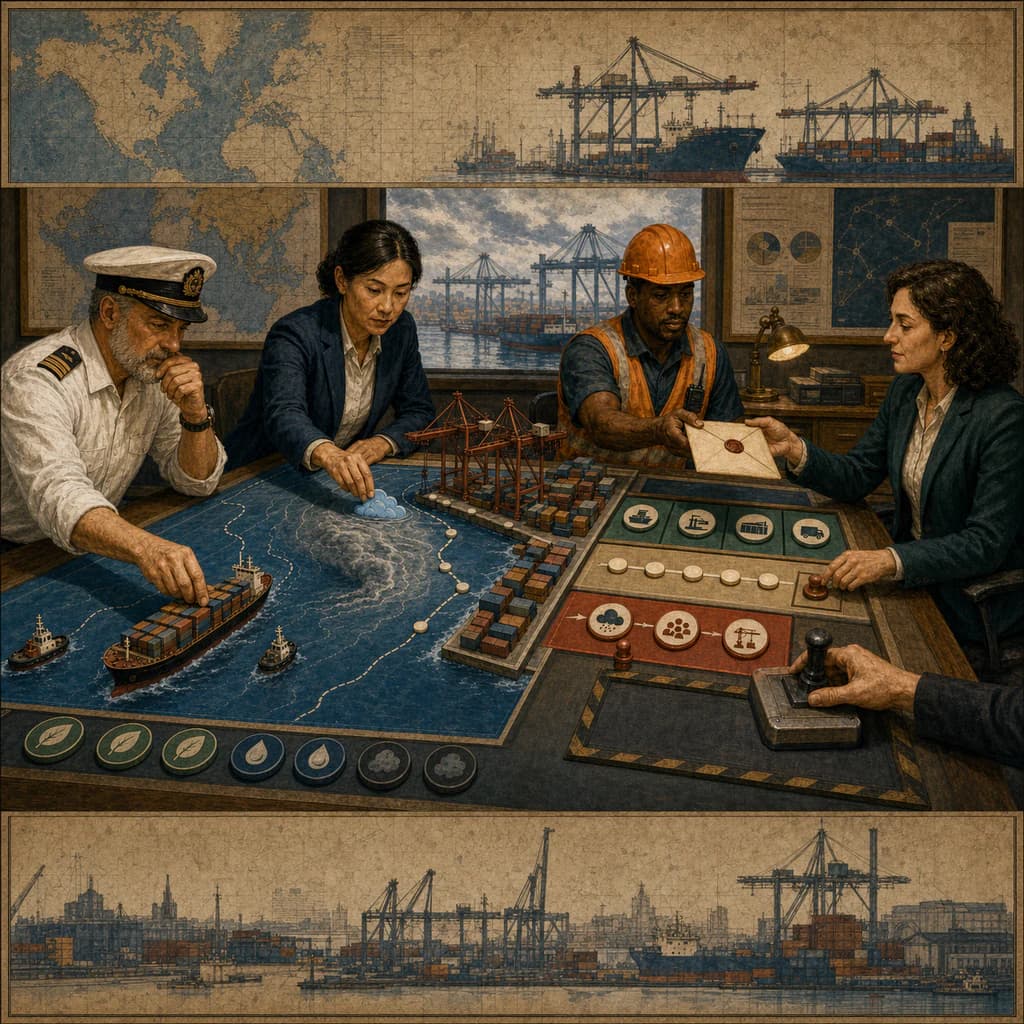
AI can recommend a route, estimate an arrival, detect an unusual engine signal, and reconcile shipment events. It does not make the sea predictable, remove the master’s responsibility, or turn a partially observed global network into a perfectly optimized machine. Weather changes, ports close, crews improvise, cargo information arrives late, and a locally efficient decision can transfer cost or risk elsewhere.
The useful 2026 architecture is a resilient decision system. Models produce bounded recommendations from traceable data. Navigators, engineers, port operators, planners, and safety teams retain defined authority. International rules, flag and coastal-state requirements, contracts, and industry standards are identified separately. Every automated action has an operating domain, an escalation path, and a record.
1. Define the decision and the operating domain
“Autonomous shipping” can mean decision support on a crewed ship, remotely supervised functions, periodically unattended machinery, or a vessel designed for much less onboard intervention. Those are different safety cases. Specify the function, waters, traffic density, visibility, weather and sea-state limits, chart and sensor assumptions, connectivity, cargo, vessel class, and human supervision.
State what the model may recommend, what it may execute, and what always requires human authorization. Define a minimum-risk condition for degraded sensing, uncertain position, conflicting targets, cyber incident, or lost communications. A trial in a surveyed coastal corridor does not establish fitness for congested straits, ice, or a typhoon.
2. Keep the master, bridge team, and remote operator in the control design
The International Maritime Organization’s first non-mandatory MASS Code was adopted in May 2026, with effect from 1 July 2026. IMO describes it as guidance for cargo ships that complements instruments including SOLAS while experience is gathered toward a future mandatory code. It is not yet the universal binding authorization sometimes implied by autonomous-ship marketing.
The Code also keeps the master’s overall responsibility, including when functions are operated remotely. Translate that principle into usable controls: clear role allocation, equivalent information between bridge and remote center, unambiguous command transfer, fatigue management, competence requirements, communication protocols, and the ability to intervene. Do not create nominal accountability without the information and authority needed to exercise it.
3. Collision avoidance needs more than object detection
Radar, AIS, cameras, infrared, sonar, and electronic charts can support traffic perception. Each has blind spots. AIS may be missing or wrong; cameras degrade in spray and darkness; radar returns can merge; small craft behave unpredictably; and sensor fusion can become confidently inconsistent.
Evaluate detection and tracking by range, target type, weather, background, and encounter geometry. Test false negatives, false alarms, latency, calibration drift, and disagreement. A predicted trajectory is not a vessel’s intent. Collision-avoidance recommendations must be assessed within applicable navigation rules and seamanship, with explicit handling of uncertainty and multi-vessel encounters. Log the information available at decision time for incident review.
4. Weather routing is advice under uncertainty
Route optimization may combine forecasts, waves, currents, draft, speed-power curves, fuel, emissions, cargo constraints, arrival windows, and piracy or exclusion zones. Forecast skill falls with horizon, while vessel-performance models may be stale after fouling, damage, or loading changes.
Generate routes with uncertainty and alternates, not a single mathematically perfect line. Respect the master’s weather judgment and hard safety constraints. Recalculate when observations diverge, but avoid unstable recommendations that repeatedly reverse. Evaluate schedule reliability, safety margins, fuel and emissions, motion limits, and maintenance effects together. A fuel-saving detour can be unacceptable if it increases fatigue, cargo damage, or exposure to another hazard.
5. Predictive maintenance must connect signal to safe work
Engine, vibration, pressure, temperature, lubricant, electrical, and alarm histories can help identify developing faults. Labels are scarce because genuine failures are rare, maintenance changes the system, and sensors fail too. A model trained on one engine family or operating profile may confuse normal transients with degradation elsewhere.
Link every alert to evidence, confidence, affected equipment, recommended inspection, and time window. Validate by vessel class and duty cycle. Track missed failures and unnecessary work, not only dashboard accuracy. Engineers must be able to reject an alert and record why. Safety-critical release remains governed by approved maintenance, class, manufacturer, flag, and company procedures—not a model score.
6. Port ETA starts with event semantics
Arrival estimates influence berth, tugs, pilots, cranes, labor, trucks, rail, inventory, and customer commitments. Yet “arrival” may mean pilot station, anchorage, port limit, berth, or cargo availability. AIS gaps, slow steaming, port congestion, customs holds, and changed rotation can corrupt a precise-looking timestamp.
Agree on event definitions, identifiers, time zones, update frequency, and confidence intervals across carrier, terminal, port, and customer systems. Compare model performance with simple schedule and last-position baselines. Measure error at horizons relevant to each user. Preserve late corrections and missing-data flags so downstream planners do not mistake an imputed event for an observed one.
7. Digital bills of lading require legal and technical alignment
DCSA’s Bill of Lading standard and open APIs are intended to support interoperable electronic processes. DCSA is an industry standards organization; its specification is not itself a statute and does not make an electronic document legally effective in every jurisdiction or contractual chain.
Before automating document extraction or transfer, map the governing law, title and possession requirements, carrier terms, platform rules, identity, signatures, endorsement, surrender, sanctions screening, retention, and fallback. Preserve the original document and all transformations. AI may flag inconsistencies across booking, shipping instructions, bill of lading, customs data, and manifest, but authorized parties must resolve material discrepancies.
8. Track-and-trace depends on shared identifiers
DCSA’s track-and-trace documentation recommends standardized shipment events across transport phases. This can reduce bespoke mapping, but adoption, implementation versions, partner coverage, and data quality vary. A common JSON shape does not guarantee that two organizations mean the same operational event.
Maintain canonical identifiers for shipment, transport equipment, transport document, vessel voyage, location, and event. Validate sequence, duplicates, impossible timestamps, and source. Mark observed, estimated, planned, and inferred states separately. Use AI for anomaly prioritization and mapping suggestions, not to silently fabricate missing milestones. Contractual service commitments should rely on agreed events and evidence.
9. Optimize the network for resilience, not a fragile average
UN Trade and Development’s Review of Maritime Transport 2025 describes a sector facing trade volatility, rerouting, costs, and disruption while digitalization and automation create both opportunity and cyber risk. It is an analytical UN publication, not a binding safety rule.
Network models should test closures, capacity loss, canal or strait disruption, labor constraints, equipment imbalance, blank sailings, and demand shifts. Present robust options and trade-offs rather than one cost minimum. Measure recovery time, service reliability, inventory exposure, demurrage, detention, and customer priority. Prevent the optimizer from repeatedly shifting delay, empty-container shortage, or unsafe pace to the least visible port or supplier.
10. Cybersecurity is part of navigational and cargo safety
Connected sensors, remote access, shore integration, model updates, vendor tools, and document APIs enlarge the attack surface. A manipulated position feed, maintenance signal, routing constraint, or cargo record can produce a physically unsafe result even when the AI behaves as designed.
Segment operational technology, minimize privileges, authenticate devices and operators, sign updates, log administrative changes, and test recovery without shore connectivity. Validate data origin and freshness before use. Maintain manual or independent means for essential functions. Include remote centers, cloud providers, terminals, agents, and maintenance vendors in incident exercises and contract notification duties.
11. Decarbonization is a multi-variable constraint
Speed optimization, trim advice, routing, arrival coordination, and maintenance can reduce some fuel use. The effect depends on vessel, weather, port waiting, cargo, fuel, operational constraints, and what happens elsewhere in the network. A percentage from a trial should not become a fleet-wide claim without comparable measurement.
Define baseline, boundary, fuel and emissions factors, voyage conditions, and whether savings are absolute or intensity-based. Check rebound effects, schedule recovery, auxiliary use, and congestion. Keep regulatory compliance calculations separate from exploratory model estimates. Report uncertainty and independent verification for public environmental claims.
12. Design the human system, not just the interface
Automation changes watchkeeping, skill, workload, staffing, and communication between sea and shore. Long quiet periods can reduce readiness just before a rare emergency; frequent false alarms can create distrust. Remote operators may supervise several assets with incomplete sensory cues.
Use bridge, engine-room, port, terminal, dispatch, and seafarer input in hazard analysis. Train normal, degraded, handover, and recovery modes. Measure workload, alarm response, intervention quality, fatigue, and near misses. Preserve stop-work authority and non-punitive reporting. Workforce reduction should never be treated as the safety evidence for the system that enables it.
13. A practical maritime AI gate
Deploy only when the function and operating domain are bounded; applicable law, IMO guidance, class and industry standards are correctly labeled; master and operator authority is usable; sensors and partners fail safely; cyber controls cover the full chain; ETA and event semantics are agreed; environmental claims have a defensible boundary; and drills prove recovery without the model.
For adjacent operations, see AI in autonomous shipping, AI in logistics and shipping, and AI supply-chain optimization. The invisible captain should remain a transparent set of controlled functions—not an excuse to make responsibility invisible.
Source notes
Sources reviewed on 2026-07-30:
- IMO adopts first international code for autonomous ships — official IMO notice: the MASS Code effective 1 July 2026 is non-mandatory guidance for cargo ships; IMO’s roadmap anticipates later mandatory regulation.
- UN Trade and Development: Review of Maritime Transport 2025 — official analytical report on maritime trade, disruption, costs, technology, and cyber risk; not a binding safety instrument.
- DCSA: Bill of Lading standard — voluntary industry interoperability standard and API framework; legal effectiveness still depends on jurisdiction and transaction.
- DCSA: Track and Trace standard documentation — industry-recommended event and data documentation; implementation and partner coverage require verification.