An individualized mRNA treatment selected with specialized AI has produced a positive Phase 3 result in melanoma. That is a genuine milestone. It is also narrower than the viral claim that cancer will be cured within a few years.
On August 19, Merck and Moderna said their INTerpath-001 trial met its primary endpoint of recurrence-free survival and a key secondary endpoint of distant metastasis-free survival. The experimental treatment, intismeran autogene, was added to Keytruda after patients had surgery to remove high-risk melanoma. The companies have not yet published the Phase 3 hazard ratios, survival curves, adverse-event tables, subgroup analyses, or overall-survival result.
The defensible headline is therefore precise: an AI-assisted, patient-specific mRNA therapy improved two measures of how long people remained free from recurrence or distant spread compared with Keytruda alone. It is not yet an approved product, a proven cure, or evidence about every cancer.
What the Phase 3 announcement actually says
The Merck and Moderna topline release reports statistically significant and clinically meaningful improvements in recurrence-free survival, or RFS, and distant metastasis-free survival, or DMFS. RFS counts recurrence at any site or death. DMFS focuses on distant metastasis or death.
The result came from a prespecified interim analysis. Merck and Moderna said the safety profiles were consistent with earlier studies and showed no new safety signal. They plan to present detailed data at a medical meeting, discuss submissions with regulators, and continue the trial to evaluate other secondary endpoints, including overall survival.
Those verbs matter. “Met endpoints” means the comparison crossed the trial’s statistical and clinical thresholds under its protocol. It does not reveal the size of the benefit, the absolute number of recurrences prevented, whether every subgroup benefited, or whether patients live longer. Those questions require the full dataset.
How INTerpath-001 was designed
The public trial record for NCT05933577 describes a randomized, double-blind, placebo- and active-comparator-controlled Phase 3 study. It enrolled 1,137 people whose stage IIB, IIC, III, or IV cutaneous melanoma had been completely removed and who had not received prior systemic treatment for this setting.
Participants were randomized two to one. The experimental group received intismeran at 1 milligram every three weeks for up to nine doses plus Keytruda at 400 milligrams every six weeks for up to nine cycles. The comparator group received a placebo matched to intismeran plus the same Keytruda schedule. Planned treatment lasted about one year, or until recurrence or unacceptable toxicity.
This is adjuvant treatment: therapy given after surgery when no visible tumor may remain but microscopic disease can still cause a relapse. It is not a trial in people with a large untreated tumor, and it did not compare the personalized treatment against no treatment. It tested whether adding intismeran improves on an established immunotherapy.
For a broader framework on endpoints, comparators, and prospective evidence, see our guide to AI and clinical trials.
How one treatment is built for one patient
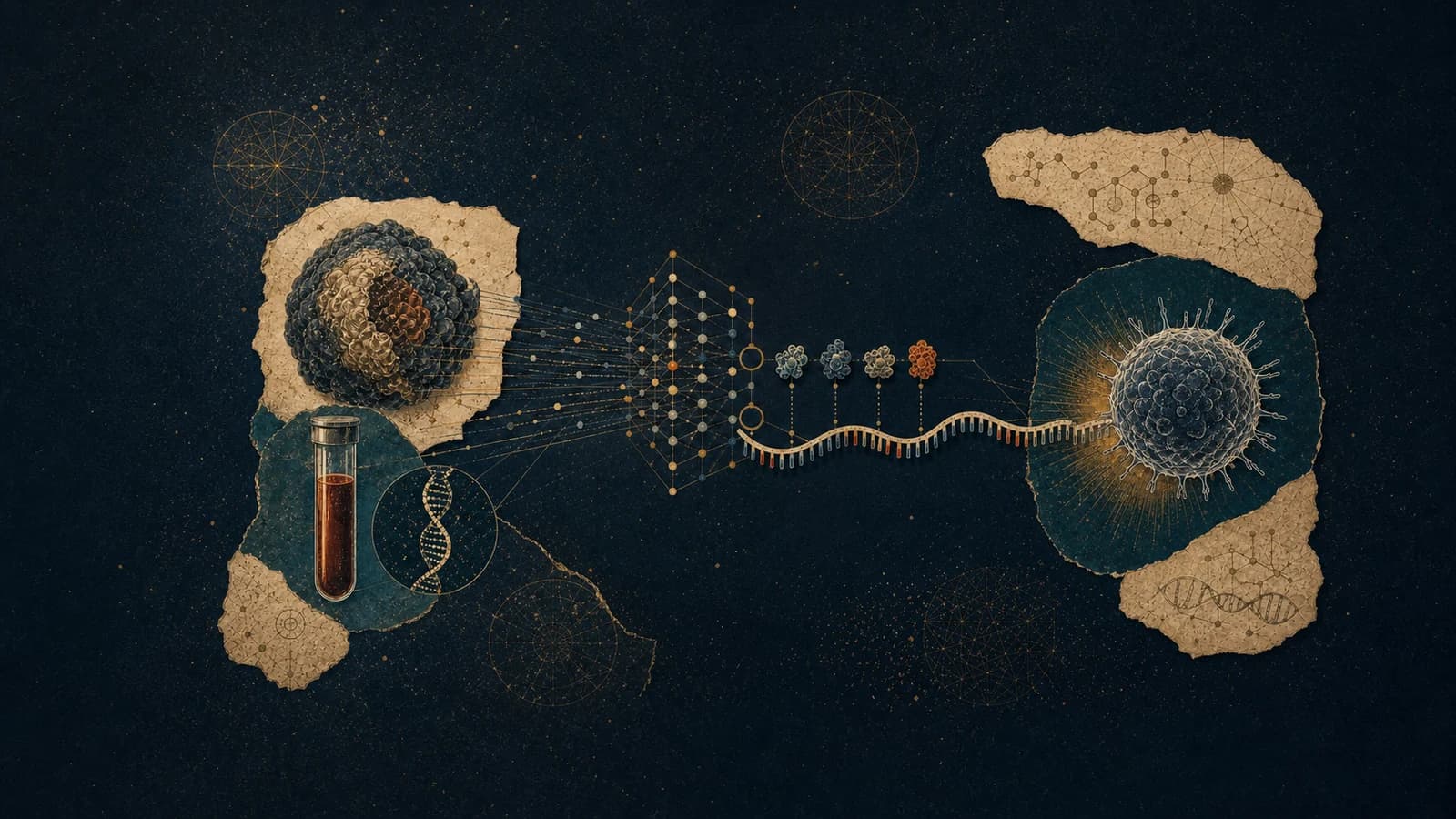
Intismeran is not an off-the-shelf sequence shared by every participant. A tumor sample and a blood sample are sequenced. The blood provides a reference for inherited variants; comparing it with the tumor helps identify mutations acquired by the cancer.
The design system then searches for neoantigens: altered protein fragments created by tumor mutations that may appear foreign to the immune system. Up to 34 selected neoantigen sequences are encoded in a synthetic mRNA molecule manufactured for that individual. After dosing, cells translate the mRNA, process the encoded antigens, and present them to immune cells. The goal is to expand T cells able to recognize cells carrying those tumor-specific signals.
Keytruda plays a complementary role. It blocks PD-1, an inhibitory checkpoint that can restrain T-cell activity. A simplified model is that intismeran supplies a personalized target list while pembrolizumab releases part of the immune brake. Biology is more complex, and a predicted target is not guaranteed to be presented, recognized, or clinically useful.
The word “vaccine” is common in public coverage because the treatment trains an immune response. It is a therapeutic cancer vaccine, not a preventive vaccine given to healthy people to stop melanoma from developing.
Where the AI really enters the pipeline
The first X post called the result AI-assisted, and a follow-up post pointed to Moderna’s own description. That attribution is supported, although “AI” needs definition.
In a 2023 technical blog about the same V940 program, Moderna said an integrated series of AI algorithms takes sequencing data from tumor and blood samples, reviews mutations, and predicts up to 34 neoantigens most likely to elicit an immune response. It also described AI scheduling for coordinating thousands of patient-specific manufacturing batches.
This is consequential AI: algorithmic selection helps determine the molecular content of each person’s investigational therapy. It is not merely a chatbot summarizing records. But the public sources do not identify the selection model as a large language model, generative chatbot, or newly invented 2026 architecture. Specialized computational prediction of antigen processing, presentation, and immunogenicity predates the current LLM wave.
The right claim is “AI-assisted molecular design and manufacturing orchestration.” The Phase 3 trial evaluates the complete treatment system—sampling, sequencing, target selection, mRNA manufacturing, delivery, Keytruda, and clinical care. It does not isolate the incremental benefit of the AI algorithm from the rest of that chain.
What the earlier five-year result contributes
The percentages circulating online—68.8% versus 49.1% cancer-free at five years—do not come from the new Phase 3 trial. They come from the earlier 157-patient, open-label, randomized Phase 2b KEYNOTE-942 study.
The original peer-reviewed Lancet report indexed by PubMed established the randomized signal. Its five-year update in the Journal of Clinical Oncology reported a five-year RFS estimate of 68.8% for intismeran plus pembrolizumab and 49.1% for pembrolizumab alone. The hazard ratio for recurrence or death was 0.51, with a 95% confidence interval from 0.294 to 0.887. DMFS had a hazard ratio of 0.411, with a 95% confidence interval from 0.200 to 0.843.
Merck’s five-year study release summarizes those as a 49% reduction in the relative hazard of recurrence or death and a 59% reduction in the relative hazard of distant metastasis or death. “Risk reduction” here describes a time-to-event hazard ratio, not a claim that 49% of all treated patients were cured.
The exploratory overall-survival estimate favored the combination, but its confidence interval was wide and crossed 1. That earlier dataset supports durability and supplied the rationale for Phase 3. Its percentages must not be relabeled as Phase 3 numbers.
What the topline release does not yet tell us
The new trial is larger and more rigorous, but the public evidence is currently a company announcement. Several essentials remain unavailable:
- the RFS and DMFS hazard ratios, confidence intervals, event counts, and landmark rates;
- median follow-up and how mature each endpoint is;
- the absolute difference between groups, not only relative effect;
- outcomes by stage, age, mutation burden, PD-L1 status, BRAF status, and other subgroups;
- discontinuations, manufacturing failures, time from surgery to first personalized dose, and patients who never received a completed product;
- complete treatment-emergent and immune-related adverse-event tables;
- quality of life, overall survival, and whether later treatments differed between groups.
The double-blind design reduces bias, and a prespecified analysis is stronger than an improvised retrospective comparison. Still, “statistically significant and clinically meaningful” is the sponsors’ topline characterization until the numerical record is presented and independently examined.
Safety, approval, cost, and access remain open questions
The five-year Phase 2b update reported fatigue, injection-site pain, and chills as common events attributed to intismeran. Immune-related adverse events were similar between the combination and Keytruda-only groups in that smaller study. The Phase 3 announcement says no new safety signal emerged, but it does not provide event rates.
Intismeran remains investigational and has not been approved by the US Food and Drug Administration. A successful Phase 3 trial can support a regulatory application; it does not itself authorize marketing. Regulators will review efficacy, safety, manufacturing consistency, assay controls, labeling, and the reliability of a one-patient-one-batch supply chain.
Access may be unusually demanding. Every course begins with suitable tissue, paired sequencing, computation, quality-controlled manufacturing, and delivery on a clinically useful schedule. Turnaround time, batch failure, geographic reach, laboratory capacity, and price will shape real-world benefit. The system cannot help a patient if the personalized product arrives too late or cannot be made reliably.
This is why medical AI must be evaluated as a care pathway rather than a model score. Our clinical AI evidence guide explains the distinction between technical performance, clinical validity, and clinical utility.
Does this mean cancer is about to be cured?
No single melanoma study can support that conclusion. Cancer is a collection of diseases with different tissues, mutations, immune environments, stages, and treatment histories. Melanoma is relatively mutation-rich and immunogenic, making it a logical proving ground for neoantigen therapy. Success there does not guarantee the same effect in tumors with fewer visible neoantigens or stronger immune suppression.
The trial also concerns recurrence after complete surgical removal. “Cancer-free” in an RFS analysis means no recorded recurrence or death by a time point; it is not a biological proof that every malignant cell has been eradicated forever. Longer follow-up and overall survival matter.
The milestone is still large. A positive Phase 3 result suggests that a repeatable pipeline can turn the mutational fingerprint of one tumor into a manufactured mRNA treatment and improve outcomes over a strong active comparator. That moves individualized neoantigen therapy from an attractive mechanism toward a possible clinical platform.
What evidence should come next
The next medical-meeting presentation should determine how strong this result is, not whether the press release was exciting. Watch the absolute RFS and DMFS differences, confidence intervals, follow-up time, stage-specific results, adverse events, manufacturing success rate, dose turnaround, and emerging overall-survival curve.
Then watch the regulatory review and the other INTerpath studies in lung, bladder, renal, pancreatic, and additional cancers. Replication across tumor types would test whether this is a broad platform or a melanoma-specific success. Post-approval evidence, if authorization follows, would need to show that community delivery preserves the benefit seen in a global trial.
For now, the balanced verdict is strong but bounded: the first positive Phase 3 readout for an individualized neoantigen therapy and an mRNA cancer therapy is a landmark. The AI attribution is real. The cure claim is not.
Source notes — reviewed August 20, 2026
- Merck and Moderna’s INTerpath-001 topline release supplies the Phase 3 endpoints, enrollment, regimen, and sponsor characterization; detailed results are not yet public.
- ClinicalTrials.gov NCT05933577 supplies the registered design, arms, eligibility, outcomes, and study status.
- Moderna’s mRNA and AI explainer documents the company’s use of integrated AI algorithms for neoantigen selection and manufacturing scheduling.
- The Phase 2b KEYNOTE-942 paper on PubMed is the peer-reviewed primary randomized report.
- The five-year KEYNOTE-942 update supplies the landmark RFS rate and long-term hazard ratios.
- Merck and Moderna’s five-year summary supplies safety and development context for the Phase 2b follow-up.
- The two original X posts are included as the public framing being assessed, not as clinical evidence.
This article is educational and is not medical advice. Treatment decisions require a qualified oncology team with access to the complete clinical record.