
Industry Insights
The Synthetic Symphony: AI in the Music Industry and Audio Synthesis
How music teams can use audio synthesis within clear rights, consent, authorship, provenance, editorial, performance, metadata, and royalty controls.
Read MoreGreat AI video is a production workflow: concept, continuity, edit, sound, rights, review, and delivery—not a lucky prompt.
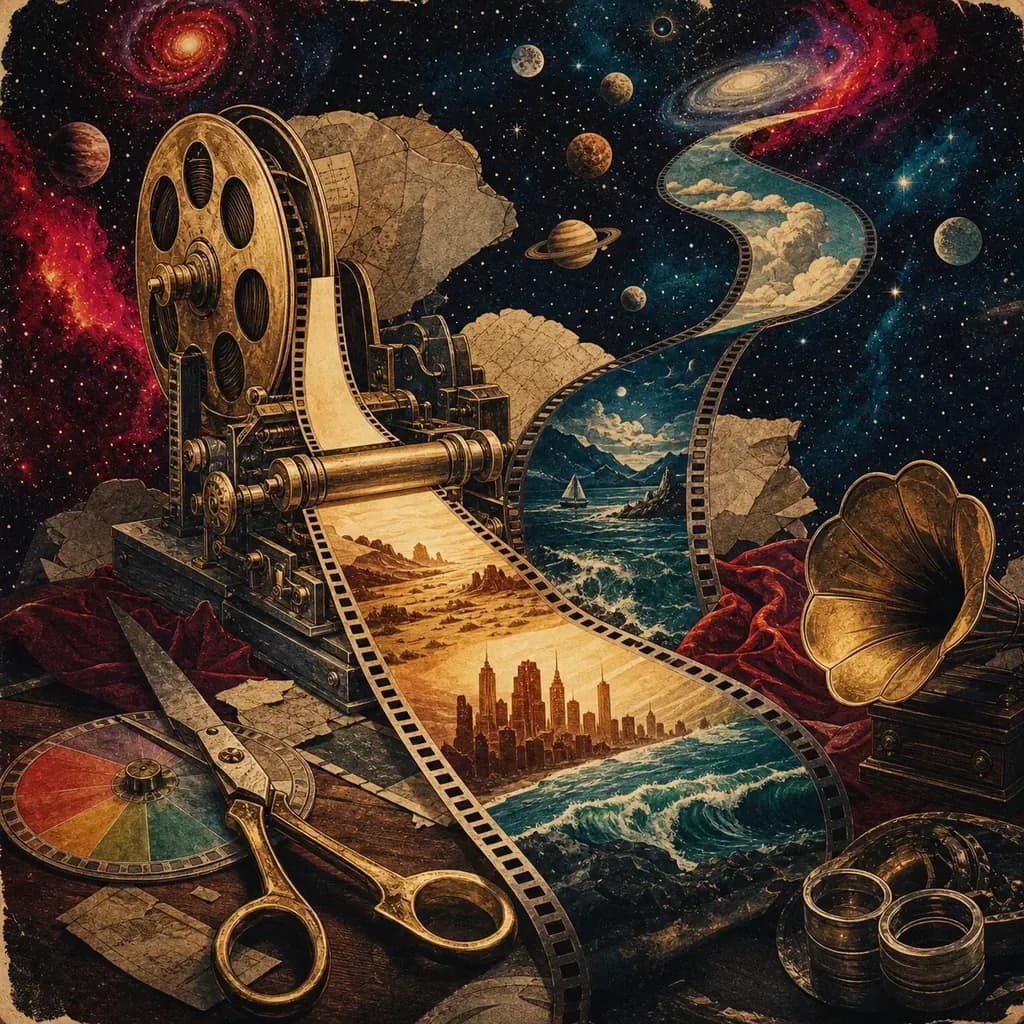
A beautiful six-second generation is a demo. A usable video is a controlled sequence of creative decisions: brief, references, shots, continuity, performance, edit, sound, rights, disclosure, delivery, and evidence about how the final asset was made.
Generative tools can compress previsualization and create shots that would otherwise exceed a budget. They can also introduce unstable identities, impossible product behavior, accidental imitation, rights uncertainty, and a pile of near-duplicate clips that are expensive to review. The production advantage appears only when generation is treated as source material inside a real media pipeline.
This guide is model-agnostic. Specific video models, limits, and licensing terms change quickly; the durable unit is the production record around each shot.
A visual contract defines what the project is allowed to change and what must remain invariant. It should fit on one page and include:
The contract prevents a common failure: every shot is individually attractive but belongs to a different world. It also gives reviewers objective rejection reasons. “The bottle cap changed shape” is actionable; “this feels off” is not.
Reference packs should contain only material the production is entitled to use. Record who supplied each image, voice, performance, font, texture, music stem, and logo; its license or consent; allowed territories and channels; expiry; and whether it may be submitted to a generative service. A paid stock license does not automatically grant permission to use an asset for every training, reference, or synthetic-replica workflow.
Do not send an entire script to a model and hope for coverage. Break it into shot packets. Each packet should specify:
| Field | Example |
|---|---|
| Narrative job | Reveal why the machine stopped |
| Start state | Technician outside closed panel |
| End state | Panel open, damaged belt visible |
| Invariants | Same technician, uniform, machine, lighting |
| Motion | Slow push-in; right hand opens latch |
| Duration and handles | 5 seconds plus 12 clean frames at both ends |
| Audio intent | Room tone and one metal latch; dialogue added later |
| Risk notes | Hands, brand marks, physically correct latch |
| Acceptance tests | Identity, hand count, latch motion, no extra text |
Generate the minimum viable coverage first: establishing shot, action, reaction, detail, and transition. Editors need handles and alternatives, not twenty versions of the hero shot. Give every candidate a stable ID such as S03_SH04_V06, then attach prompt, reference hashes, model or service version, generation date, seed if exposed, operator, and review status.
The shot packet also makes model switching possible. When a provider changes behavior, the team can rerun a defined input and compare results instead of reconstructing intent from chat history.
The efficient loop is not “prompt until lucky.” It is:
Use a defect vocabulary that the whole team understands:
Track first-pass acceptance and defect types by shot category. A model may be strong on landscapes but weak on a specific product interaction. That information should change the storyboard, not just the prompt.
Continuity is an editorial property. Assemble rough cuts early so the team can judge eyelines, screen direction, rhythm, and information order. A technically impressive clip that breaks the edit should be rejected or repurposed.
Lock dialogue and timing before expensive lip synchronization. Record or license the performance, clean it, approve pronunciation, and retain the performer’s consent record. Generate room tone, effects, or music only under terms appropriate to the release, and keep stems separate. Final review should cover loudness, clipping, synchronization, language versions, captions, audio description, and whether a synthetic voice could be mistaken for a real person.
Accessibility is part of production, not a post-launch patch. Captions need speaker changes, meaningful sound cues, and reading speeds appropriate to the audience. Important information conveyed only visually may need audio description; information conveyed only in color needs another cue.
For every visible or audible identity, record whether it is:
Consent should state the performer, approved uses, duration, territory, channels, product or context, whether new performances may be generated, review rights, compensation, security, retention, revocation or suspension terms, and deletion duties. Do not treat a broad release for an original shoot as automatic consent for unlimited synthetic performances.
Current collective-bargaining terms offer a concrete benchmark, though they do not govern every production. The SAG-AFTRA 2025 Commercials Contracts require consent before creating a covered performer’s digital replica and informed consent tied to a reasonably specific description before use. Applicable rights still depend on contract, jurisdiction, union coverage, and the facts of the production.
Copyrightability is a separate question from permission to use inputs or likenesses. The U.S. Copyright Office’s 2025 copyrightability report concludes that human-authored expression, creative selection and arrangement, and human modifications may be protected, while purely AI-generated material is not; prompts alone generally do not provide sufficient control under current generally available technology. That is a U.S. administrative view and a case-by-case analysis, not a global rule or a guarantee of registration.
Preserve evidence of human contribution: annotated storyboard, shot selection, compositing, paint work, timing changes, performance direction, edit decisions, color grade, sound design, and final arrangement. This is useful both for authorship analysis and for explaining the work honestly.
For adjacent workflows, see AI media rights and royalty tracking and synthetic-media authenticity.
The C2PA 2.2 specification defines Content Credentials: signed, tamper-evident provenance assertions bound to an asset. A production can record that a clip was generated, opened from an ingredient, edited, or exported, along with the signer and relevant actions.
Content Credentials are valuable but easy to misdescribe:
At ingest, hash the source and store its credential or manifest. At each material edit, retain parent–child relationships. At final export, sign the release asset, archive the validation result, and test the actual renditions delivered by the CDN or social platform. Our technical guide to content provenance and watermarking explains the difference between provenance, detection, and watermark claims.
Disclosure should answer a viewer’s likely misunderstanding. “AI-assisted” may be enough for an obviously illustrative background; a photorealistic synthetic statement by a recognizable person needs much more: visible disclosure, authorization, context, and often a persistent link to production details.
The EU AI Act adds a near-term operational requirement. The European Commission’s Article 50 transparency guidance says the obligations apply from August 2, 2026. Providers of systems that generate synthetic media must add machine-readable marks in scope, and professional deployers must clearly disclose deepfakes, subject to defined exceptions and adaptations for evidently artistic or fictional works. Scope, transitional provisions, and the exact role of the production require legal analysis; a C2PA credential alone should not be assumed to satisfy every visible-label duty.
Put disclosure decisions in the visual contract:
Review these answers again if the edit changes context. A fictional clip reused as “breaking footage” becomes a different risk.
Useful production metrics include:
Do not optimize for clips generated per hour. High output with low promotion yield creates review debt and storage cost.
Suppose a team needs a square and vertical campaign showing a new hiking lantern in a storm.
First, photograph the approved product from six angles and license the location and performer. The visual contract locks the lantern’s dimensions, button position, light color, logo treatment, wardrobe, and safe handling. The storyboard uses eight shots, but generation is limited to atmospheric transitions and two wide shots; real footage carries close product interactions where geometry and claims matter most.
Each generated candidate receives a shot ID and reference record. Reviewers reject any changing controls, impossible rain interaction, unsafe footing, or unidentified face. The editor assembles a rough cut before high-resolution generation. Sound is built from licensed rain, recorded clicks, and commissioned music. The final review checks product truth, rights, captions, disclosure, and platform crops. The release master and derivatives are signed and then validated after platform processing.
The result is not “fully AI” or “not AI.” It is a traceable mixed production in which each technique is used where its failure cost is acceptable.
Keep the record needed to reproduce decisions and defend the release, not an unbounded pile. Define retention by project risk, contract, privacy, and storage cost. Preserve final ingredients, prompts and settings, rejected compliance cases, approvals, and provenance links; document when transient drafts are deleted.
Not necessarily. In the United States, the Copyright Office says prompts alone generally do not establish sufficient human control under current technology. Ownership and protection depend on human authorship, contracts, source rights, and jurisdiction.
No. Disclosure affects framing, labels, credits, metadata, contracts, and platform versions. Decide it during the brief and confirm it at export.
No. Provenance records assertions about origin and edits and can make tampering evident. A detector estimates characteristics from content. Neither is a universal truth oracle.
These sources operate at different levels: C2PA is a technical provenance standard; the EU material is jurisdiction-specific law and implementation guidance; the Copyright Office report addresses U.S. copyrightability; and SAG-AFTRA terms apply to covered work. A production should obtain advice for its contracts, territories, and release context.
How music teams can use audio synthesis within clear rights, consent, authorship, provenance, editorial, performance, metadata, and royalty controls.
Read More
AI implementation cost in Iran, in toman: a dated Mehr 1405 estimate table from ready-made Persian chatbots to self-hosted GPUs, built from sourced salaries, server rents, and token prices.
Read More
A closer reading of Anthropic’s economic scenarios: what changes by 2030, who benefits, and how to turn uncertain futures into better decisions today.
Read MoreThis article is part of our reference library. For current analysis see the briefing, and for practical guides browse the blog.