
AI Tutorials
Grok Bot: Build a One-Person AI Company Safely
A practical guide to Grok Bot's shared computer, role charters, routines, multi-agent handoffs, pricing, evidence, and safety boundaries.
Read MoreZharfAI Research
Agent systems research desk

The most useful idea in NO1ennn's “Ledger Architecture” build is not that one person can run six businesses with seven bots. It is that each operating lane owns a ledger, each role has explicit refusals, every handoff carries evidence, and anything consequential stops before a human.
This edition reconstructs the complete design, preserves all four of the source article's embedded figures, and checks the product claims against current Kimi and SpaceXAI documentation. It also separates a practical control architecture from the source's illustrative revenue model. The quoted $102,870 month is arithmetic, not receipts, and neither the model nor the cost range demonstrates that six businesses can be operated profitably with ten minutes of daily human work.
The operational question is more useful: how can a small operator divide work among persistent agents without giving any one agent enough authority to create, approve, execute, and certify a consequential action?
This is not six generic chat windows. It is one control desk supervising six bounded business-state machines. Each ledger records what arrived, what is in progress, what was delivered, what changed externally, what was paid, what failed, and which exception needs a person.
The business names are examples. The reusable structure has five parts:
The last point is essential. Our separation-of-duties field guide explains why several role labels inside one authority path are not independent controls. Two bots sharing credentials, writable state, and one model failure mode may look separate while remaining one effective actor.
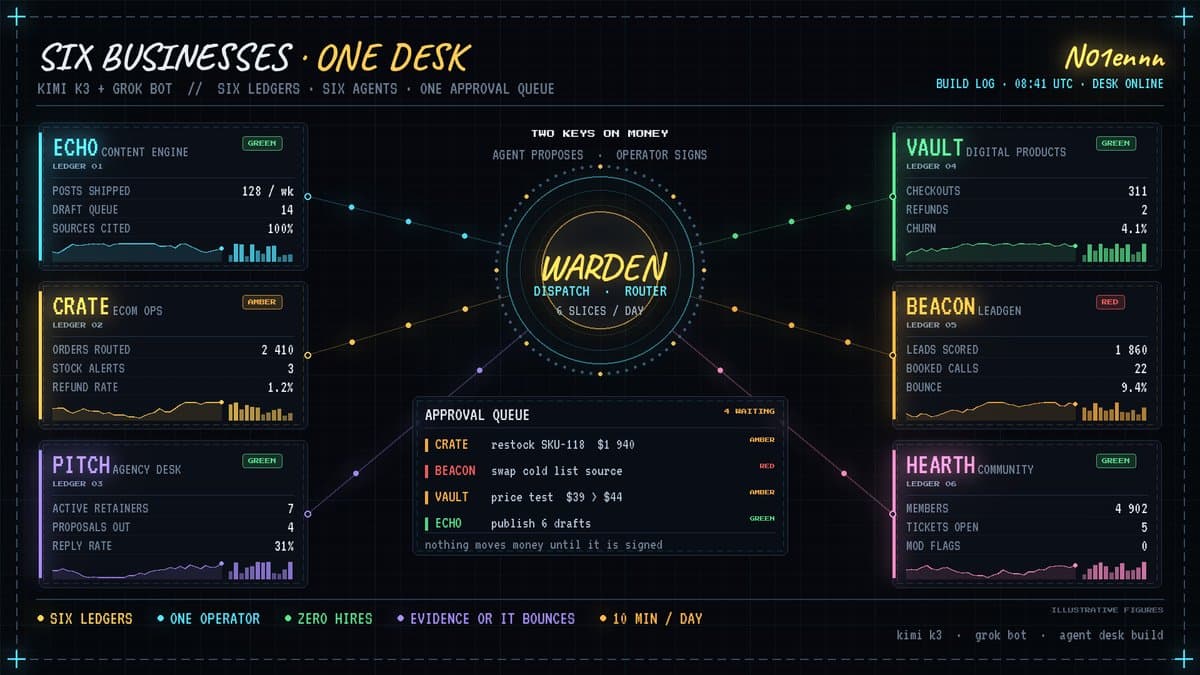 A six-ledger operating desk with WARDEN at the center and an approval queue below.
Creator figure from the source article. Its operating numbers are illustrative, not verified business results.
The source pairs two different layers rather than treating them as competitors.
Grok Bot is the managed work surface. SpaceXAI's official overview says a user's named Bots share one persistent cloud computer, files, browser sessions, and app logins. Each Bot gets its own screen and can work in parallel, but the screens are not separate security boundaries. This makes demonstrations, ongoing sessions, and cross-application handoffs easy while concentrating credentials and blast radius.
Kimi K3 is the model and programmable agent stack. Moonshot AI's official Kimi K3 repository describes a 2.8-trillion-parameter open-weight MoE model with 104 billion active parameters per token, 16 selected experts out of 896, native multimodality, and a 1,048,576-token context window. Kimi Code supplies terminal tools, skills, MCP integrations, and subagents; Kimi Agent SDK exposes that runtime to applications.
A sensible split is therefore:
| Layer | Best use | Main constraint |
|---|---|---|
| Grok Bot | persistent browser/app work, routines, fast operational prototyping | Bots share one computer and its sign-ins |
| Kimi K3 API | long-context reasoning, extraction, planning, and verification | usage cost, latency, and evidence still need controls |
| Kimi Code | repository, terminal, file, and scripted workflow execution | work-directory and command permissions must be bounded |
| Kimi Agent SDK | programmatic sessions, approvals, tools, and orchestration | an application still needs its own durable state and policy plane |
The pairing does not automatically create a company. The ledgers, identities, connectors, schemas, approval envelopes, and reconciliation jobs are the real system.
The source proposes six business lanes and a dispatcher. What matters is the owned number and the refusal, not the theatrical role name.
| Ledger | Agent | Owns | Must not do |
|---|---|---|---|
| Content studio | ECHO | accepted published pieces, reach, and qualified downstream demand | pitch clients or issue invoices |
| Ecommerce | CRATE | fulfilled orders, stock cover, contribution margin per SKU | change prices or cancel supplier orders without approval |
| Service agency | PITCH | qualified calls, proposals, and signed retainers | deliver client work or alter another ledger |
| Digital products | VAULT | paid units, refund rate, and support exceptions | run paid media or approve its own price changes |
| Lead generation | BEACON | evidence-backed qualified leads delivered | negotiate rates or contact an unapproved list |
| Membership | HEARTH | active members, churn, and unresolved member issues | issue credits or alter billing |
| Routing desk | WARDEN | priorities, cash view, handoff validity, and approval queue | write content, sell, fulfill, support, or move money |
Each ledger needs an append-only event history plus a current projection. A mutable spreadsheet cell saying “margin = 31%” is not enough. The system should retain the source events, calculation version, observation time, exceptions, and the actor that produced the state.
WARDEN is deliberately weak. It can reject a malformed handoff, compare a proposal with ledger state, and direct a task to the right owner. It cannot repair a missing number by inventing one, perform the rejected work itself, or turn an operator's draft into authorization.
The source uses a three-beat operating day:
The compounding value comes from controlled cross-ledger handoffs. A content item with unusual qualified traffic can create a BEACON lead packet; qualified accounts can move to PITCH; a signed client can enter HEARTH onboarding; recurring questions can become a VAULT product hypothesis; ECHO can then draft the launch. CRATE contributes verified cash and inventory state rather than customer data it does not need.
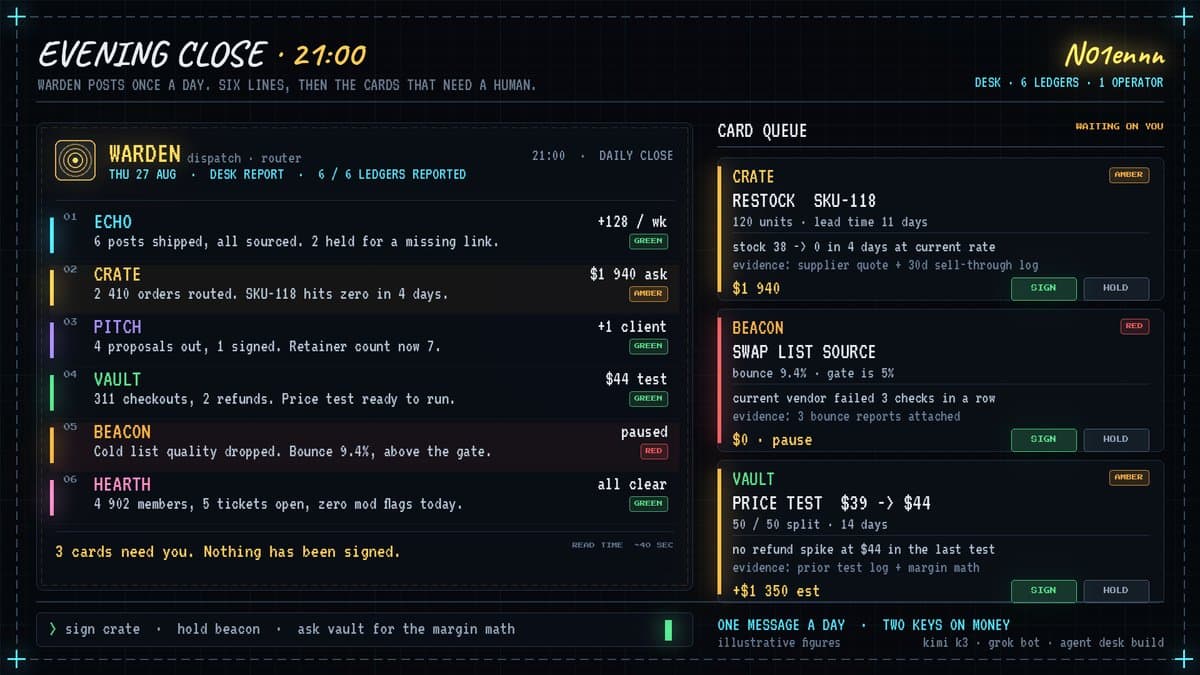 An evening close showing six ledger state lines and three human decision cards.
Creator figure from the source article. The dashboard is a conceptual interface, not a production screenshot.
A handoff should be data, not conversational implication:
{
  "handoff_id": "beacon-pitch-20260830-0042",
  "from": "beacon",
  "to": "pitch",
  "ledger": "leadgen",
  "kind": "qualified_lead",
  "payload": {
    "account_id": "acct_741",
    "trigger": "four verified operations openings in fourteen days",
    "fit_score": 0.81
  },
  "evidence": [
    "mcp://jobs/account/acct_741?window=14d",
    "mcp://crm/account/acct_741/history"
  ],
  "created_at": "2026-08-30T07:12:00Z",
  "expires_at": "2026-08-31T07:12:00Z",
  "idempotency_key": "sha256:..."
}
The receiving role verifies the schema, destination, expiry, evidence accessibility, and duplicate key before acting. It does not inherit the sender's permissions.
The source's “two keys” rule is a good start: one role proposes, a different control verifies, and a human decides. It should apply beyond money to publication, external messaging, price changes, refunds, order cancellation, access, deletion, production changes, and legal acceptance.
For high-consequence work, three chat turns are not enough. Bind approval to a canonical action object containing the exact target, amount or value, evidence references, policy version, expiry, and digest. The executor must reject a changed, expired, reused, or self-approved envelope. Our human-approval design guide covers the information a real decision card must show.
The source also colors actions:
| Class | Meaning | Examples |
|---|---|---|
| Green | reversible preparation inside a bounded workspace | read approved sources, calculate, draft, classify, write a scratch artifact |
| Amber | perform only within a narrow rule and report before it lands | update a non-sensitive stage, schedule an approved draft, prepare a support reply |
| Red | stop for a specifically informed human decision | send, publish, pay, refund, change a price, cancel, delete, grant access, deploy |
Color must resolve to enforceable allow, require-approval, or deny policy at the tool adapter. SpaceXAI's approval documentation makes the same limitation explicit: Auto Review is model-based and complements rather than replaces least privilege and explicit approval boundaries.
Two subtleties from the source are worth retaining. A cancellation is a new external action, not a harmless undo. A read can also become consequential when a scraper can exhaust a shared API quota, expose restricted records, or monopolize the computer needed by other ledgers.
Multi-agent systems can move an invented number faster than a human team. Make provenance a schema requirement:
{
  "claim": "SKU-118 sell-through over 30 days",
  "value": 0.712,
  "unit": "ratio",
  "source": "mcp://store/reports/sellthrough?sku=118&window=30d",
  "observed_at": "2026-08-30T06:14:02Z",
  "produced_by": "crate",
  "ledger": "ecommerce",
  "calculation_version": "sellthrough-v3"
}
An absent source is not an invitation for WARDEN to browse until it finds a convenient number. The handoff returns to its origin with a machine-readable reason. Conflicting authoritative sources travel together as an exception; the agent must not quietly pick the value that makes its proposal pass.
Evidence also needs scope. A CRM record can support the last contact date but not prove a company is solvent. A model explanation can describe a calculation but is not the underlying receipt. Store source identity, retrieval time, version, transformations, and a stable reference or hash where possible.
Kimi K3 is open-weight, but the full checkpoint is not a normal laptop install. The current official vLLM recipe describes roughly 1.68 TB of MXFP4 weights, an eight-GB300 or eight-MI355X/MI350X floor for validated single-node layouts, and much larger H100 requirements. For most teams, hosted access is the practical first path.
Kimi Code is the accessible execution layer. The current getting-started guide documents these installers:
# macOS / Linux
curl -fsSL https://code.kimi.com/kimi-code/install.sh | bash
# Windows PowerShell
irm https://code.kimi.com/kimi-code/install.ps1 | iex
Run kimi, use /login, then /model. The current model configuration lists k3 and k3-256k; access and the full one-million-token window depend on the Kimi Code plan. Read-only operations may run automatically, while file changes and shell commands ask by default. Preserve those boundaries instead of enabling blanket auto-approval.
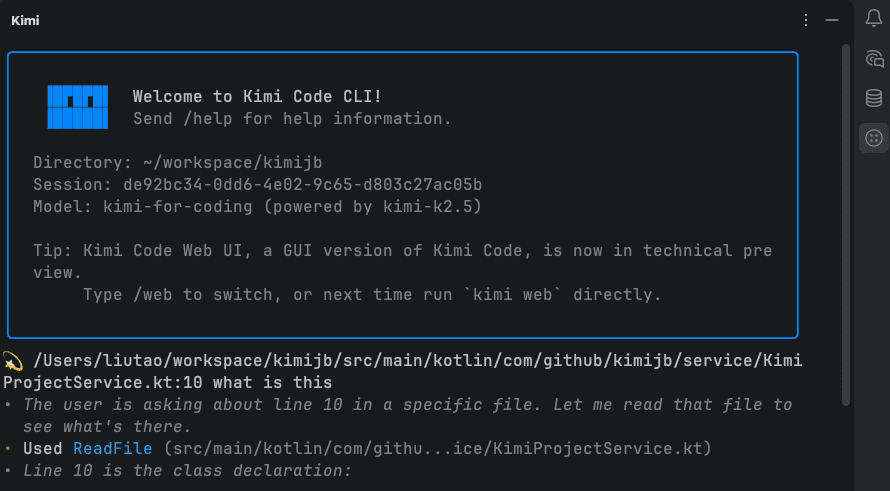 Kimi Code CLI working inside a project directory.
Product screenshot embedded in the source article. The pictured model label predates the current K3 selector; use current documentation rather than copying the screenshot literally.
For orchestration, Moonshot's Kimi Agent SDK has Python, Node.js, and Go clients and surfaces sessions, tool calls, and approvals. The short Python example in the source article is conceptual rather than current copy-paste API. Build against the SDK's versioned quickstart, and keep ledgers, queues, idempotency, policy, and audit state in your application rather than assuming the model session is the system of record.
SpaceXAI launched Grok Bot in early beta on August 11 and expanded access on August 26 to SuperGrok, Cursor Pro, and all Cursor Teams plans, in addition to higher tiers. Availability, included usage, and pricing are changing during beta, so verify the current product page before procurement.
The important architectural boundary is stable: all Bots for one account or member share one persistent cloud computer. They share files, sessions, and sign-ins even though each Bot has its own screen. This makes the source's cross-agent handoff plausible, but it means ECHO and CRATE are not isolated merely because they have different names.
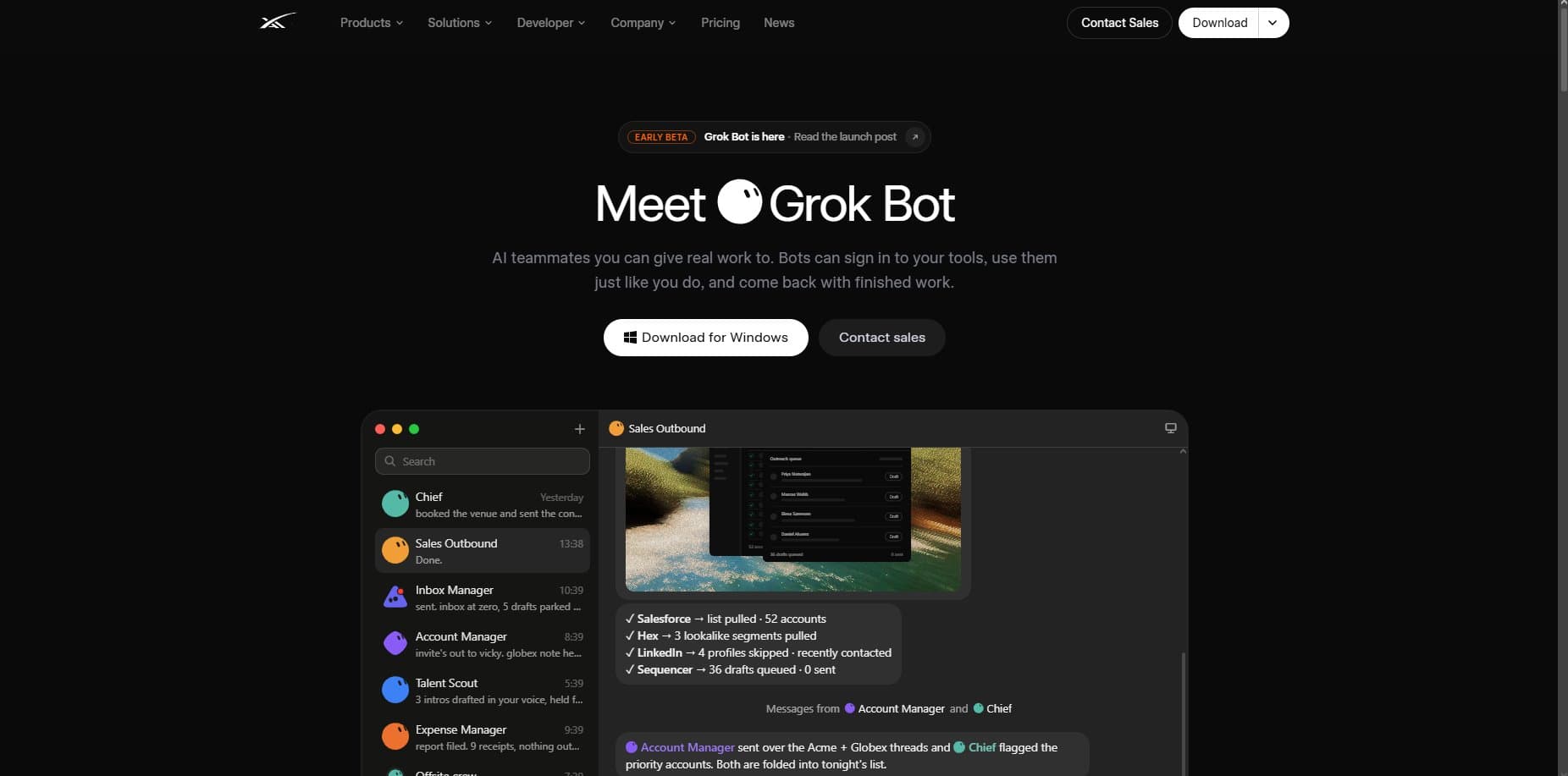 The official Grok Bot product page and multi-Bot work surface.
Product screenshot embedded in the source article. Product availability and plan details should be checked on current first-party pages.
Use a dedicated work identity, narrow application roles, ledger-specific connectors, and scoped secrets. Do not place a broadly privileged bank, ad, mail, store, and CRM session on one shared computer and call role prompts isolation. SpaceXAI's skills and routines guide recommends proving a one-time task before automating it, retaining approval for sending, purchasing, deleting, publishing, and production changes, and defining stale-data and retry behavior.
Do not create all seven roles on day one. The source's staged sequence is sound when translated into acceptance gates:
| Week | Build | Exit condition |
|---|---|---|
| 1 | one ledger already tied to real demand | ten observed jobs; every stall, guess, and correction recorded |
| 2 | action classification and tool policy | red actions cannot execute; green actions are bounded and logged |
| 3 | second ledger plus WARDEN | malformed and unsourced handoffs bounce deterministically |
| 4 | one directional cross-ledger handoff | duplicates, expiry, and missing evidence are tested |
| 5–6 | ledgers three and four | each charter has owned metrics, refusals, and recovery behavior |
| 7 | SDK wrapper, schedule, and approval queue | interrupted jobs resume safely; expired approvals cannot land |
| 8 | ledgers five and six | four ledgers have operated a full week within error and review budgets |
Break the system on purpose before expanding it: revoke a connector, return contradictory numbers, expire a login, duplicate an event, poison a webpage, change a product price after approval, and simulate an ambiguous timeout. The safe outcome is often a visible stop, not heroic recovery.
The source provides this illustrative monthly revenue shape:
| Ledger | Model arithmetic |
|---|---|
| Service agency | 8 retainers × $4,500 = $36,000 |
| Digital products | 620 units × $39 = $24,180 |
| Ecommerce | 1,400 orders × $14 contribution margin = $19,600 |
| Lead generation | 3 clients × $3,500 = $10,500 |
| Membership | 410 members × $19 = $7,790 |
| Content | sponsorship and affiliate assumptions = $4,800 |
| Total | $102,870 |
It also estimates $900–$1,600 per month for model usage and $400–$700 for tools, hosting, data, and subscriptions. These figures are not independently evidenced. They omit or leave uncertain acquisition cost, payroll and contractors, taxes, payment fees, returns, inventory capital, bad debt, legal and compliance work, human review time, outages, and the value of the operator's domain knowledge.
Use the table as a sensitivity model. Replace every volume, price, margin, conversion, churn, refund, and cost assumption with observed data. The first economic metric should be cost per accepted finished task, including reviewer minutes and correction work—not tokens per run. This is business architecture analysis, not financial or investment advice.
Six is not a magic number. Add a role only when the existing boundary is stable and the new ledger has a distinct owner, data scope, tool scope, and measurable outcome.
Track each ledger and the desk as an operating system:
The ten-minute daily queue is a target to test, not a design requirement. If informed decisions regularly require more time, shrinking the packet is safer than hiding context. If approval becomes automatic clicking, narrow the number of decisions, automate deterministic checks, or reduce agent authority.
The source article's durable contribution is a compact operating constitution: one ledger owner per lane, explicit refusals, evidence-bearing handoffs, a dispatcher that does not operate, and human control over consequential actions. Grok Bot can provide the persistent shared work surface; Kimi K3, Kimi Code, and Kimi Agent SDK can provide reasoning and programmable execution.
The org chart becomes trustworthy only when the product boundary is translated into distinct identities, scoped credentials, immutable events, typed schemas, action-bound approvals, idempotent execution, and independent reconciliation. Build one ledger, prove its control loop, then add the second. A seven-agent diagram is easy; a desk that can stop itself is the actual product.
A practical guide to Grok Bot's shared computer, role charters, routines, multi-agent handoffs, pricing, evidence, and safety boundaries.
Read More
A control architecture for separating proposal, approval, execution, and reconciliation when AI can trigger consequential business actions.
Read More
A field guide to atomic reservations, concurrent spend, approval binding, reconciliation, and hard economic limits for tool-using AI agents.
Read MoreIf this note maps to a real system in your organisation, start with the services page or a shipped case study.