AI Capacity Advances Faster Than Cash Proof
August 11, 2026
The latest release cycle widened the practical AI stack while making its commercial burden of proof more exacting. vLLM v0.27.0 added major model, hardware and fault-tolerance coverage; Transformers v5.15.0 expanded model support but introduced migration-sensitive defaults; and llama.cpp corrected a CUDA and Metal path that could silently return wrong results for non-contiguous input. At the company level, Perion reported 136% year-over-year growth in pro forma spend through its Outmax AI agent, yet total revenue fell 5%, adjusted EBITDA fell 61%, and operating cash flow fell 88%. Keel advanced power and data-center sites with $819 million of stated liquidity, but reported active tenant negotiations rather than signed leases, alongside a $141 million operating loss. The Reserve Bank of Australia then held its cash-rate target at 4.35%, saying AI investment had supported major trading partners while inflation remained too high. ZharfAI's conclusion: capacity is not the same as conversion; the decisive sequence is correct output, billed use, contracted demand, margin and cash.
ZharfAI Analysis
The strongest connection in the rolling 30-hour window is a widening gap between technical capacity and financial conversion. Three open-source releases made more models and workloads deployable, but one of them also documented a path that could produce silently wrong results. Two public companies then supplied different adoption and infrastructure signals without yet delivering matching consolidated cash economics. At 14:30 AEST on 11 August, inside this edition's 05:32 UTC cutoff, the Reserve Bank of Australia supplied the capital-price boundary: it held the cash-rate target at 4.35%, described inflation as still too high and kept another increase available if upside risks materialise. The useful thesis is therefore not that AI demand is weak. It is that every step from executable model to financeable capacity now needs its own evidence.
vLLM v0.27.0 is the clearest capacity expansion. The project counted 561 commits from 242 contributors, including 64 first-time contributors. It landed a full support stack for Kimi K3, added Qwen3.5 text-only dense and mixture-of-experts models, moved to PyTorch 2.13.0, deepened FlashAttention 4 support on NVIDIA SM100 and widened Model Runner V2 beyond generation into embedding, classification and token-level workloads. It also introduced simplified fault tolerance for data-parallel plus expert-parallel deployments behind an external load balancer, prepared elastic expert parallelism and extended prefill/decode disaggregation. These changes widen what operators can serve and how they can recover at scale; they do not establish a common throughput, power or cost improvement across hardware and workloads.
The release also contains a warning against treating an upgrade as frictionless capacity. PyTorch 2.13.0, torchvision 0.28.0 and Triton 3.7.1 are described as a breaking environment change. Some DeepSeek-V4 items report specific kernel or end-to-end time-to-first-token improvements and a 448 MiB buffer saving, but those figures attach to particular changes and configurations rather than a universal service-level result. Before changing a production fleet, an operator still has to reproduce latency distributions, quality, memory headroom, warm-up behavior, failure recovery and cost per verified request on its own model mix. A longer support matrix can increase addressable demand while also increasing the number of combinations that require regression coverage.
Transformers v5.15.0 reinforces that operational point from a different layer. The release added Muse Glimmer, Granite SWA and MoE variants, A.X-K1 and A.X-K2, and Cosmos3 Edge, among other support. It also made kernels opt-in rather than mandatory for linear-attention families, limited cache-cropping calls to negative relative offsets and enabled alternative attention backends for the T5 family, potentially changing the default path unless users explicitly retain eager attention. The same release corrected multi-head latent-attention cache compression and several attention bugs. New model access is valuable, but a dependency bump can simultaneously add capability, change behavior and repair correctness. That combination calls for pinned environments, migration tests and explicit output comparisons rather than version-number enthusiasm.
llama.cpp release b10353 makes the correctness gate concrete. Its ROLL implementation accepted a permuted, non-contiguous source because the generic assertion checked only the first stride. CUDA and Metal kernels indexed tensor dimensions without reading the remaining strides, so a valid non-contiguous input could return silently wrong results instead of failing. Because the backends had not declared a contiguity requirement, the scheduler did not fall back to the CPU implementation that handled the strides correctly. The fix added the missing requirement for both backends and a permuted test case. This is narrow, well-scoped maintenance—not evidence that all GPU or Metal inference was wrong—but it demonstrates why nominal hardware acceleration has no economic value until outputs are verified across the actual tensor paths used in production.
Perion offers a commercial conversion test. The advertising-technology company said Perion One spend rose 15% year over year to $156.7 million and spend through its Outmax AI agent rose 136% on a pro forma basis. Those are management operating metrics, and the pro forma qualification matters: neither number is the same as recognized AI revenue. Consolidated second-quarter revenue was $98.2 million, down 5%; contribution excluding traffic-acquisition costs was $42.3 million, down 11%, at a 43% margin. GAAP net loss widened to $6.8 million from $3.5 million and included $2.5 million of restructuring costs and other charges. Adjusted EBITDA, a non-GAAP measure, fell 61% to $2.8 million; operating cash flow fell 88% to $2.5 million; and adjusted free cash flow fell 77% to $4.8 million. The company also spent $24.5 million on share repurchases during the quarter.
There is a constructive reading of Perion's split. Fast Outmax growth may be an early mix shift whose revenue and operating leverage arrive later, and management narrowed rather than withdrew its full-year outlook: contribution ex-TAC is now guided to $215–225 million versus $215–235 million previously, while adjusted EBITDA is guided to $51–53 million versus $50–54 million. But the reported quarter does not yet prove that agent adoption offsets weaker web activity or converts into stronger consolidated cash generation. The next evidence should be cohort retention, the relationship between Outmax spend and recognized contribution, and whether the expected second-half ramp lifts GAAP operating results and cash without relying on exclusions or buybacks as a substitute for operating progress.
Keel Infrastructure moves the same test upstream to power and physical capacity. The company said it was in active negotiations at three priority sites, had delivered the first Vertiv modules at Moses Lake, was executing final fiber contracts and had completed the decommissioning of its US Bitcoin-mining operations for high-performance-computing construction. It also announced a conditional transfer of 96 MW at Sherbrooke. As of 7 August, Keel described $819 million of liquidity: about $698 million of unrestricted cash and $121 million of unencumbered Bitcoin, so the headline is not all cash and the digital-asset component remains price-sensitive. The quarter included $458 million raised through convertible notes. These are real financing and development steps, but the releases report negotiations rather than an executed tenant lease; pipeline capacity should not be counted as contracted revenue.
Keel's current financial base shows why that distinction matters. Second-quarter revenue from continuing legacy operations fell 50% to $30.4 million as Bitcoin prices declined and mining operations shut down. Operating loss was $140.8 million, including $84.1 million of non-cash depreciation, versus $10.8 million of operating income a year earlier. Loss from continuing operations was $64.0 million. Adjusted EBITDA from continuing operations was negative $23.7 million, compared with positive $6.6 million; the company defines that non-GAAP measure with several exclusions. Front-loading permits, power equipment and financing before lease signing can be rational in a supply-constrained market. It also leaves investors and operators exposed to construction timing, tenant credit, pricing, dilution and interest costs until signed contracts specify capacity, commencement dates and economics.
The RBA decision ties the company evidence to the hurdle rate. The Board unanimously held at 4.35% after three increases this year. It said AI-related investment had so far helped growth in Australia's major trading partners outweigh adverse effects from the Middle East conflict, but it also said headline and trimmed-mean inflation remained too high, financial conditions had tightened and inflation was not expected to return near the midpoint of target until late 2027. The Board judged policy somewhat restrictive and left open another increase if upside risks emerge. This does not prove that AI investment caused inflation or prescribe a rate for US data centers. It does show that a central bank can recognize AI capital spending as a growth support while maintaining a demanding price of money because energy, capacity and broader inflation pressures persist.
The combined watch list is practical. Engineering teams should test vLLM's breaking dependency change, Transformers' altered defaults and llama.cpp's corrected stride path against pinned models, devices and golden outputs, then measure tail latency, recovery and cost per accepted result. Perion needs to show that agent spend becomes contribution, GAAP improvement and operating cash. Keel needs signed leases with credible tenants, transparent pricing and commencement schedules, permitting and equipment milestones, and a liquidity bridge that separates cash from Bitcoin and future financing. Macro observers should track the RBA's inflation, productivity and demand evidence rather than infer a global rate path from one meeting. The conclusion is deliberately conditional: AI capacity is expanding; value appears only when correct output crosses into durable, cash-generating demand.
Sources & documents
- 01vLLM v0.27.0 Release NotesvLLM · August 11, 2026
- 02Transformers v5.15.0 Release NotesHugging Face Transformers · August 10, 2026
- 03llama.cpp b10353: Require Contiguous Source for ROLL on CUDA and Metalllama.cpp · August 11, 2026
- 04Keel Infrastructure Reports Second Quarter 2026 ResultsKeel Infrastructure · August 10, 2026
- 05Keel Infrastructure Form 10-Q for the Quarter Ended June 30, 2026US Securities and Exchange Commission · August 10, 2026
- 06Perion Reports Second Quarter 2026 ResultsPerion Network · August 10, 2026
- 07Statement by the Monetary Policy Board: Monetary Policy DecisionReserve Bank of Australia · August 11, 2026
Tags
Related News
ASML Says Planned Supply Will Fall Short in 2027 and 2028
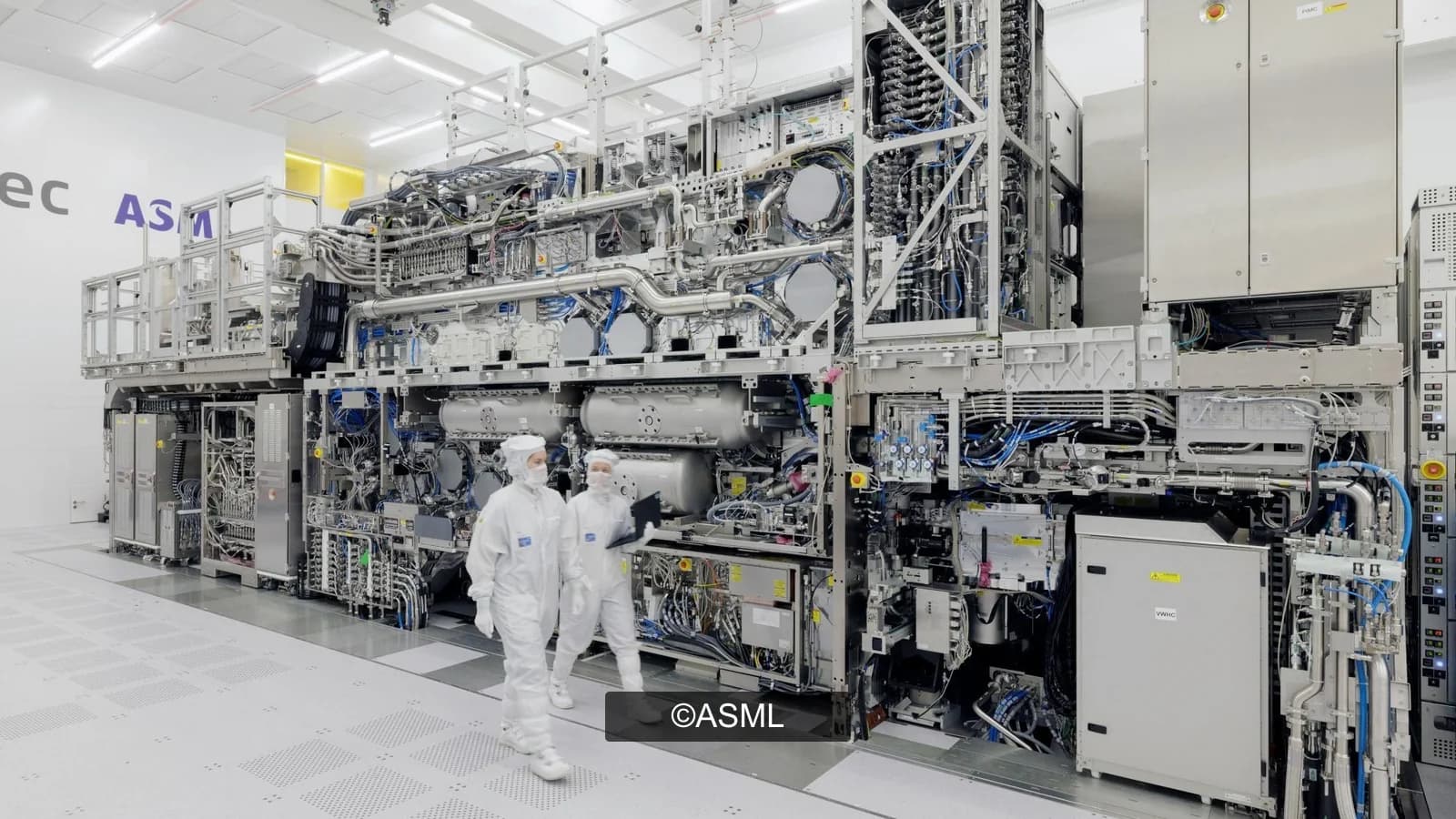
ASML says its planned supply cannot fully meet customers' demand in 2027 and 2028, despite substantial current earnings. NVIDIA's new simulation tools may shorten engineering work, but selected-task speedups do not establish additional factory output. A survey of semiconductor professionals points to staffing constraints, while US inflation adds a separate financial consideration. This edition examines what each record actually measures: equipment capacity, reported profit, computation time and consumer prices. The useful next evidence is a firmer manufacturing commitment and validated performance in real workflows, not an assumption that software has already closed the supply gap.
GlobalFoundries Targets 2028 for US AI-Packaging Components
GlobalFoundries has agreed to make AI-packaging components for TSMC in New York, but the announcement does not mean new capacity is available today. Fresh revenue figures from TSMC and preliminary earnings guidance from Samsung describe a different stage of the semiconductor business: activity already recorded. Meanwhile, NVIDIA and the US Department of Energy have announced new support for AI research. This edition separates manufacturing commitments, reported business and research funding. None is a substitute for the others, and they cannot be added into a single measure of AI demand. The useful questions concern delivery dates, the meaning of each financial figure and the results that funded projects must still demonstrate.
Applied Digital’s AI Fit-Out Revenue Runs Nearly Three Times Base Rent
Applied Digital reported $183.5 million of tenant fit-out revenue against $65.8 million of base rent in its AI-hosting business. That composition explains why rapid data-center sales growth cannot automatically be read as growth in recurring rental income. A large accounting loss, a much smaller adjusted loss and positive operating cash flow also answer different questions. This edition unpacks those distinctions before examining the newly released Fed minutes, ChatGPT's interactive-interface rollout and Haiku 5.5's lower prices. The question is how revenue from constructing infrastructure becomes durable income from using it—a transition that still depends on delivery, financing costs and actual consumption.