ONNX Decouples Deployment from GPUs; Korea’s Career Ladder Pays the Price
August 19, 2026

ONNX Runtime 1.28.1 can transform and serialize WebGPU models in a compile-only session without GPU hardware, while the first separately packaged CUDA Plugin EP makes the accelerator provider a more modular part of the runtime. The releases lower one kind of commitment, but fresh Korean evidence shows why technical flexibility is not the same as costless adoption: the Bank of Korea says youth employment fell by 285,000 over four years, with 268,000 of that decline in high-AI-exposure industries, while explicitly warning that exposure is not proof that AI caused the losses. U.S. July production was similarly selective—business-equipment output rose 0.8% even as total capacity utilization remained 3.1 percentage points below its long-run average—and housing permits rose 5.0% while starts fell 12.4%. Korea’s provisional household-credit balance increased by KRW 25.9 trillion in the second quarter. The common signal is a commitment gap: software can preserve more options before hardware arrives, but firms, workers and borrowers still bear uneven conversion and transition risk.
ZharfAI Analysis
The most useful connection in today’s releases is not another claim that AI changes everything at once. It is a change in when commitments become irreversible. ONNX Runtime is making model preparation and accelerator support more separable from the machine that will ultimately run the workload. At the same time, Korean labor and credit data and U.S. production and housing data show that real commitments still convert unevenly: an employer can automate without rebuilding an entry-level career path, a permit need not become a housing start, and stronger equipment output can coexist with broad spare capacity. Technical optionality is improving; the economic adjustment remains selective and costly.
Microsoft published ONNX Runtime 1.28.1 at 23:19:52 UTC on August 18. Its clearest new capability is a device-free, compile-only WebGPU session that can apply offline graph transformations and serialize an optimized model without access to GPU hardware. That is operationally meaningful for build systems, controlled deployment pipelines and teams that prepare artifacts somewhere other than the target device. It does not mean WebGPU inference can run without a GPU, and the release supplies no performance benchmark or cost saving to extrapolate. The same patch skips DXGI device discovery under Windows Win32k lockdown and fixes several graph-validation cases, including malformed FastGelu patterns and unregistered or mismatched in-memory external initializers. This is a preparation and hardening release, not a new model or a blanket speed claim.
A companion release at 23:12:43 UTC on August 17—nineteen minutes beyond the default 30-hour window but inside the permitted 48-hour extension—makes the infrastructure direction clearer. ONNX Runtime CUDA Plugin EP 0.1.0 is the first separately packaged CUDA execution provider and becomes the default CUDA provider implementation. Its release notes describe arena allocation, resource accounting, IOBinding synchronization, user-stream and copy controls, external allocators, CUDA Graph capture and profiling. Version-gated callbacks provide compatibility back to ONNX Runtime 1.24.4, while packaging work adds Python and NuGet artifacts and makes cuDNN and cuFFT optional in some configurations. Separating the provider can reduce the need to move the core runtime and GPU integration in lockstep.
Modularity transfers risk rather than deleting it. A device-free build stage creates an artifact that still has to behave correctly on the target adapter, driver and browser; a separately versioned provider adds combinations of runtime, plugin, CUDA libraries, allocator ownership and stream policy that need testing. Operators should retain an unoptimized model, record the transformation settings, verify numerical parity on the deployment device, test provider negotiation and fallback, and exercise sandbox startup, IOBinding and external-initializer rejection. The value is reversibility: prepare earlier, swap a narrower component and fail closed. The danger is mistaking more packaging choices for lower total integration work.
The Bank of Korea’s August 18 issue note shows the human side of that distinction. Using National Pension subscriber data and the Economically Active Population Survey, its researchers report that youth employment fell by 285,000 over four years and that 268,000 of the decline—94% as a contribution share—occurred in industries with high AI exposure. Youth employment fell 31.4% in information services, 27.4% in publishing, 16.6% in computer programming and 11.6% in professional services, while employment among people in their fifties continued to rise in the same high-exposure industries. Since November 2022, the average unemployment rate for young university graduates was 7.0%, versus 5.4% for young people with junior-college education or less, a 1.6-percentage-point gap.
Those figures do not establish that AI caused 94% of the job decline, and the central bank explicitly cautions against that reading. Post-pandemic over-hiring normalization, greater preference for experienced recruits, weaker internal training and remote work may also contribute. The study finds larger youth-employment declines where AI use is more automation-oriented, but not the same pattern where AI augments human work; reduced new hiring and increased exits both matter. That makes the missing first rung more important than the total headcount alone. A deployment can be technically reversible while a firm quietly stops producing experienced workers. The BOK response is therefore not to freeze old junior roles, but to redesign apprenticeships, mentoring and the balance between technology subsidies and workforce formation.
U.S. July data show the same commitment gap in physical capital. The Federal Reserve reported that industrial production and manufacturing output each rose 0.2%. Business-equipment production increased 0.8%, with information-processing and industrial equipment contributing, while defense and space equipment rose 1.8% and construction supplies 0.8%. Yet consumer-goods output fell 0.4%, motor vehicles and parts fell 2.1%, and total capacity utilization was only 76.3%—3.1 percentage points below its 1972–2025 average. Census reported building permits at a 1.443 million seasonally adjusted annual rate, up 5.0% from revised June, but starts fell 12.4% to 1.239 million and completions fell 9.1% to 1.212 million. The overall starts decline exceeded its ±9.5% sampling interval; the 9.9% single-family starts decline and 9.1% total-completions decline did not clear their reported 90% intervals.
Korea’s balance sheet was expanding at the same time. The Bank of Korea’s preliminary second-quarter release put household credit at KRW 2,019.8 trillion, up KRW 25.9 trillion from the previous quarter. Household loans reached KRW 1,891.3 trillion, up KRW 24.9 trillion, and sales credit was KRW 128.5 trillion, up KRW 0.9 trillion. These aggregates do not identify AI financing, borrower quality, interest sensitivity or the distribution of debt, and the figures are provisional. They do show that option preservation is not free: even as technology makes deployment components more separable, households and the real economy continue to carry large, growing contractual commitments.
The operating rule is to measure conversion, not announcements. For ONNX Runtime, watch whether optimized WebGPU artifacts reproduce across target devices and whether plugin version negotiation survives real upgrade and rollback tests. For employers, separate automation savings from augmentation outcomes, junior hiring, exits, mentoring capacity and time to proficiency. For capital, follow business-equipment orders and utilization, the permits-to-starts conversion rate, housing revisions and the composition of Korean household credit. Iranian teams with scarce access to accelerators may gain real leverage from preparing models before target hardware is available, but they still need device-side validation, dependency access, licensing and rollback plans. Today’s defensible conclusion is narrow: the software stack is buying more time before commitment; institutions that preserve the first rung and test the final conversion will capture more of that option value. None of these releases is investment advice.
Sources & documents
- 01ONNX Runtime v1.28.1ONNX Runtime · August 19, 2026
- 02ONNX Runtime CUDA Plugin EP 0.1.0ONNX Runtime · August 18, 2026
- 03Is the Contraction in Youth Employment Caused by AI? The Changing Career Ladder and Policy ResponsesBank of Korea · August 17, 2026
- 04Household Credit in the Second Quarter of 2026 (Preliminary)Bank of Korea · August 19, 2026
- 05Industrial Production and Capacity Utilization: July 2026Federal Reserve Board · August 18, 2026
- 06New Residential Construction: July 2026U.S. Census Bureau · August 18, 2026
Tags
Related News
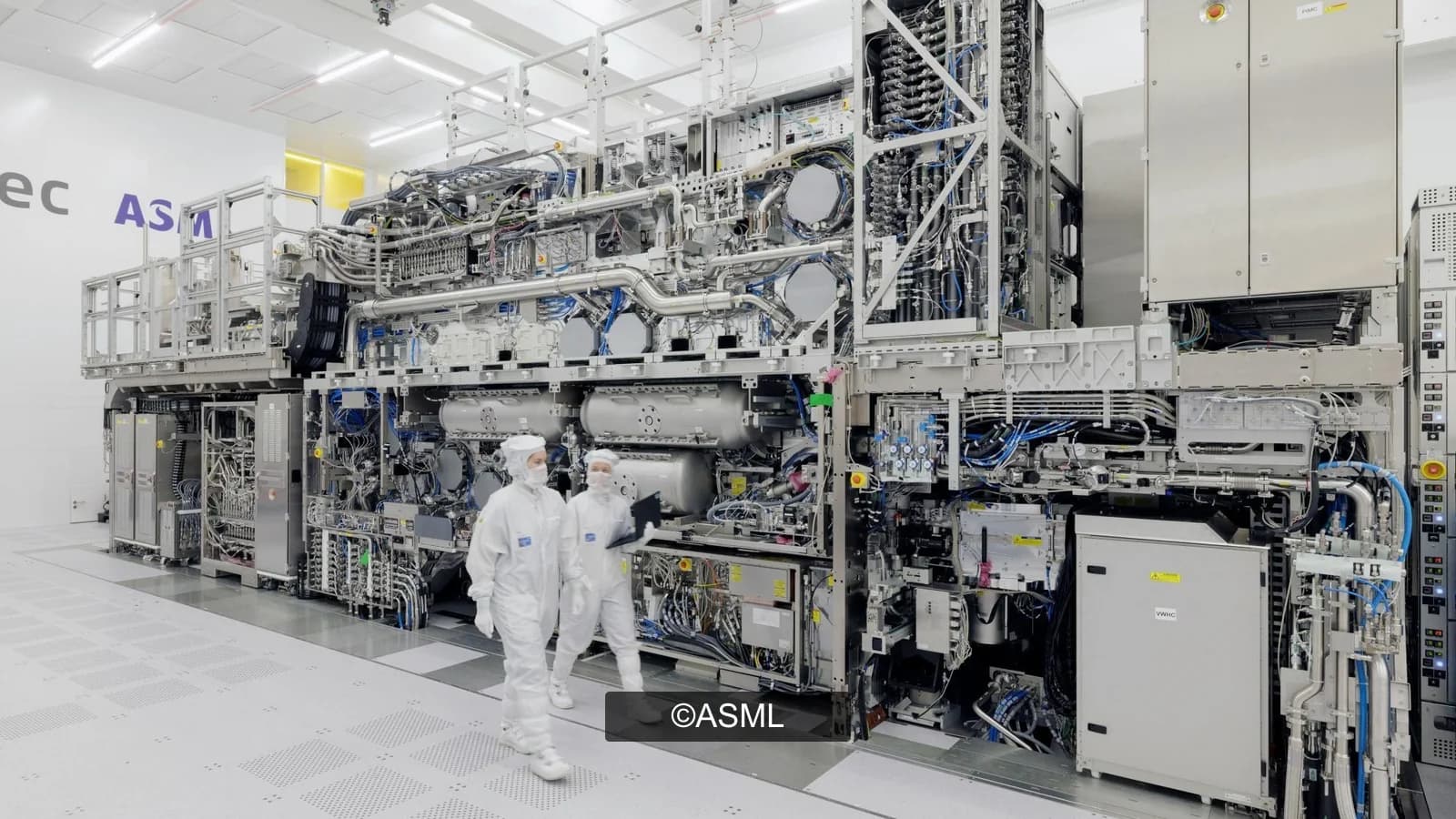
ASML Says Planned Supply Will Fall Short in 2027 and 2028
ASML says its planned supply cannot fully meet customers' demand in 2027 and 2028, despite substantial current earnings. NVIDIA's new simulation tools may shorten engineering work, but selected-task speedups do not establish additional factory output. A survey of semiconductor professionals points to staffing constraints, while US inflation adds a separate financial consideration. This edition examines what each record actually measures: equipment capacity, reported profit, computation time and consumer prices. The useful next evidence is a firmer manufacturing commitment and validated performance in real workflows, not an assumption that software has already closed the supply gap.
GlobalFoundries Targets 2028 for US AI-Packaging Components
GlobalFoundries has agreed to make AI-packaging components for TSMC in New York, but the announcement does not mean new capacity is available today. Fresh revenue figures from TSMC and preliminary earnings guidance from Samsung describe a different stage of the semiconductor business: activity already recorded. Meanwhile, NVIDIA and the US Department of Energy have announced new support for AI research. This edition separates manufacturing commitments, reported business and research funding. None is a substitute for the others, and they cannot be added into a single measure of AI demand. The useful questions concern delivery dates, the meaning of each financial figure and the results that funded projects must still demonstrate.
Applied Digital’s AI Fit-Out Revenue Runs Nearly Three Times Base Rent
Applied Digital reported $183.5 million of tenant fit-out revenue against $65.8 million of base rent in its AI-hosting business. That composition explains why rapid data-center sales growth cannot automatically be read as growth in recurring rental income. A large accounting loss, a much smaller adjusted loss and positive operating cash flow also answer different questions. This edition unpacks those distinctions before examining the newly released Fed minutes, ChatGPT's interactive-interface rollout and Haiku 5.5's lower prices. The question is how revenue from constructing infrastructure becomes durable income from using it—a transition that still depends on delivery, financing costs and actual consumption.