An AI recommendation is not agronomic proof. A yield forecast, disease score, irrigation map, or indoor-climate setpoint must be tested against a credible baseline under the soil, cultivar, weather, water, facility, labor, and market conditions where it will be used. A controlled environment is not automatically food-safe, low-carbon, profitable, or climate-proof.
The practical opportunity is more disciplined: use sensing and models to manage variability, then verify crop response, input use, product quality, worker impact, food safety, energy, and economics over complete production cycles.
Define the production decision
Choose one decision: planting window, cultivar, irrigation, fertilizer, crop protection, harvest timing, grading, lighting, temperature, humidity, carbon dioxide, airflow, nutrient solution, or production scheduling. Name the grower or authorized agronomist who decides and the constraints imposed by label, water right, food-safety plan, organic certification, labor rules, and facility limits.
Separate system outputs:
- measurement reports a sensor observation;
- estimate infers an unmeasured crop or environmental state;
- forecast predicts a future condition with uncertainty;
- recommendation compares actions under assumptions;
- control command changes equipment inside an approved envelope;
- agronomic claim requires replicated evidence under representative conditions;
- food-safety release requires the applicable preventive controls and authority.
An optimizer should not silently cross these boundaries.
Map the field or facility as a biological system
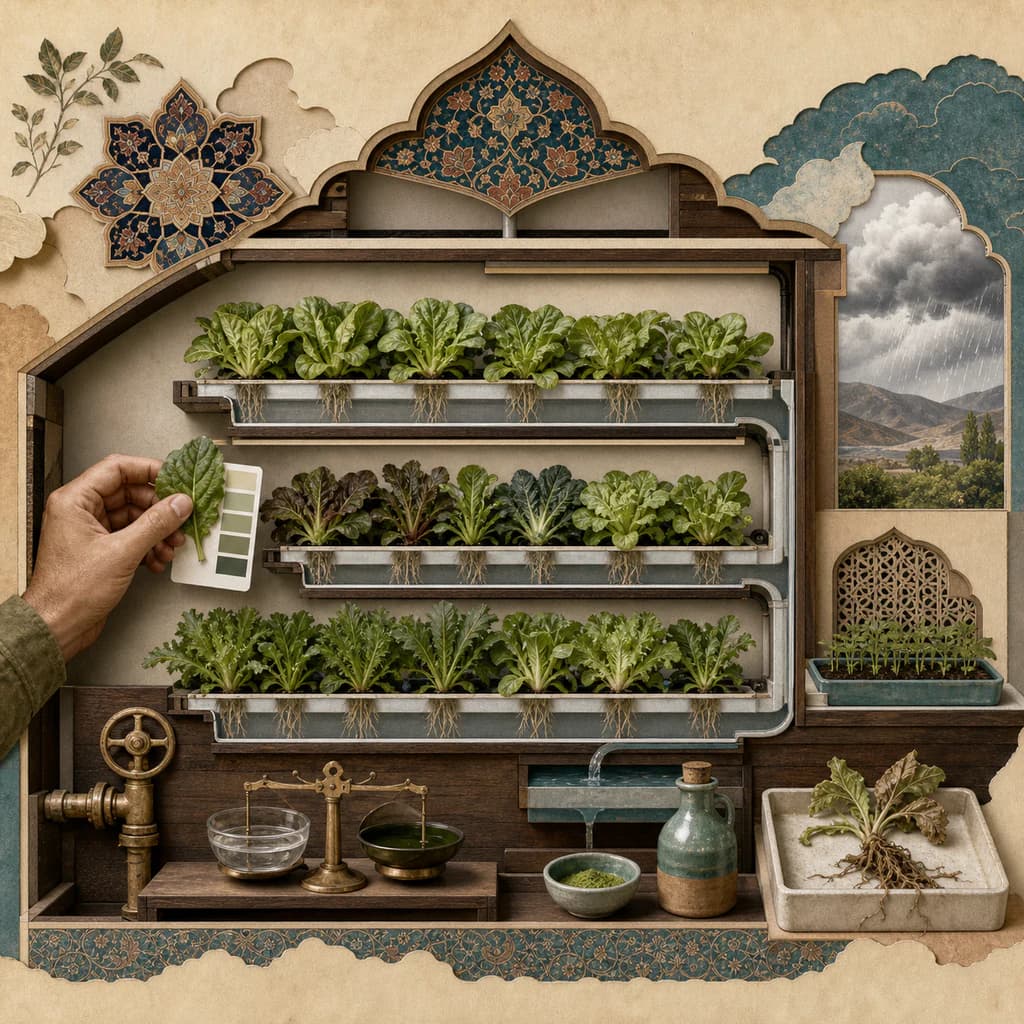
For open fields, map soil series, texture, organic matter, slope, drainage, irrigation zones, compaction, salinity, management history, cultivar, pest pressure, and yield stability. For controlled-environment agriculture, map room, rack, zone, air and water circuits, lighting, HVAC, nutrient delivery, sanitation, worker and material flow, and neighboring land or water risks.
Define the management unit before calculating a prescription. A satellite pixel, sensor location, irrigation valve, plant tray, and harvest lot are different grains. Preserve relationships among them.
Record seasons and crop cycles with failures, not only successful harvests. Models trained on ideal production can fail during heat, smoke, equipment degradation, disease, or supply interruption.
Calibrate sensors and data lineage
Maintain an inventory for weather stations, soil and substrate sensors, flow meters, nutrient and pH probes, cameras, spectral instruments, scales, climate sensors, meters, and actuators. Record serial number, location, calibration, uncertainty, range, drift, maintenance, firmware, sampling interval, and clock.
Use reference measurements and field sampling to verify remote or proxy signals. A canopy image does not directly measure root-zone water, nutrient availability, pathogen presence, or marketable yield.
Give persistent identifiers to field, zone, crop, cultivar, seed lot, input lot, treatment, device, reading, image, model run, recommendation, operator action, harvest lot, and laboratory result. Keep units and coordinate systems explicit.
Build agronomic baselines before AI
Compare against current grower practice, extension recommendations, simple thresholds, weather-based schedules, and conventional control. Baselines must receive comparable attention and input quality.
Use randomized replicated field trials, split plots, alternate bays, or other designs appropriate to the operation. Predefine primary outcomes and minimum meaningful effects. Block by known gradients and carry trials across representative seasons or cycles.
Measure marketable yield and quality, not only biomass. Include input use, disease, labor, downtime, crop loss, and downstream shelf life. A model that increases fresh weight while reducing quality or increasing energy may not improve the business.
FAO’s definition of precision agriculture centers on managing temporal, spatial, and individual variability using data; it does not imply that every data-driven prescription is validated.
Keep recommendations inside an approved envelope
Set agronomic and engineering limits for irrigation, fertilizer, pesticide, light intensity and duration, temperature, humidity, carbon dioxide, airflow, nutrient concentration, pH, and equipment cycling. Derive limits from crop evidence, product labels, food-safety plans, worker safety, and equipment specifications.
Use plausibility checks, rate limits, change control, and conflict rules. A crop-stress model should not command irrigation if a leak detector, water-quality alarm, or maintenance lockout says otherwise.
For higher-risk actions, require human approval with the source data, uncertainty, expected benefit, constraints, and fallback. Automatic control should revert to a known schedule or safe setpoint on stale inputs, model failure, or network loss.
Validate crop response and generalization
Split data by field, farm, season, cultivar, facility, room, and cycle to prevent near-duplicate leakage. Evaluate unseen farms and abnormal conditions. Report error by growth stage, canopy, weather, disease pressure, lighting, device, and management practice.
For classification, report precision, recall, calibration, and false alerts per area or crop cycle. For prescriptions, report causal treatment effects from trials, not correlation between historical input and yield. For forecasts, report error and interval coverage at the horizon needed to act.
Monitor whether users follow recommendations. An apparent model failure may be non-adoption; an apparent success may reflect an agronomist overriding the system.
Treat controlled environments as food operations
Indoor walls do not eliminate microbial hazards. Seeds, water, substrates, nutrients, workers, tools, equipment, pests, drainage, condensation, and adjacent land or water can introduce or spread contamination. Recirculating water can amplify a problem across plants.
Build a hazard analysis with preventive controls, sanitation, hygienic zoning, water management, supplier controls, environmental monitoring where appropriate, cooling, cold holding, traceability, recall, and root-cause investigation. Define lot boundaries and prevent mixing that defeats traceback.
FDA’s investigation of a 2021 Salmonella outbreak linked to packaged leafy greens from a controlled-environment operation identified conditions and practices that could contribute to contamination and emphasized science- and risk-based controls. “No soil” is not a food-safety certificate.
Connect farm data to food safety and traceability without letting prediction replace microbiological evidence or required controls.
Account for energy, water, and full economics
Controlled environments trade land and weather exposure for infrastructure, electricity, cooling, dehumidification, pumping, lighting, and skilled maintenance. Measure source and site energy by end use, peak demand, water withdrawal and discharge, nutrients, carbon intensity by time and location, refrigerants, consumables, waste, and crop loss.
Report energy, water, emissions, labor, and cost per conforming marketable kilogram—not per planted tray or theoretical yield. Include construction, equipment replacement, financing, downtime, rejected lots, packaging, distribution, and revenue quality.
DOE research on horticultural lighting examines energy-saving potential and plant productivity together. Efficient LEDs do not make an otherwise inefficient facility sustainable.
Protect growers, workers, and farm data
Farm data can reveal land value, yield, disease, water use, contracts, and financial condition. Define ownership, access, portability, secondary use, retention, and vendor exit. Prevent a platform from using one grower’s data against them in pricing, insurance, or procurement without authorization.
Design for poor connectivity, local languages, low-end devices, and shared equipment. Give growers a manual path and explain recommendations in agronomic terms. Do not transfer liability to a farmer for an opaque vendor change.
Automation changes work. Assess chemical, electrical, robotic, lifting, heat, cold, confined-space, and ergonomic risks. Train staff and preserve lockout, emergency stop, and manual recovery.
Measure outcomes across the whole system
Useful KPIs include:
- sensor calibration, uptime, missingness, and drift;
- forecast error and uncertainty coverage at decision horizon;
- treatment effect on marketable yield and quality;
- water, nutrient, pesticide, and energy per conforming kilogram;
- disease, crop loss, and rejected-lot rates;
- worker time, override, and safety incidents;
- food-safety control completion and environmental findings;
- traceability and recall-exercise time;
- model performance by farm, season, cultivar, and facility;
- downtime, maintenance, and safe-fallback success;
- gross margin and cash impact under realistic prices;
- greenhouse-gas and waste burden using disclosed boundaries.
More data points, higher predicted yield, or more crop turns are not proof of resilience or food security.
Anticipate field and facility failure
Plan for failures that can turn optimization into loss:
- a sensor drifts within a plausible range;
- units or coordinates are mixed;
- cloud or imagery is mistaken for crop stress;
- historical management confounds input-response learning;
- a disease class is absent from training;
- a prescription extrapolates beyond trial conditions;
- equipment latency or valve failure defeats the command;
- lighting or HVAC optimization creates condensation;
- recirculating water spreads contamination;
- a sanitation event is missing from traceability;
- energy price or grid carbon changes the optimum;
- the model improves biomass but reduces shelf life;
- a grower cannot export records from the vendor;
- automation fails during connectivity loss;
- a pilot result from one cultivar is marketed universally.
For each, define detection, a safe agronomic or engineering state, owner, quarantine or crop-hold rule, communication, correction, and retest.
Roll out from measurement to controlled action
Begin with one crop and decision where reference measurements and a credible baseline exist. Repair sensor, unit, identity, and recordkeeping gaps before training. Run the model in advisory shadow mode for a full representative cycle.
Next, conduct replicated trials with agronomic, economic, energy, worker, and food-safety outcomes. Let the grower and agronomist review every recommendation and reason for override. Freeze the model during each experiment.
Only then automate bounded, reversible actions. Keep independent alarms, local fallback, manual control, exportable records, spare sensors, preventive maintenance, and an incident drill. Expansion to another field, crop, cultivar, facility, or climate requires renewed validation.
Broader smart-agriculture systems should strengthen local agronomy and farmer agency. Indoor operations should also apply energy-aware computing and control so that digital optimization does not hide its own energy burden.
Source notes
Source status was checked on 2026-07-30. FAO’s February 2026 AGROVOC definition of precision agriculture describes a management strategy for temporal, spatial, and individual variability. The USDA Economic Research Service report Trends, Insights, and Future Prospects for Production in CEA and Agrivoltaics reviews adoption, market production, opportunities, and economic and technical challenges. FAO’s 2025 modern indoor farming and food-safety review announcement stresses that Salmonella, E. coli, and other hazards remain possible through seeds, water, substrates, and handling. DOE’s Better Lighting for Agriculture program examines horticultural lighting, productivity, and energy-saving potential. FDA’s controlled-environment leafy-greens outbreak report documents a real food-safety investigation and recommended controls. None validates a particular AI prescription or proves all vertical farms are safe, sustainable, or profitable.