AI Technology
DeepSeek V4.1 Flash: Vision, Pricing, and the V4 Pro Transition
DeepSeek's September 10 release adds native vision and cheaper agent workloads. We examine the benchmarks, API prices, and September 14 migration deadline.
Read MoreZharfAI Research
Model release desk
Anthropic released Claude Fable 5.1 and Claude Mythos 5.1 on September 1, 2026. The official model overview positions Fable 5.1 as the generally available model for demanding reasoning and long-horizon agentic work. Mythos 5.1 exposes the same underlying capabilities only to approved Project Glasswing participants, with safeguards designed for vetted cybersecurity and life-sciences work.
The headline gain is unusually concentrated. Fable 5.1 scores 52.6% on Terminal-Bench-Science 0.1, versus 24.7% for Fable 5 and 29.0% for Opus 5 in Anthropic's runs. It also reaches 55.8% on Terminal-Bench 4.0, 73.4% on CursorBench 3.2.0, and 31.4% on AutomationBench. The release keeps the $10 input and $50 output price per million tokens, but reduces cache reads from one tenth to one fortieth of base input pricing: $0.25 per million cached input tokens.
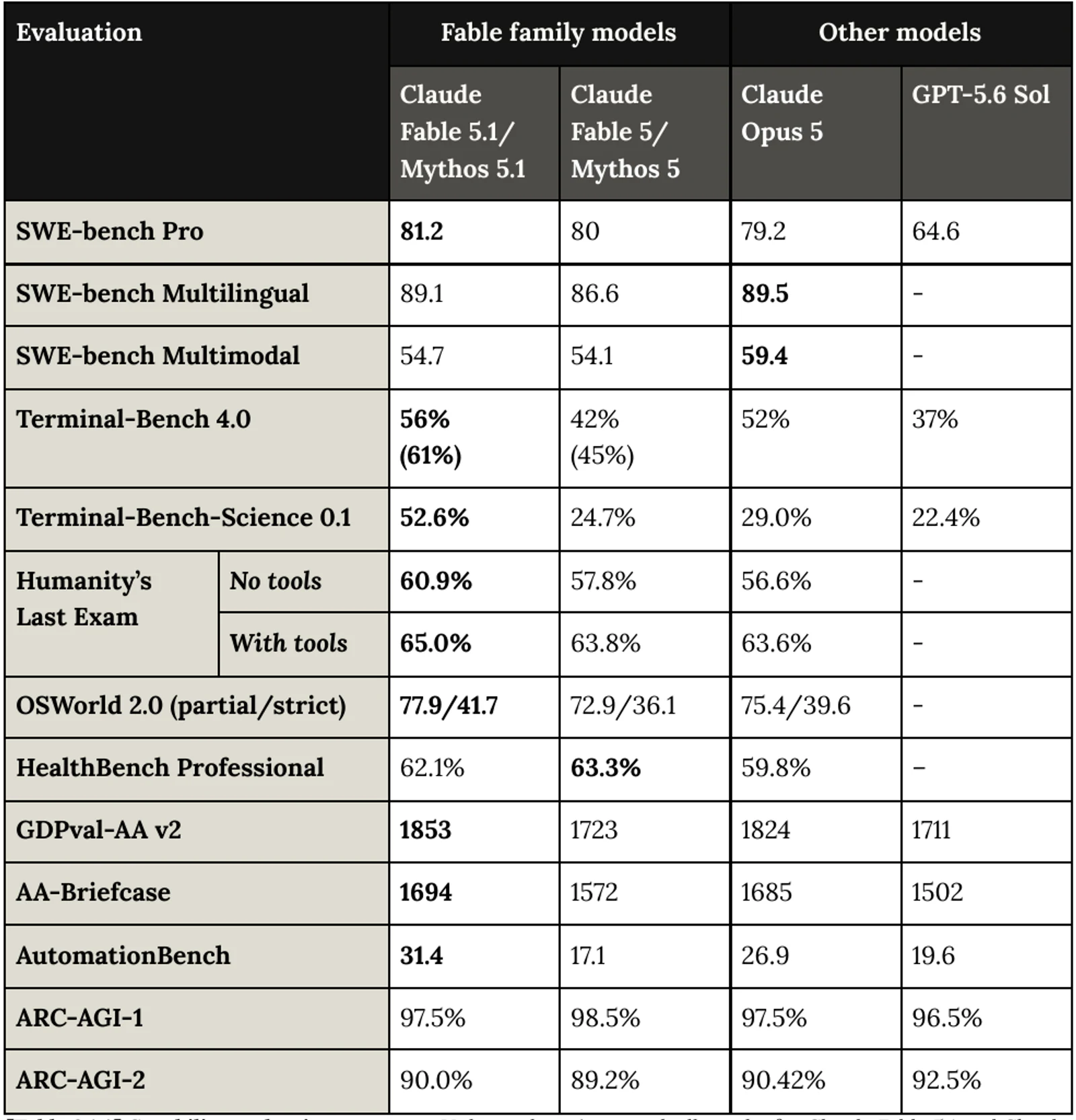 The capability summary table from Anthropic's official Fable 5.1 and Mythos 5.1 system card.
First-party evidence: Anthropic's Fable 5.1 and Mythos 5.1 system card, Table 8.1.A. The vendor's table documents its release runs; it is not an independent leaderboard or a guarantee for a different harness.
Fable 5.1 is active as claude-fable-5-1 on the Claude API, Amazon Bedrock, Google Cloud, Microsoft Foundry, and Claude Platform on AWS. It accepts text and image input, returns text, has a one-million-token context window, and allows up to 128,000 output tokens. Adaptive thinking is always on, with high as the default effort. Anthropic lists June 2026 as both its reliable knowledge cutoff and training-data cutoff.
Mythos 5.1 uses claude-mythos-5-1 and is not an open sign-up tier. It is available to approved Project Glasswing customers through Anthropic and selected cloud partners. Anthropic says the two names share specifications, capability, and pricing; their effective behavior can differ where Fable's public safeguards intervene.
That continuity matters for readers of our Fable 5 and Mythos 5 launch analysis. Version 5.1 does not erase the original architecture of one capable model behind two access regimes. It upgrades that architecture and changes several API contracts around it.
Terminal-Bench-Science 0.1 contains 70 agentic tasks drawn from life, physical, earth, mathematical, and engineering sciences. An agent receives a natural-language instruction, works in a contained environment, and is graded against hidden tests on the artifact it produces. Anthropic reports 700 Fable 5.1 trials, or ten trials per task, at maximum effort through Claude Code in bare mode.
The resulting 52.6% is more than twice Fable 5's 24.7% in the same internal setup. The system card reports a relatively wide standard error of roughly 3.5 to 4.5 points because tasks are strongly bimodal: many are solved nearly always or almost never. The result is still too large to dismiss as ordinary run variance, but it should not be read as “52.6% of science solved.” It measures a particular set of executable research workflows.
This is the release's strongest product signal. It suggests the model is better at carrying a technical investigation through environment inspection, computation, artifact production, and verification. A laboratory or engineering team should still build domain-specific acceptance tasks with frozen data, executable checks, provenance, and expert review.
On Terminal-Bench 4.0, Mythos 5.1 scores 60.9% and Fable 5.1 scores 55.8%, compared with 52.3% for Opus 5 and 42.0% for Fable 5. Anthropic used Claude Code in bare mode and maximum effort. Trial counts differ: Mythos received ten trials per task, while the other three models received fifteen. The reported standard error is about 1.6 to 2 points.
Cursor independently measured Fable 5.1 inside its production agent harness. At maximum effort, the model scored 73.4% on CursorBench 3.2.0, 2.9 points above Fable 5 while costing a little over half as much per task in that evaluation. At medium effort it scored 68.0% for $3.53 per task. These figures are useful because they pair quality and cost, but they remain results from Cursor's private workload distribution and scaffold.
SWE-bench Pro moves more modestly, from 80.0 for Fable 5 to 81.2 for the 5.1 family. Multilingual software work reaches 89.1, slightly behind Opus 5 at 89.5, and multimodal software work reaches 54.7, behind Opus 5 at 59.4. The table is more credible precisely because it does not show Fable 5.1 winning every row.
Anthropic emphasizes documents, spreadsheets, slides, multistep research, dense PDF vision, long context, and computer use. In the system card, GDPval-AA v2 rises from 1,723 for Fable 5 to 1,853 for Fable 5.1, while AA-Briefcase rises from 1,572 to 1,694. OSWorld 2.0 reaches 77.9 on the partial measure and 41.7 on the strict measure.
AutomationBench makes the business-agent claim concrete. The benchmark places an agent in a simulated company with 47 applications, layered policy documents, planted distractions, and dozens of interdependent API actions. Fable 5.1 scores 31.4%, compared with 17.1% for Fable 5 and 26.9% for Opus 5. That is a meaningful gain and a reminder that most end-to-end workflows still fail under a strict pass/fail contract.
For production adoption, score the completed artifact rather than the fluent conversation. A spreadsheet should preserve formulas, sources, and reconciliation checks. A slide deck needs accurate claims and usable layout. A code change needs tests, reviewable scope, and a known commit. Our frontier-model evaluation guide provides a system-level acceptance frame beyond vendor pass rates.
Base prices remain $10 per million input tokens and $50 per million output tokens. Five-minute cache writes cost $12.50, one-hour cache writes cost $20, and batch input and output receive a 50% discount. The important change is the cache-read price: $0.25 per million tokens, one quarter of Fable 5's cached-read rate and 2.5% of base input pricing.
That discount targets workloads that repeatedly replay a long, stable prefix: a repository map, policy pack, research corpus, or accumulated agent history. It does not make every call 75% cheaper. Fresh input, cache writes, output, tools, retries, and human review remain billable. Teams should calculate cost per accepted task under realistic hit rates rather than multiplying the headline token price by an idealized context size.
The model uses the same tokenizer as Fable 5. Anthropic notes that text can produce roughly 30% more tokens than models older than Opus 4.7, so a migration from an older family should be estimated from actual token counts rather than character length.
The official what's-new guide identifies three breaking behaviors.
First, forced tool use is not supported. tool_choice set to any or to a named tool returns a 400 invalid_request_error. Use automatic tool choice with strict schemas or structured outputs, and state clearly in the prompt when a tool is required.
Second, earlier Claude models cannot read Fable 5.1 thinking blocks. Fable 5.1 can consume earlier reasoning, but a router that falls back from 5.1 to Opus 5, Fable 5, or an older model loses those blocks for the fallback turn. The API can drop incompatible blocks rather than bill for them, but the downstream model no longer has that reasoning context.
Third, editing anything before a Fable 5.1 thinking block can bind that block to a different conversation and trigger an error. Rebuilding the system prompt, changing the tools array, editing an old turn, or serving different file bytes from the same URL can invalidate later reasoning. Production histories should be append-only; instructions and tool changes should use mid-conversation mechanisms, and compaction should happen through supported server-side paths.
Fable 5.1 adds per-message effort in beta, allowing an agent to raise effort for a difficult step and lower it for routine work without invalidating the prompt cache. Turn-scoped system messages can apply a high-authority reminder for one user turn while remaining in the immutable conversation history. A new thinking.display: "updates" option can expose short progress messages between tool calls without revealing private chain-of-thought.
These are operational features, not benchmark decorations. Long jobs need visible progress, but progress must be distinct from proof of completion. The model-specific prompting guide also warns that parallel tool calling is more variable, high-effort runs may emit fewer updates, low effort may search less often, and small file edits can become whole-file rewrites. Harness instructions and telemetry should test those behaviors directly.
Content provenance is now part of the output contract. Anthropic says Fable 5.1 and Mythos 5.1 text carries its statistical watermark on supported platforms, while supported image and video files retrieved through the Files API can receive signed C2PA Content Credentials. That supports provenance, but it does not validate the truth of a claim or the safety of generated code.
The system card says Fable 5.1's cyber safeguards cover the same high-risk categories as Fable 5, while allowing source-code vulnerability discovery at general access and continuing to block discovery in compiled binaries. The updated classifiers block significantly less defensive work than Fable 5's launch safeguards, though they are still more likely to trigger than Opus 5's.
Mythos 5.1 remains for vetted cyber and life-sciences use. Restricted access does not convert a model result into authorization to exploit a system, run an experiment, or expose sensitive data. Scope, sandboxing, expert review, and approval gates remain external responsibilities.
Both models carry a 30-day data-retention requirement and are not available under zero-data-retention terms unless Anthropic expressly authorizes an exception. That condition can be decisive for regulated, confidential, or unpublished work. Data classification and contract review should happen before an evaluation corpus is uploaded.
Start with a replayable evaluation pack in four lanes: repository engineering, research with executable artifacts, office documents, and computer or API use. Record the exact model ID, effort, harness version, cache state, tool permissions, safety fallback, wall time, token cost, human interventions, and final acceptance result.
Run migration failures deliberately. Send a forced tool choice and confirm the expected 400. Route a conversation from Fable 5.1 to an earlier model and observe how thinking blocks are handled. Modify an earlier turn in a test history and verify the configured mismatch behavior. Exercise cache misses as well as ideal hits.
Keep material actions behind separate approval: merge, deploy, send, purchase, permission change, destructive API call, and laboratory execution. A model that is better at long-horizon work can travel farther before a human notices a wrong assumption. Stronger completion makes evidence gates more important, not less.
Claude Fable 5.1 is a substantive long-horizon upgrade. The most persuasive evidence is not the small SWE-bench Pro gain; it is the combination of a twofold science-terminal improvement, stronger terminal and business-agent results, better cost-quality curves in Cursor's harness, and cache pricing designed for repeated long contexts.
The migration is not a one-line model-name change. Forced tools, thinking-block compatibility, immutable history, progress visibility, safeguards, and retention all affect the deployed system. Fable 5.1 is the broad route for the hardest general work; Mythos 5.1 is the restricted route for approved sensitive domains. Evaluate them as two effective systems sharing one capability base.
DeepSeek's September 10 release adds native vision and cheaper agent workloads. We examine the benchmarks, API prices, and September 14 migration deadline.
Read More
OpenAI's Astra launch brings stronger scientific and computer work, new agent APIs, and premium pricing. Here is the evidence and a practical adoption guide.
Read More
Anthropic's June 30 model lifts coding, terminal, search, computer use, and knowledge work while exposing effort as a cost-performance control.
Read MoreIf this note maps to a real system in your organisation, start with the services page or a shipped case study.