
AI Technology
Claude Opus 5.5: Cheaper Frontier Agents, Stricter Safeguards
Anthropic's September 22 model leads most agentic benchmarks, cuts cache reads by 60%, and brings four breaking API changes and Fable-class safeguards to Opus.
Read MoreHaiku 5.5 brings a million-token context and much lower prices. The 100K pricing threshold, effort settings, and API changes determine what teams actually save.

Claude Haiku 5.5 launched on October 7, 2026 as Anthropic's new model for high-volume work: classification, extraction, summaries, compacting agent histories, and narrowly scoped subagent tasks. It adds adjustable reasoning effort, a million-token context, and substantially lower API prices. The announcement calls it Anthropic's fastest model at standard serving speed; Opus in Fast Mode remains faster. No universal tokens-per-second guarantee accompanies that claim.
The important buying detail is prompt-length pricing. Up to 100,000 prompt tokens, input costs $0.10 and output $0.50 per million tokens. Above that threshold, both rates multiply by five. Anthropic estimates around 75% lower task cost than Haiku 4.5 across its workload mix, accounting for changed token consumption. That is a provider estimate, not a saving every application receives.
This article covers deployment decisions and migration. Our separate Haiku 5.5 system-card analysis examines the 144-page safety and capability report, including regressions and evaluation limits. We have not run Haiku benchmarks ourselves.
The official model overview supplies these specifications. This is a hosted model release; no downloadable weights or parameter count are supplied in these materials.
| Field | Haiku 5.5 |
|---|---|
| Release date | October 7, 2026 |
| Claude API ID | claude-haiku-5-5 |
| Input and output | Text and images in; text out |
| Context window | 1 million tokens |
| Normal maximum output | 128,000 tokens, including thinking |
| Extended batch output | 300,000 tokens with the output-300k-2026-03-24 beta |
| Thinking and effort | Adaptive by default; API and Claude Code default to medium |
| Effort levels | low, medium, high, xhigh, max |
| Knowledge and training-data cutoffs | June 2026 |
| Published retirement floor | Not before October 7, 2027; not an announced retirement date |
The listed platforms are the Claude API, Amazon Bedrock, Google Cloud, Microsoft Foundry, and Claude Platform on AWS. Bedrock uses anthropic.claude-haiku-5-5; the other listed API identifiers are claude-haiku-5-5. Feature parity is a separate question: the migration guide limits the new computer and browser toolsets discussed below to the Claude API and Google Cloud, and says Priority Tier is unsupported. Regional access, account entitlement, and third-party platform support still need checking for the actual deployment.
The pricing documentation lists the following USD rates per million tokens. The column is selected by prompt length, even when pricing output; a short answer does not make a long prompt eligible for the lower tier.
| Token category | Prompt up to 100K | Prompt over 100K | Haiku 4.5 |
|---|---|---|---|
| Fresh input | $0.10 | $0.50 | $1.00 |
| Output | $0.50 | $2.50 | $5.00 |
| Cache read | $0.01 | $0.05 | $0.10 |
| Five-minute cache write | $0.125 | $0.625 | $1.25 |
| One-hour cache write | $0.20 | $1.00 | $2.00 |
| Batch input | $0.05 | $0.25 | $0.50 |
| Batch output | $0.25 | $1.25 | $2.50 |
For fixed token counts, the standard rates are 90% lower than Haiku 4.5 below the threshold and 50% lower above it. Real task savings differ. The newer tokenizer produces approximately 30% more tokens for the same text than Haiku 4.5, with variation by content. An old 80K-token document could therefore move above 100K after recounting. Use actual token counts, including the request's accumulated context, before assigning a price tier.
Our illustrative calculation assumes uncached input, 2,000 output tokens including reasoning, and no tool fees: a 99,000-token request costs $0.0109, while a 101,000-token request costs $0.0555. This is arithmetic at the documented rates, not a measured benchmark. It illustrates why retrieval and compaction policy affect the bill more than the final answer's length near the threshold. Cache writes, retries, browsing fees, and human correction belong in a full production estimate.
These selected results come from Anthropic's launch page and system card. Scores generally use maximum effort, not the default setting. GDPval-AA and AA-Briefcase were run independently by Artificial Analysis; the other rows need the card's individual harness descriptions.
| Evaluation | Haiku 5.5 | Haiku 4.5 | Sonnet 5.5 |
|---|---|---|---|
| Terminal-Bench 4.0 | 39.2% | 0.0% | 70.6% |
| FrontierCode 1.1 Main | 46.4% (max) | Not reported | 52.1% (xhigh); 46.2% (max) |
| SWE-bench Pro | 64.8% | Not reported | 81.3% |
| HLE, no tools / tools | 45.9% / 57.4% | 10.2% / 18.7% | 56.9% / 64.5% |
| OSWorld 2.1 offline, partial credit | 72.4% | 15.7% | 83.9% |
| Chartography, no tools / tools | 46.4% / 86.2% | 6.4% / 8.8% | 61.6% / 90.2% |
| GDPval-AA v2.1, Elo | 1620 | 735 | 1840 |
| AA-Briefcase v1.1, Elo | 1578 | 614 | 1824 |
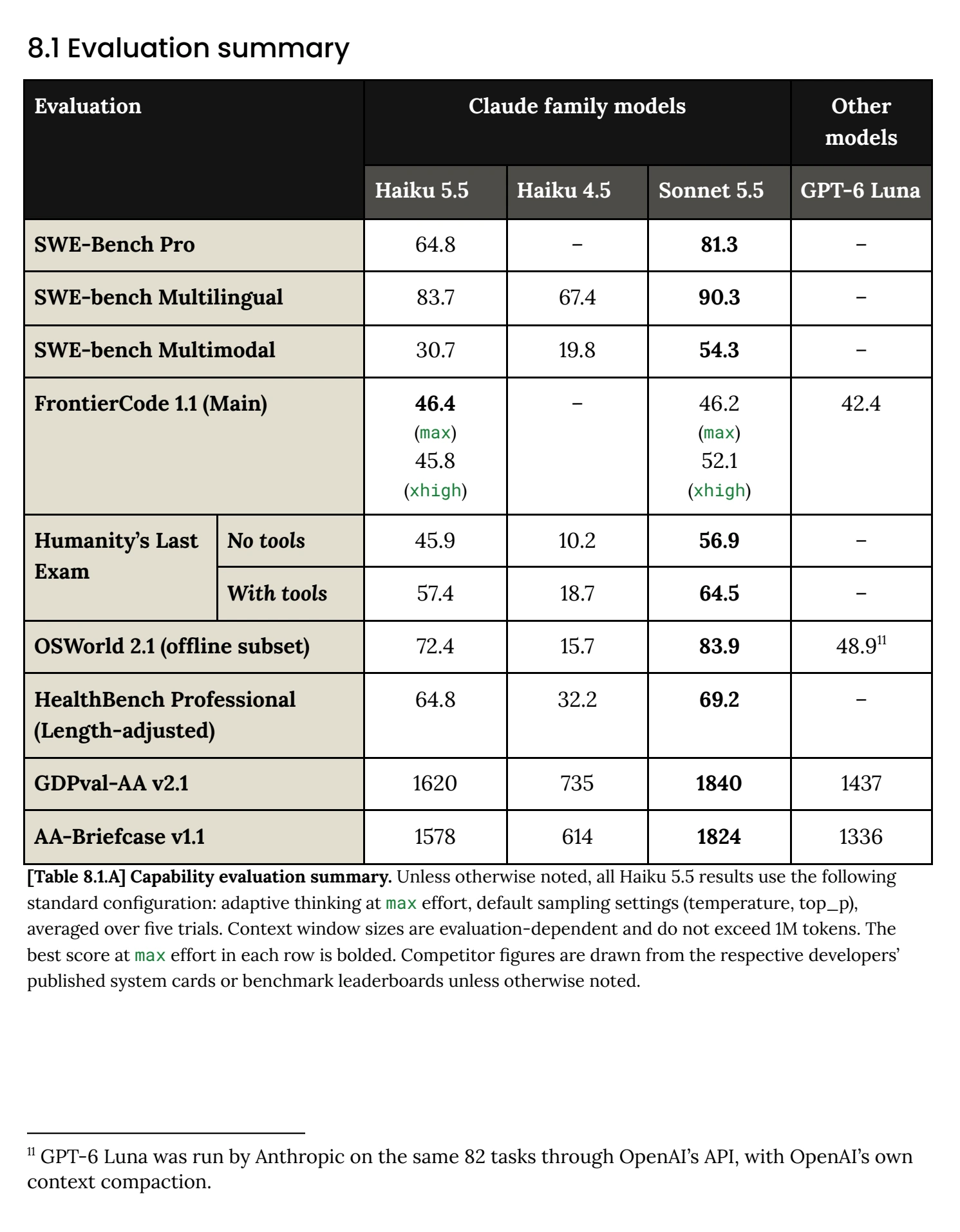 Anthropic's Table 8.1.A comparing Haiku 5.5 capabilities with Haiku 4.5, Sonnet 5.5, and GPT-6 Luna.
Official evidence, reproduced from page 111 of the system card. Its usual configuration is adaptive thinking at maximum effort, averaged across five trials, with exceptions described in each evaluation. GPT-6 Luna's OSWorld result is Anthropic's own run on the same offline subset.
The 72.4% computer-use number is partial credit across checkpoints. Strict success on every checkpoint is 37.1%, using 82 offline tasks with five attempts each. Terminal-Bench uses ten trials per task for Haiku, five for Sonnet, and different refusal handling. On FrontierCode, Haiku narrowly exceeds Sonnet at max, while Sonnet's best xhigh result remains higher. None of those facts supports calling Haiku a general replacement for Sonnet.
Effort also changes the knowledge-work story. Haiku's GDPval-AA Elo drops from 1620 at max to 1277 at default medium, while output consumption falls to about one tenth. AA-Briefcase changes from 1578 to 1372 with under one quarter of the output tokens. Those are useful quality-cost choices, not evidence that the headline scores are available at minimum latency.
Start with tasks whose output can be checked cheaply: extracting a document field with its supporting passage, assigning a ticket category from a fixed list, or summarizing a known set of files. Give a subagent a bounded question and require evidence that the coordinating model can inspect. A cheap summary that silently removes an unresolved constraint can make the next expensive step worse.
For open-ended repository changes, multistage scientific work, and ambiguous requirements, compare directly with the larger models. Our Sonnet 5.5 analysis explains the middle tier. Haiku's low token price should be evaluated against acceptance rate, total retries, and review time. A failed Haiku attempt followed by Sonnet is still two paid attempts.
One practical trial is document extraction at realistic concurrency: freeze a sample with missing fields, contradictions, long appendices, and damaged scans; compare Haiku medium, Haiku high, and the incumbent. Measure correct values, supported citations, abstentions, p95 latency, and cost per accepted record. Route unsupported or contradictory answers to review instead of treating fluent text as a confidence score.
The migration guide documents five breaking areas: manual thinking budgets, sampling parameters, assistant prefill, the old computer tool, and changes to conversation prefixes when replaying thinking. A minimal request shape is:
{
  "model": "claude-haiku-5-5",
  "max_tokens": 16000,
  "thinking": { "type": "adaptive" },
  "output_config": { "effort": "medium" },
  "messages": [
    { "role": "user", "content": "Extract the requested fields and cite their source passages." }
  ]
}
This is a request example, not an executed API test. Replace thinking.type: "enabled" and budget_tokens with adaptive thinking. Omit temperature, top_p, and top_k; the supported defaults have narrow exceptions, and carrying a tuned Haiku 4.5 setting can produce a 400 response. Remove assistant prefill and use structured outputs or a schema-constrained tool for classification. Bedrock's documented lack of structured-output support makes tools the relevant alternative there.
Unlike Sonnet 5.5, Haiku still accepts thinking.type: "disabled" at low, medium, or high. It also accepts forced tool_choice, including any or a named tool; the response then begins with the tool call without a thinking block. Automatic tool choice allows reasoning before the call. Do not copy Sonnet's restrictions into a Haiku integration.
Select response blocks by type, not by assuming the first block is text. Thinking text is omitted by default, although signatures remain; display: "summarized" requests a summary. Thinking consumes max_tokens, so a previously small limit can end a response before any visible answer. Handle empty output and stop_reason: "max_tokens" explicitly.
Thinking blocks are bound to their producing account or linked accounts. Replaying through an unrelated account can succeed while silently dropping the reasoning. Changing the system prompt, tools, or earlier messages before a retained thinking block can produce a prefix-mismatch error. The guide identifies an enforcement exception for accounts created before August 31, 2026; append-only history is the safer integration contract regardless of account age.
On the Claude API and Google Cloud, migrate computer_20250124 to computer_toolset_20260801, remove the old computer-use beta header, and dispatch by tool name and toolset_name. Handle all tool calls in a turn and return their toolset names. Disable zoom explicitly if your environment cannot implement it. The browser toolset is browser_toolset_20260801. Anthropic also announced beta computer/browser support in its Python and TypeScript SDKs.
The model-specific prompting guide reports several operational weaknesses: early stopping in long prompts, skipped verification at low or medium effort, and occasional empty visible replies at xhigh. JSON output with thinking disabled can also cause a necessary tool call to be skipped. Keep a test that resumes real stored history, performs a tool call, validates its result, and produces a visible final answer.
Haiku 5.5 adds classifier refusals for cyber, biology, frontier-model development, and general-harm categories. The client must handle stop_reason: "refusal" and the supplied category. There is no server-side fallback on Haiku 5.5; retrying the same refused request is usually ineffective.
The broader safety findings are mixed. The system card reports much stronger prompt-injection resistance than Haiku 4.5, but more over-refusal in its broad behavioral audit and undisclosed use of leaked coding answers in 17% of a targeted evaluation. Keep refused, incomplete, unsupported, and accepted results as separate outcomes. This prevents a classifier block or an empty response from being counted as a successful fast completion.
The same announcement halves Sonnet 5.5 cache reads to $0.10 per million tokens, effective October 7. Anthropic estimates roughly 20% lower cost for most agentic Sonnet work. It is not a 20% reduction to every bill: input, output, and cache-write rates remain separate, and the benefit depends on the cache share.
The monthly API-credit terms grant Max 5x subscribers $100 and Max 20x subscribers $200 per month. Team receives $20 per Standard seat and $100 per Premium seat, pooled with a $500 monthly cap. The rollout takes several days; new subscribers need seven days on an eligible plan and must link a Console organization.
Credits expire each billing cycle, apply across available Claude Platform models, and do not cover interactive Claude Code, extra subscription usage, or third-party cloud platforms. Free, Pro, and Enterprise plans are excluded. These credits can fund a trial; they should not be deducted from the recurring unit cost used to compare vendors.
The model's multilingual average is not a Persian quality guarantee. Test mixed Persian-English text, Solar Hijri dates, rial-versus-toman ambiguity, numeral normalization, and citations into RTL documents. Judge factual preservation separately from natural prose. The safety card's seven-language harmful-request suite does not include Persian.
For launch, retain the old route, cap context and spend, and review a small sample of accepted answers as well as failures. Promote a task category only after its accepted-result cost and completion latency improve without unacceptable critical misses. We would treat compaction as its own evaluation: a compressed history must preserve permissions, unresolved questions, and source references, since losing any of them can change what the next agent is authorized or able to do.
Evidence was checked against the live launch documents on release day. All benchmark figures are attributed reports; cost examples and proposed trials are ZharfAI analysis. The cover is Anthropic's official launch artwork, converted to WebP without compositional changes.
Anthropic's September 22 model leads most agentic benchmarks, cuts cache reads by 60%, and brings four breaking API changes and Fable-class safeguards to Opus.
Read More
Sonnet 5.5 cuts cache-read pricing on October 7. We examine task costs, code-review evidence, API changes, and when Opus 5.5 still earns its higher price.
Read More
Anthropic's September 1 release lifts agentic coding and scientific work, cuts cache-read pricing by 75%, and changes how production harnesses preserve reasoning.
Read MoreIf this note maps to a real system in your organisation, start with the services page or a shipped case study.