AI Technology
GPT-6 Astra Announced: Capabilities, Pricing, and What Changes
OpenAI's Astra launch brings stronger scientific and computer work, new agent APIs, and premium pricing. Here is the evidence and a practical adoption guide.
Read MoreZharfAI Research
Model release desk
DeepSeek announced V4.1 Flash on September 10, 2026, combining native image understanding with a redesigned model architecture aimed at cheaper long-running agents. For developers already using DeepSeek, this is also a migration event: existing model names can continue accepting requests while the model serving them changes.
The official announcement confirms direct API availability under deepseek-flash. This article explains the release for engineering leads, application developers, and teams choosing a model for document or coding workflows. Availability is DeepSeek's statement; we did not execute paid inference or validate individual account access. Our separate technical architecture analysis works through the paper's equations, cache layout, and reference implementation.
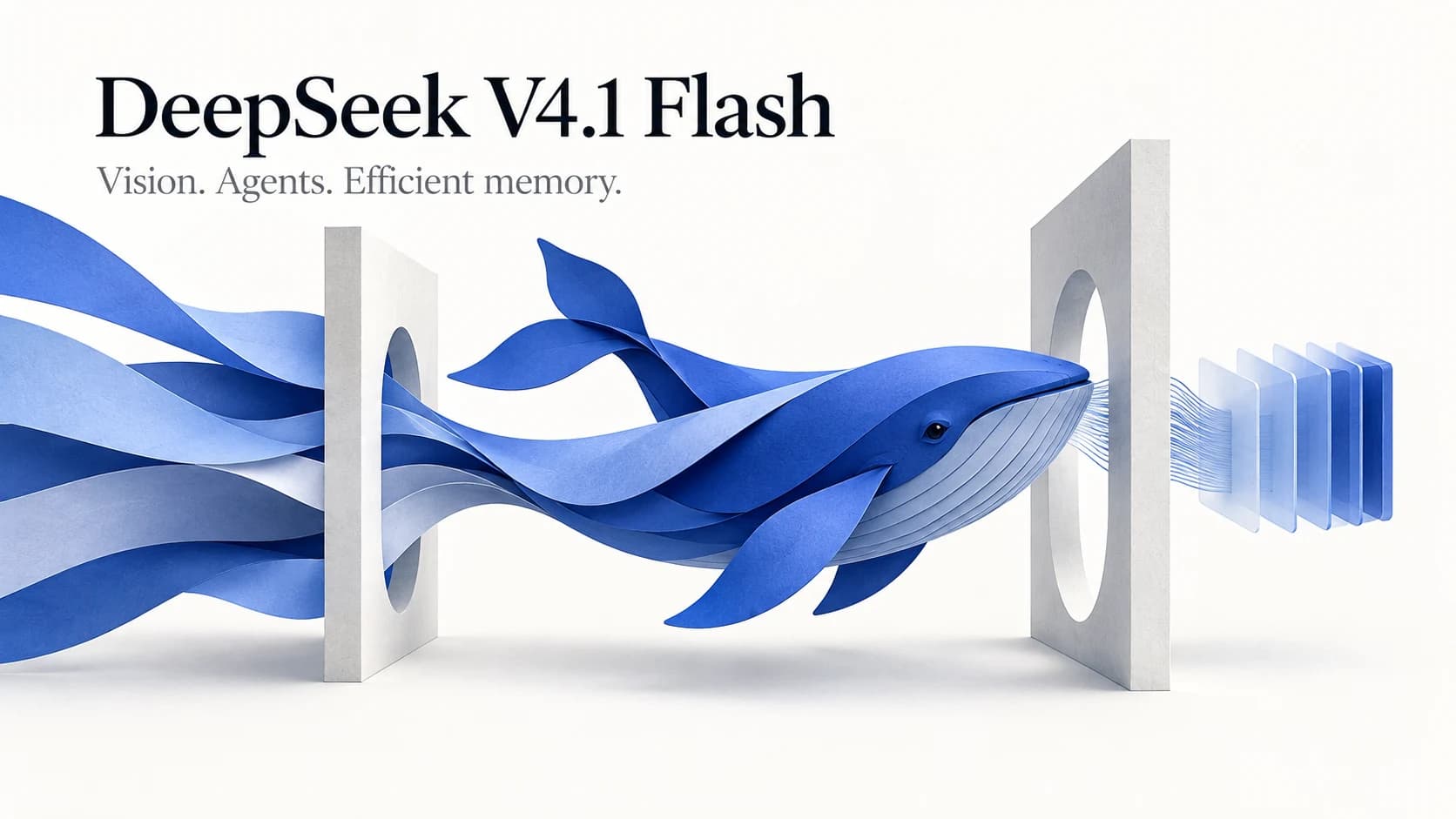
Cover: an original AI-generated editorial illustration of asymmetric computation and compact memory. The charts below are DeepSeek's original figures, credited separately.
The useful question is whether an agent can finish a job with less repeated processing. A coding assistant may read a repository, receive a long test log, inspect a screenshot, and revisit the same context after every tool call. Input handling and retained conversation state can dominate that workload even when the final answer is short.
V4.1 Flash targets this pattern. Its new design gives teams a reason to evaluate input-heavy tasks such as repository maintenance, screenshot-assisted frontend work, and document comparison. It does not establish that every extraction job needs a reasoning agent. Keep deterministic parsing and direct calculations where they already provide reliable results; test the model at the points where interpretation is necessary.
Our earlier DeepSeek V4 Pro and Flash coverage documents the April family launch. September's release is a new architecture and serving transition, not a new date for that earlier announcement.
DeepSeek says deepseek-v4-flash and deepseek-v4-flash-vision-exp now resolve to V4.1 Flash because their original models have been retired. It also schedules all deepseek-v4-pro traffic to move to V4.1 Flash, at Flash rates, on September 14 at 04:00 UTC, continuing until V4.1 Pro launches. That is 07:30 in Tehran. The announcement gives no V4.1 Pro release date.
An unchanged identifier is therefore not a version pin. Record the transition in your evaluation history, especially if a dashboard labels results simply “V4 Pro.” A silent model change can alter answer style, token use, tool arguments, and failure patterns without any application deployment.
Before the deadline, collect a baseline from your current service and rerun representative tasks through the new route. After rerouting, the retired Pro alias cannot be treated as a rollback target. Keep an independently available alternative and verify its access before making it your recovery plan.
The model card separates a 552B-parameter backbone from 196B of Engram conditional memory. The causal encoder–decoder activates about 8B parameters for prefill and 16B for decoding. Cross-layer sharing and low-precision storage reduce global KV to 890 bytes per token; the report describes roughly one-quarter of the previous Flash model's global cache and one-eighth of its persistent cache footprint.
These are different quantities. Active parameters describe a computation path, while total stored weights, temporary state, and cache determine deployment resources. “8B active” does not make this an 8B downloadable model. Likewise, a smaller KV cache does not imply the whole service needs one-quarter as much GPU memory. Those distinctions matter before anyone orders hardware or promises a particular latency.
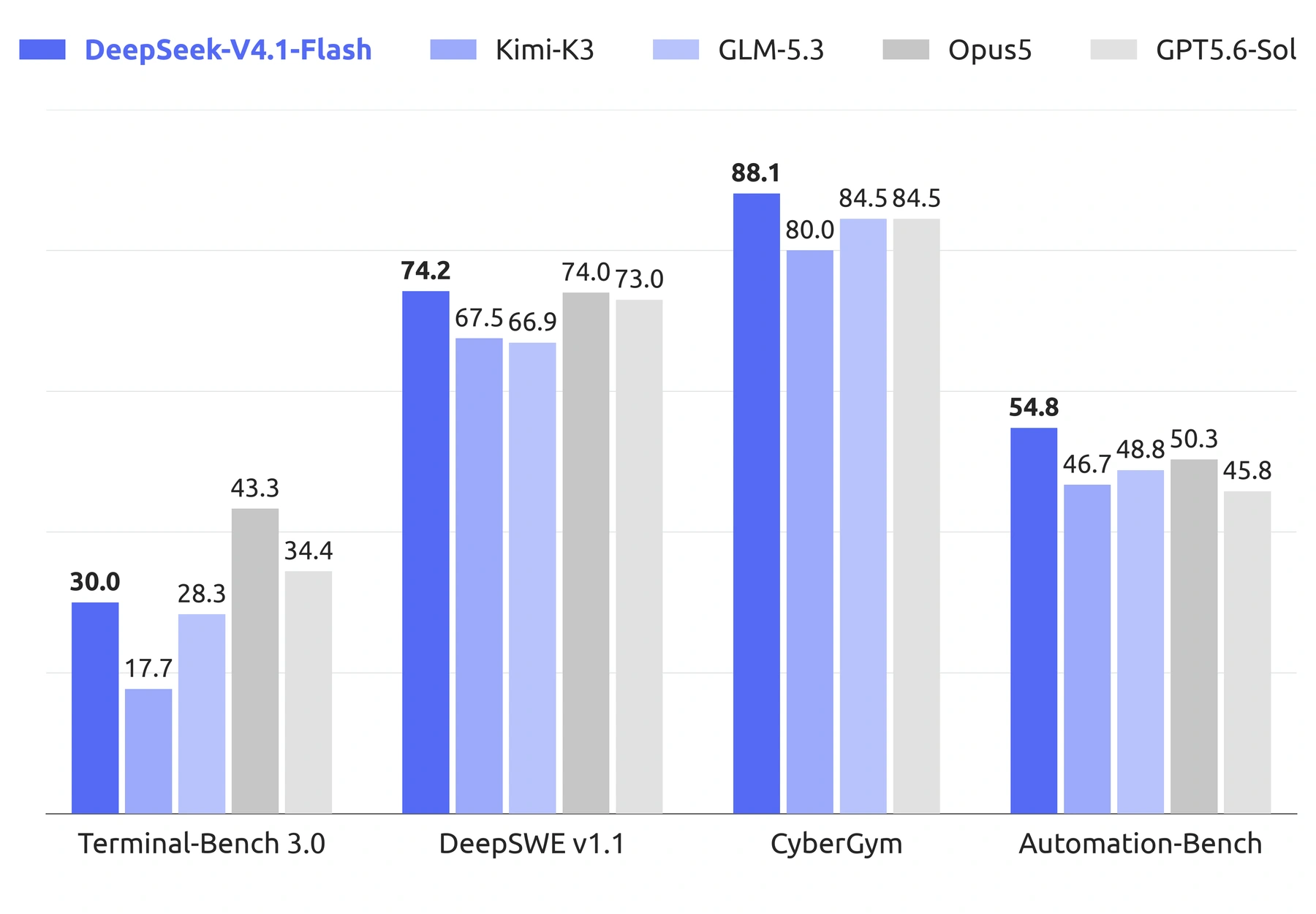
The following selected results are DeepSeek-reported instruct evaluations at maximum effort, not ZharfAI measurements. DeepSeek uses task-specific harnesses; these percentages describe the reported setups.
| Benchmark | V4.1 Flash | V4 Pro | Opus 5 | GPT-5.6 Sol |
|---|---|---|---|---|
| Terminal-Bench 2.1 | 90.6 | 87.9 | 89.1 | 88.8 |
| DeepSWE v1.1 | 74.2 | 62.7 | 74.0 | 73.0 |
| AutomationBench | 54.8 | 43.2 | 50.3 | 45.8 |
| Terminal-Bench 4.0 | 31.2 | 12.4 | 51.8 | 39.9 |
| GPQA Diamond | 90.9 | 92.4 | 93.4 | 94.1 |
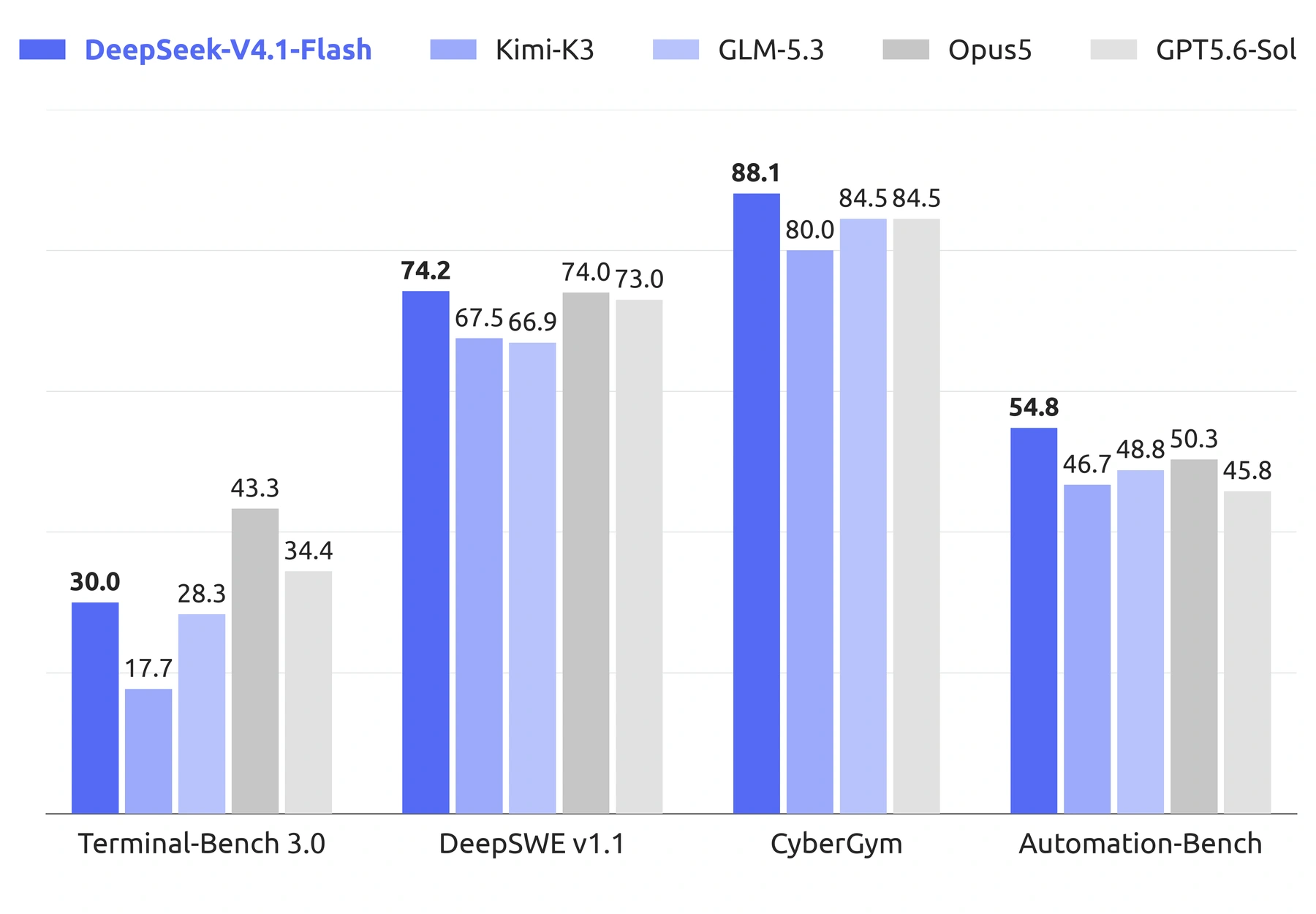 DeepSeek's original agent benchmark chart. The Terminal-Bench 3.0 comparison also shows the gap to Opus 5 and GPT-5.6 Sol; this is provider evidence, not independent testing.
Open the figure at full resolution
The last two table rows prevent a blanket “best model” conclusion. A service maintaining routine application code and a research agent tackling specialist scientific problems need different evidence. Do not average unrelated percentages into an overall workplace success rate.
For a fair pilot, freeze the task inputs, tool permissions, time limits, and acceptance rubric. Count rejected patches and human repair alongside successful demonstrations. A model that produces an attractive answer quickly may still lose on time per accepted deliverable if a reviewer must repeatedly fix it.
The official price sheet lists the following US-dollar rates per one million tokens, checked September 11. It specifies a 1M-token context and up to 384K output tokens.
| Billable category | Off-peak | Peak |
|---|---|---|
| Cached input | $0.003 | $0.006 |
| Uncached input | $0.15 | $0.30 |
| Output | $0.60 | $1.20 |
Peak windows are Monday–Friday, 01:00–04:00 and 06:00–10:00 UTC; all other hours are off-peak. These are direct DeepSeek API rates, not a guarantee about every reseller's bill.
As an arithmetic example, 100,000 uncached input tokens and 10,000 billable output tokens cost $0.021 off-peak or $0.042 at peak. If all those input tokens qualify as cache hits, the totals become $0.0063 and $0.0126. Actual agent bills also depend on reasoning output, repeated calls, retries, and external tools. These examples are not measured average task costs.
A scheduler can move flexible work to cheaper hours, but keep deadlines and failure recovery in the calculation. Saving a fraction of a cent is not useful if a stalled batch delays the report colleagues need in the morning. Track cache-hit share and accepted outputs separately so that a change in workload does not masquerade as a model improvement.
The vision documentation supports images supplied inline, through accessible URLs, or by uploaded file reference. Images contribute billable input tokens. The low detail option downsizes to 512 × 512, which may sacrifice small text; other supported detail settings preserve the original image before the service's normal processing.
For a Persian document pilot, use clear scans and difficult examples: mixed Persian and Latin numbers, dense tables, faint stamps, rotated pages, and screenshots with RTL labels. Ask for the original field text, its location, and a separate normalized value. Grade transcription and interpretation separately. These are proposed tests; the release evidence does not establish Persian OCR accuracy.
When a chart is involved, compare the extracted values with the underlying table if available. Correctly recognizing a bar's color is different from reading its scale and denominator. Require the assistant to identify unreadable evidence rather than invent a value that makes the summary look complete.
The thinking-mode guide exposes low, high, and max, with thinking enabled and high selected by default. For Chat Completions requests carrying tools, preserve the returned reasoning_content in subsequent requests as the guide requires. A wrapper that discards fields can break a conversation even when a simple single-turn request works.
Start with an explicit effort setting and record it with every evaluation. Maximum-effort benchmark results are not predictions for default settings. Test interrupted tool calls, malformed tool results, and a user correction during a long task. Confirm that your application associates each response with the right request and does not mistake a retry for a second authorized action.
For basic integration, the direct service uses base URL https://api.deepseek.com and model deepseek-flash. Vercel's gateway announcement, dated September 9, uses the separate identifier deepseek/deepseek-v4.1-flash. Keep provider configuration and billing records explicit; that earlier gateway date is distinct from DeepSeek's September 10 announcement.
The repository releases weights under MIT, but its minimal inference guide describes a readable implementation rather than the production serving engine. It includes the DSpark forward path while using ordinary autoregressive sampling for generation.
For most application teams, an API pilot is the fastest way to investigate output quality. A self-hosting decision additionally needs a checkpoint inventory, precision support, host-memory capacity, interconnect measurements, and an operational owner. Do not infer those requirements from the marketing word “Flash.” The ability to download weights and the ability to serve them economically answer different questions.
Prioritize workflows with long reusable inputs and checkable outputs. Establish the old service's baseline before the Pro transition, run the new service with explicit effort and identical tools, and inspect both successful and rejected results. Include a cold-cache run and a resumed session so that token-cost comparisons reflect real usage.
Expand only where the improvement survives review. Our assessment is that V4.1 Flash warrants serious evaluation for everyday agents and visual application work. Its strongest argument is the combination of price, input efficiency, and reported agent performance. Whether it should replace your current route depends on your accepted outputs, not the launch label.
Reviewed September 11, 2026. Launch date: September 10. Benchmarks and serving claims are attributed to their providers. Cost calculations and evaluation recommendations are editorial analysis; no independent model benchmark was run.
OpenAI's Astra launch brings stronger scientific and computer work, new agent APIs, and premium pricing. Here is the evidence and a practical adoption guide.
Read More
Anthropic's September 1 release lifts agentic coding and scientific work, cuts cache-read pricing by 75%, and changes how production harnesses preserve reasoning.
Read More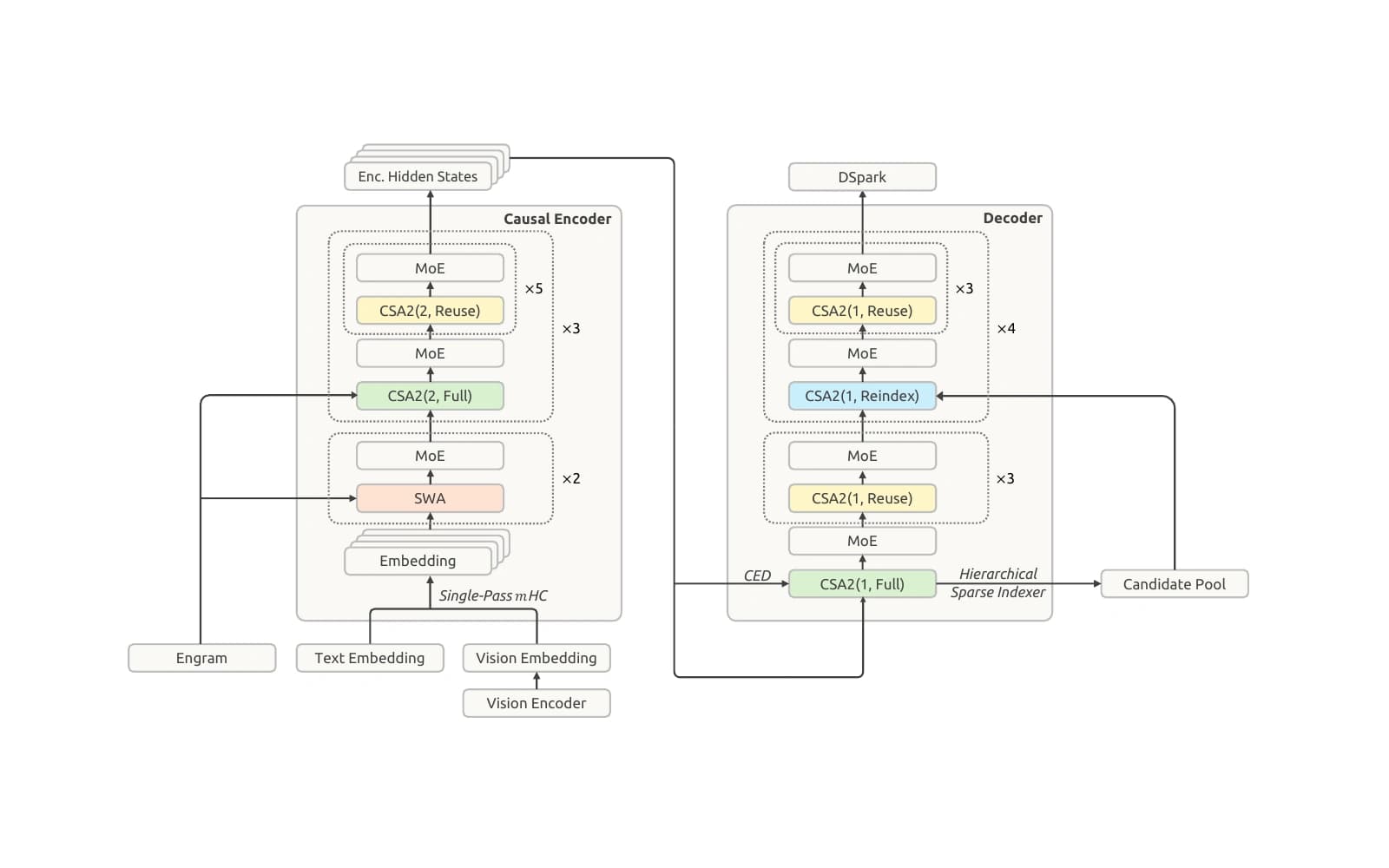
A technical reading of DeepSeek's 51-page report: causal encoder–decoder execution, CSA2, bounded replay, Engram, DSpark, and what the reference code omits.
Read MoreIf this note maps to a real system in your organisation, start with the services page or a shipped case study.