
AI Tutorials
Intelligent Automation Systems: A Practical Guide
Learn how AI-powered workflow automation is transforming enterprise operations, from hyperautomation strategies to selecting the right platforms for your business.
Read MoreA comprehensive tutorial on building powerful AI agents and automating enterprise processes with n8n, the flexible node-based automation platform.

n8n is a workflow automation platform that connects triggers, data transformations, application actions, and AI components in a visual graph. That graph can make an integration easier to inspect than a pile of scripts, but the canvas does not remove software-engineering obligations. A workflow still needs explicit contracts, least-privilege credentials, retries, idempotency, monitoring, change control, and a safe response when an AI model proposes the wrong action.
This guide uses two labels deliberately. Documented behavior means the capability or limitation is described in current official n8n documentation reviewed on 2026-07-30. Recommended practice is operational advice derived from general reliability and security engineering; it may not be an n8n product default. Keeping those categories separate prevents a recommendation from being misread as a built-in guarantee.
Write one sentence that defines the outcome: “When a paid invoice arrives, validate it, create one ledger draft, and notify the owner if any field is uncertain.” Then specify the trigger, input schema, authoritative system, side effects, expected volume, latency target, and failure owner.
Classify every node as one of five roles:
This classification exposes where risk lives. A summarization node is usually reversible; a refund or record deletion is not. Keep the model away from effect-node parameters unless each parameter is constrained and reviewed. For the broader engineering pattern, see durable AI agent workflows and AI tool permission security.
Use a simple support-triage example. A webhook receives a ticket with ticketId, subject, body, customerTier, and createdAt. A validation step rejects missing identifiers and limits body size. A deterministic mapping normalizes the tier and creates a correlation ID. An AI step returns structured fields—category, urgency, short summary, and uncertainty—without permission to contact the customer. Rules route low-uncertainty routine tickets to a queue and uncertain or sensitive cases to a human.
The final action writes a triage record using ticketId as the idempotency key. A separate workflow sends notifications from approved records. Separating classification from communication makes replay safer: rerunning the classifier cannot accidentally send a second customer message.
Documented behavior: n8n passes items between nodes and provides expressions for mapping previous-node data. The official data-mapping documentation describes referencing values; it does not validate your business schema.
Recommended practice: create a small internal schema at the workflow boundary and map every vendor payload into it. Reject unexpected enum values and log schema versions. Avoid expressions that reach arbitrarily far back through a large graph; a dedicated mapping node makes dependencies visible.
Failures have different meanings. A network timeout may be transient, a 401 may require credential intervention, a 429 should respect provider backoff, and a validation error should not be retried. Retrying every failure can multiply invoices, messages, or database rows.
Documented behavior: n8n records executions and its execution interface supports inspecting and retrying failed runs. The official error-handling material documents error workflows that start with an Error Trigger, while the Stop And Error node can deliberately fail a workflow.
Recommended practice: define a retry matrix per external operation. Use bounded exponential backoff with jitter for transient errors; route permanent errors to a review queue; and attach workflow ID, execution ID, correlation ID, node, error class, and redacted context to alerts. Make every effect idempotent with a unique business key or an external provider’s idempotency facility.
An error workflow is an escalation path, not a substitute for local handling. If a partial workflow created a record before failing, the recovery procedure must know whether to continue, compensate, or stop. Document that decision for each effect.
An LLM node should receive the minimum necessary context and return a machine-checked structure. Define allowed categories, length limits, required citations, and what “uncertain” means. Validate output before any downstream action. A fluent paragraph is not an API contract.
For tool-using agents, separate read tools from effect tools. Search and retrieval can usually run with narrower consequences than “send,” “update,” or “delete.” Pass resource identifiers from trusted workflow data rather than letting the model invent them. Cap iterations, tool calls, payload size, and total execution time. Store the model, prompt version, retrieved source identifiers, proposed tool call, approval outcome, and final effect.
Documented behavior: n8n’s AI Agent tooling can connect tools, and official documentation describes human review for selected tool calls: the workflow pauses and requests approval before the guarded tool executes.
Recommended practice: approval should be enforced in the graph for high-impact actions, not requested only in the prompt. Show the reviewer the exact action, target, changed fields, evidence, and expiry. Denial should end or safely reroute the action; approval should be bound to that exact payload so the model cannot alter it afterward.
The article human approval design for AI goes deeper on when an approval step reduces risk and when it merely shifts accountability.
Self-hosting gives an organization more deployment control; it does not create automatic privacy or regulatory compliance. The operator remains responsible for TLS, authentication, authorization, patches, backups, secrets, network policy, retention, and incident response.
Documented behavior: n8n provides a security audit callable through the CLI, API, or n8n node. The audit reports categories involving credentials, database expressions, file-system access, risky or community nodes, unprotected webhooks, missing settings, and outdated instances. n8n also documents blocking nodes through configuration. These mechanisms identify or reduce exposure; they do not prove the instance is secure.
Recommended practice: run the audit at deployment and on a schedule, triage every finding, and retain results. Block Execute Command, file-system, or other powerful nodes unless a reviewed workflow needs them. Restrict community-node installation, pin versions, review provenance, and rebuild after updates. Put n8n behind controlled ingress, validate webhook signatures, rate-limit public endpoints, and restrict outbound destinations so a compromised workflow cannot scan internal services or exfiltrate data.
Credentials should be scoped per environment and purpose. A read-only reporting workflow should not share the credential used for production writes. Rotate secrets and know which workflows depend on each one. Redact sensitive fields from execution data and alerts; an error trace can become a second data leak.
A saved visual graph is executable code. Changing a mapping, credential, or node version can alter financial or customer-facing behavior. Treat workflow JSON and associated configuration as reviewed artifacts.
Documented behavior: n8n documents source-control environments and advises against pushing and pulling in both directions on the same instance because changes can be overwritten. Its environment tutorial describes patterns for moving workflow changes between instances and branches.
Recommended practice: maintain development, staging, and production separation; use one-way promotion; require review for effectful workflows; and attach migration notes. Export a known-good version before change. Test with synthetic or redacted fixtures, never copied production secrets. A release checklist should cover schema compatibility, credential references, node availability, timeout, retention, rollback, and the first production observation window.
Pin representative inputs and expected outputs in an external test harness or evaluation workflow. Test empty arrays, duplicated events, malformed timestamps, non-Latin text, very large payloads, provider timeouts, and downstream partial failure. For AI outputs, test adversarial instructions inside user content and retrieved documents.
Scaling is not the first cure for a slow workflow. Measure node duration, provider latency, database contention, payload size, binary-data handling, and concurrency limits first. A third-party API may be the bottleneck, and adding workers can only increase its rate-limit failures.
Documented behavior: n8n’s queue-mode documentation describes a main instance receiving triggers and worker instances executing workflows with Redis as the message broker; the database persists execution data. Official docs also describe execution-data and binary-data considerations. Queue mode is an architecture capability, not a promise of exactly-once effects.
Recommended practice: benchmark a production-shaped workload, then set concurrency below the tightest downstream limit. Monitor queue age, start delay, run duration, success rate, retry rate, worker saturation, database latency, and external 429 responses. Keep main and worker configuration aligned, test worker loss, and verify that any binary-data strategy works across processes. Idempotency remains mandatory because distributed execution can be retried or interrupted.
Estimate cost per successful business outcome, not just executions per minute. Include model tokens, third-party calls, database storage, execution retention, human review, and failure rework.
A green “success” status can hide a bad business result. The workflow may run while classifying every ticket as “other,” writing an empty amount, or sending to the wrong tenant. Technical metrics need business assertions.
At minimum record:
Documented behavior: n8n provides execution views for filtering, examining, and retrying runs, plus documented monitoring and logging options depending on deployment and plan.
Recommended practice: export operational signals to a system independent of the instance being monitored. Alert on sustained error ratios, queue age, missing expected events, abnormal classification distributions, and reconciliation differences. Use saved execution data according to a deliberate retention policy; do not retain sensitive payloads indefinitely just because debugging is convenient.
Before activation, confirm that the trigger is authenticated and rate-limited; the input schema is validated; tenant and authorization context cannot be supplied by an untrusted model; and credentials have the minimum scope. Confirm every external effect is idempotent, every retry is bounded, and partial completion has a documented recovery path.
For AI steps, confirm the output schema is enforced, retrieval sources are controlled, prompt injection tests exist, risky tools require graph-level approval, and a deterministic fallback exists. Confirm logs are redacted, alerts have an owner, retention is set, backups and restore are tested, and rollback does not depend on the broken workflow.
Run a tabletop exercise: duplicate the trigger, make the provider time out after accepting a request, revoke a credential, inject hostile text, stop a worker, and restore the previous workflow version. A workflow is ready when operators can explain the resulting state and recover it—not when the happy path succeeds once.
In week one, define the contract, threat model, baseline manual process, and success metrics. Build the deterministic skeleton first, including validation, idempotency, and reconciliation. Use sample payloads that represent edge cases.
In week two, add the model only where it improves a defined decision. Constrain output, create an evaluation set, and compare against a non-AI baseline. Add human review for sensitive effects and record overrides.
In week three, configure error workflows, monitoring, security audit, node restrictions, retention, backups, and staging promotion. Load-test at realistic concurrency and simulate partial failures.
In week four, run shadow mode or a limited production cohort. Review every failure and a sample of successes. Expand only if business outcomes, guardrails, and operational load meet predeclared thresholds. That sequence turns a visually compelling automation into a service the organization can own.
If you want your team to learn to build these workflows on its own real processes, see AI training for teams; if n8n and the model both need to run on your own servers, see local AI on your own servers.
All product statements above are limited to behavior documented at the review date. Every item labeled “Recommended practice” is implementation advice and should be adapted to the organization’s risk, deployment model, n8n edition, and applicable obligations.
Learn how AI-powered workflow automation is transforming enterprise operations, from hyperautomation strategies to selecting the right platforms for your business.
Read More
Every 24 hours is not every day at 9. A practical guide to preserving local-time intent, resolving missing or repeated hours, and preventing duplicate scheduled actions.
Read More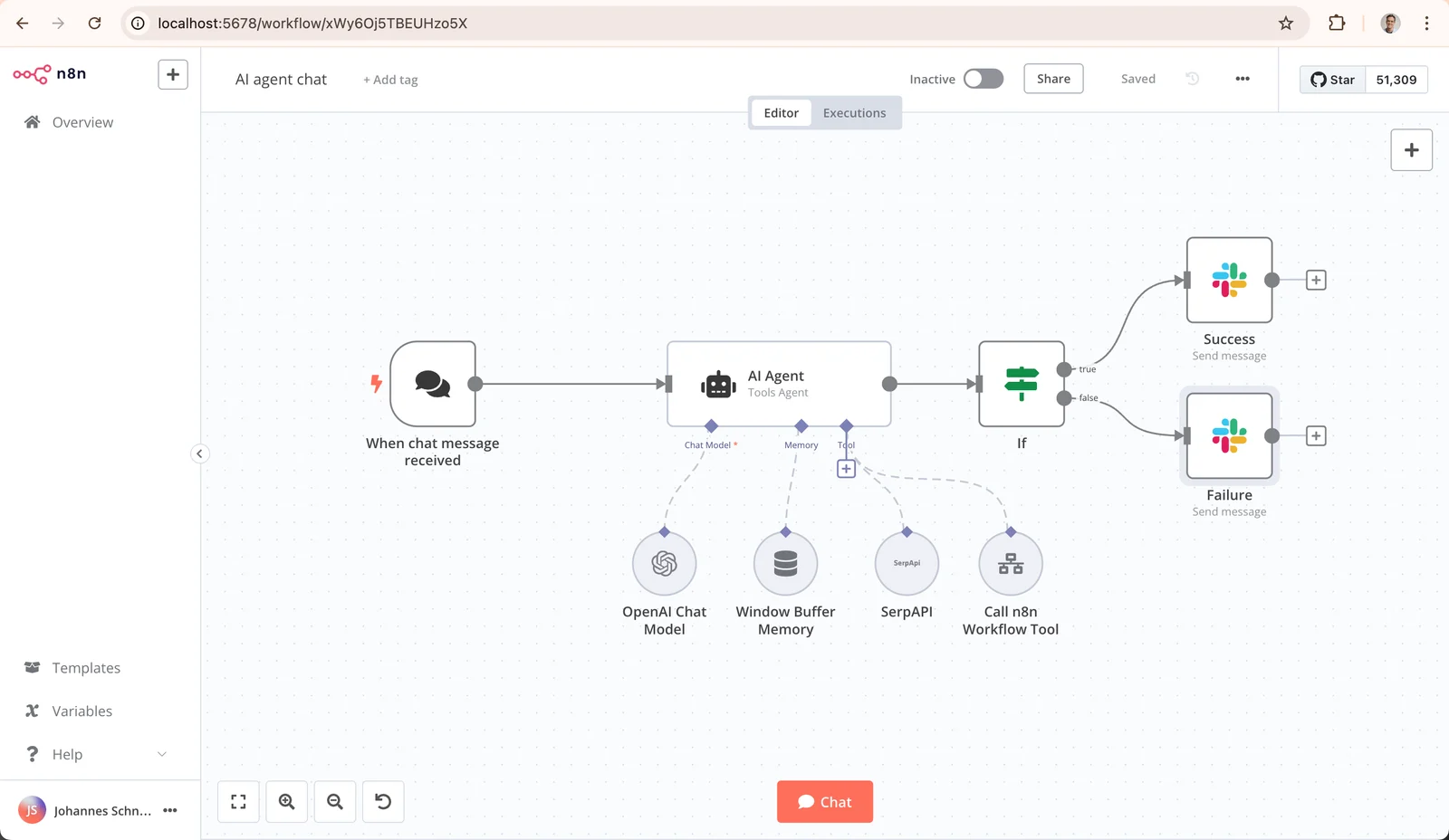
Run n8n on an Iranian server with Docker Compose, PostgreSQL, and HTTPS: domestic image mirrors, backups, upgrades, queue mode, local Ollama models, and Jalali dates.
Read MoreIf you want the agents and automation in this guide working for your engineering team or business processes, start with a small pilot you can measure.