On November 20, 2026, Levent Alpöge, a number theorist who works at Anthropic, posted a four-page note saying that he, working with Claude, has found a proof of the Riemann Hypothesis. He says the same method proves the Generalized Riemann Hypothesis as well. There is no paper. The proof was released only as a Lean project, a form a computer can check line by line, split into 14 downloadable parts.
Status when this article was published (20 November 2026, evening, Tehran time): a claim, released publicly for checking and not yet confirmed by any independent mathematician or by a completed independent build. Anthropic had not commented when AFP asked. We downloaded the release and inspected it ourselves; what follows separates what Alpöge says, what we saw in the files, and what nobody has checked yet.
Update, 21 November 2026: the Lean and Mathlib communities certified the proof in a joint statement dated 13:55 UTC, after independent builds and several independent proof checkers accepted it. The archive they checked has the same SHA-256 as the one we inspected below. Our follow-up sets their statement against the published check logs: Lean and Mathlib communities certify the Riemann Hypothesis proof. It also corrects one point in our inspection, marked below.
What Alpöge announced
The note sits on Alpöge's personal site as remark.pdf. Its first claim is direct: "I believe I have, working with Claude, discovered a proof of the Riemann Hypothesis." He adds that "Claude and I have also formalized the arguments without assumptions," and that he chose to publish only the Lean version because the informal argument is "incredibly long" and he has not yet mastered all of the mathematics around it. He plans to write a readable account later.
The note is unusual for an announcement of this size. It is personal, partly a memoir of the problem he says he had planned to work on since his student days, and partly a compressed sketch of the method. A footnote jokes that the unreadable draft Claude produced ran past 250,000 pages. The PDF's own metadata dates it to 12:52 UTC on November 20.
Scientific American and AFP, via France 24, reported the claim the same day. AFP noted that it "has not been independently verified, and the proof has not yet been reviewed by outside experts."
What the Riemann Hypothesis says
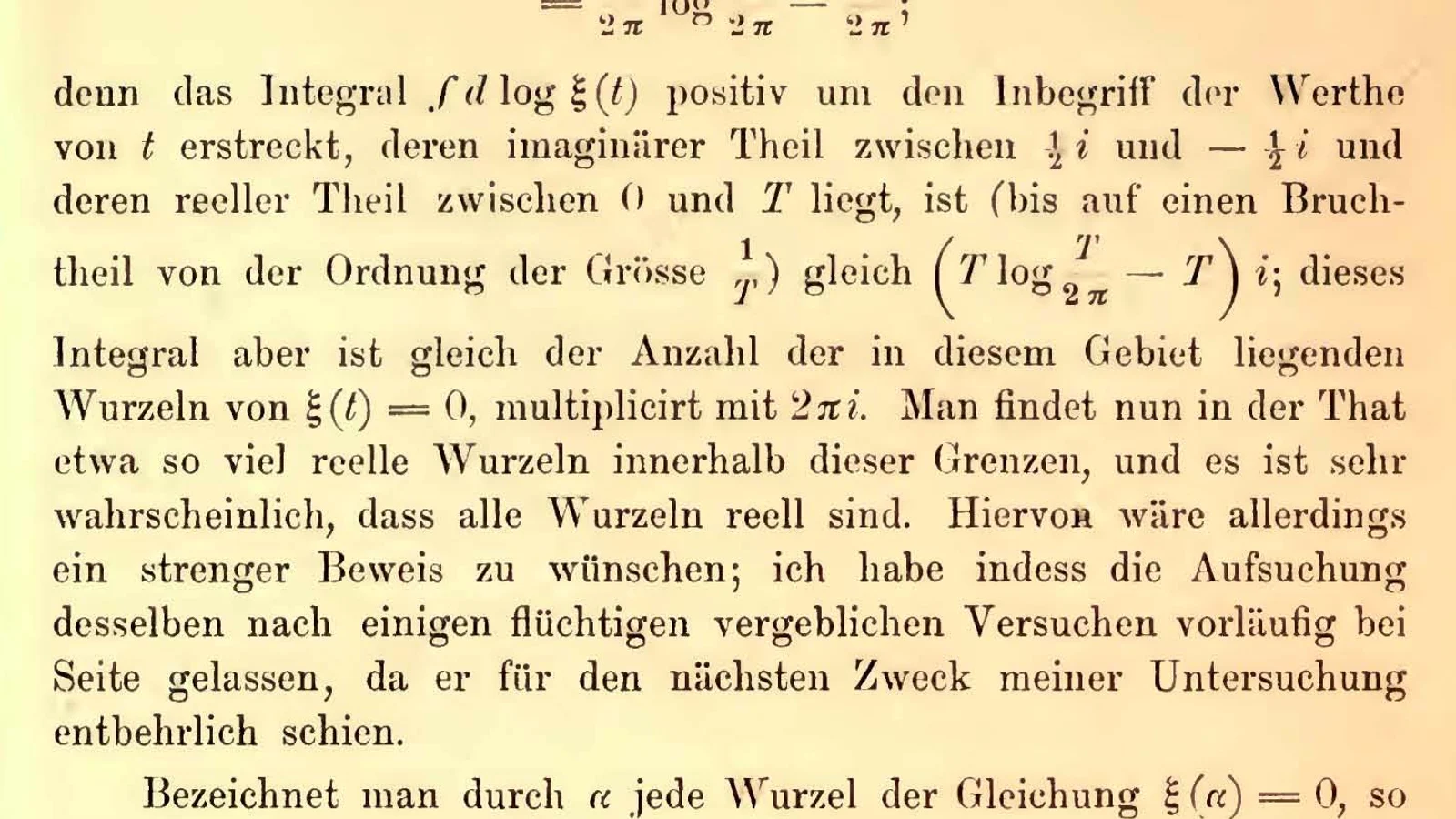
Bernhard Riemann's 1859 paper connected the prime numbers to a function now called the Riemann zeta function. The function has "trivial" zeros at the negative even integers and infinitely many other zeros in a vertical strip of the complex plane. Riemann conjectured that all of those other zeros lie on one line, the critical line, where the real part equals one half.
The reason anyone cares is the primes. As the Clay Mathematics Institute puts it, the prime number theorem gives the average distribution of the primes, and the Riemann Hypothesis describes the deviation from that average. If it is true, the count of primes up to any size stays about as close to its predicted value as it possibly can, with an error that grows roughly like the square root of the size. Many results in number theory are proved "assuming RH" or "assuming GRH" and would become unconditional at once. The Generalized Riemann Hypothesis makes the same statement for a wider family of functions, Dirichlet L-functions, which govern how primes spread among remainder classes such as numbers ending in 1, 3, 7 or 9.
Clay notes that the hypothesis has been checked for the first 10 trillion zeros; no amount of checking proves it for all of them. It is one of the institute's seven Millennium Prize Problems, each carrying $1 million, and Clay points out that it also appeared on David Hilbert's 1900 list of 23 problems.
What we found inside the Lean release
We downloaded all 14 parts from Alpöge's site, joined them, and read the files without building or running any of the code. Building would have meant running a very large program from an unverified source, so we stopped at reading.
- Size. Thirteen parts of 18,000,000 bytes and one of 5,275,554: 239,275,554 bytes compressed. The joined archive's SHA-256 is
9631b4f020199e580ba86178cb56c6e9b09f690c2369a80dc4334aa93f49c7fc.
- Contents. 175,187 Lean source files, about 17.4 million lines, plus three project files. The largest folder,
Development, holds about 142,000 of them.
- Tools. Lean version 4.33.1, with Mathlib, the community mathematics library, pinned to a single commit (
0df444a3…).
- The statement. The top-level file proves
theorem riemannHypothesis : RiemannHypothesis. That target is not defined in the project; it is Mathlib's own definition, and we found no local redefinition of it or of the zeta function. It says that every zero of riemannZeta other than the trivial zeros has real part one half, with the point 1, where the function has a pole, set aside. In the Mathlib source at the pinned commit, the comment above that definition reads: "constructing a term of this type is worth a million dollars."
- Four more theorems. One restates the hypothesis with a definition written in the project's
Statements.lean, a 16-line file that imports only Mathlib and spells out the same condition. The other three cover Dirichlet L-functions: no zeros to the right of the critical line, for all Dirichlet characters; every zero inside the critical strip on the line, for all characters; and that second statement again for primitive characters. So "Generalized Riemann Hypothesis" here means GRH for Dirichlet L-functions. The note says Alpöge expects to reach the Extended Riemann Hypothesis "with more time"; that is not in these files.
- Shortcuts. A text search found no
sorry or admit (Lean's placeholders for unproved steps), no new axiom declarations, and no native_decide, implemented_by, extern or unsafe. Five small helper files hide parts of the project from Lean's automatic lemma suggestions, and one helper copies existing theorems under new names through Lean's normal checked path. Neither exempts any step from the kernel's check. Correction, 21 November: the community's notes list more metaprogramming than we found: two tactics, kexactB (used in 67 files) and kcopy, place proof terms without the elaborator first checking their type. The kernel still checks those steps, but it is the only check on them.
Interesting Engineering reported the same archive size and file count, and said an unnamed independent project had matched the files and found that the main theorem statements compile against Mathlib, with the check of the full proof still running.
What a machine check settles, and what it does not
A finished Lean build would settle the question most people care about: whether each step follows from the previous ones. Lean's kernel, a small and heavily reviewed program, checks every inference. That is why Scientific American's reporter expected the check not to take long, while refereeing a 250,000-page manuscript by hand would hardly be possible.
Three things remain open even so. First, the build has to finish under the pinned versions, and #print axioms riemannHypothesis has to list only Lean's three standard axioms. Our text search makes surprises less likely; only the build can rule them out. Second, the definitions underneath the statement have to mean what mathematicians mean. Here that risk is low, because the statement uses Mathlib's long-standing zeta function and its own RiemannHypothesis, not new definitions written for this project. Third, a checked proof is not yet understood mathematics. Mathematicians want to know why it works, which new ideas it contains and what else they unlock. Alpöge says the same in the note, and expects the argument to be "massively simplified."
How the argument is said to work
The note gives only a sketch, and Alpöge warns that parts of it paraphrase a summary Claude wrote, which he calls "slop," because he is not yet expert in every area the proof uses. What follows is his description, not our assessment.
The starting point is Stepanov's method, which proved the analogue of the Riemann Hypothesis for curves over finite fields. That argument relies on a tool called multiplicity, and multiplicity has no obvious meaning over the ordinary integers; Alpöge compares it to "differentiating whole numbers." The new idea is to imitate multiplicity with chains of theta lifts, a construction from the theory of automorphic forms, applied to a weighted sum over primes up to a size X. The line he expects to make mathematicians "fall out of their chairs" is Claude's suggestion for the length of that chain: the square root of X.
A timeline that Claude compiled at his request runs from October 6, 2026, with a "Stepanov determinant," to November 16, 2026, with "GRH." Eight of its twenty steps are dated November 15. The list names tools from across number theory: Iwasawa theory, relative trace formulas, Chowla–Selberg, Siegel mass formulas and a weakened form of Vandiver's conjecture.
What Claude did, in Alpöge's words
Alpöge credits himself with the direction and Claude with much of the execution. He says he chose the toy setting, combined two ideas from it and "guided us to the right situation," and that "Claude far outpaced me near the finish line." He also writes that he has "little mastery of automorphic forms on higher rank groups," an area at the centre of the final steps.
The note does not say which Claude model was used, how much computing went into the work or how the formalization was organized. AFP adds that Alpöge consulted Anthropic chief executive Dario Amodei before announcing. It also recalls that in August Anthropic said an unreleased version of Claude had improved a long-standing result related to the hypothesis while stressing that it had not proved it. The announcement comes two months after OpenAI said an AI model had solved the Navier–Stokes Millennium Problem, a result AFP says mathematicians consider likely correct but not yet fully vetted. For how reasoning models spend computation on problems of this kind, see our explainer on test-time compute and reasoning.
What outside mathematicians have said so far
Very little on the substance, which is expected on day one. Scientific American quoted Hector Pasten of the Pontifical Catholic University of Chile: "If the proof is correct and understood, this completes a dictionary between different branches of math." Its reporter also expected that "it shouldn't take long for experts to verify whether the hypothesis is properly coded, and if the proof is correct."
The note thanks a long list of people, including Peter Sarnak, Manjul Bhargava and Maksym Radziwiłł. A thank-you is not a review, and we found no public statement from any of them on whether the proof is correct.
The timing and Anthropic's stock market debut
The note has a page about timing. Alpöge writes that "the precise timing is horrible," that he messaged Dario Amodei to ask about announcing, that "there was a constraint to respect," and that "there is an obvious cynical view, to do with the timing, but it is false." He does not say what the constraint was. AFP wrote that he was "probably referring to this week's record IPO"; that link is AFP's inference, not the note's.
The financial facts are Anthropic's own. Its shares began trading on Nasdaq on November 19 under the symbol ANT, and the offering closed on November 20: 1.127 billion shares at $83, about $93.5 billion in gross proceeds, plus a $26.0 billion private placement with AMD, Broadcom, Google, Micron, Microsoft, NVIDIA and TSMC, about $119.5 billion in total. US rules limit what a company may say publicly around its listing, which would fit the note's "constraint," but nothing in the note confirms that reading.
Our view: if the result holds, it is the strongest public evidence so far that an AI system can do research-level mathematics, and it arrives from a company employee in the week the company listed. That is one more reason the independent build and expert reading, not the announcement, are what to watch. This article is not investment advice.
Encryption, the $1 million prize and other practical questions
The hypothesis is about how primes are distributed, not about how to find the prime factors of a given number. Widely used public-key systems such as RSA depend on factoring being hard, and a proof of the hypothesis gives no factoring method. Its main practical effect would be to make results that were proved "assuming GRH," including some guarantees about how fast certain algorithms run, hold without the assumption. The serious long-term threat to today's public-key encryption is quantum computing, which we cover in AI, quantum computing and cryptography.
The prize will not be decided soon. The Clay Institute's rules say a proposed solution is considered only after three conditions are met: publication in a qualifying outlet, at least two years since that publication, and general acceptance by the mathematics community. A Lean archive on a personal website is the start of that process, not the end.
What to watch next
- Independent builds. Someone outside Anthropic compiling the archive with the pinned Lean and Mathlib versions and publishing the output of
#print axioms for the main theorems.
- Reading by specialists. Number theorists who work on automorphic forms and theta correspondences looking at how the files are organized and where the key estimates sit.
- A human-readable proof. Alpöge's promised write-up, and the shorter proofs he expects others to find.
- Anthropic's own statement. So far the claim is one researcher's, published on his personal site.
For our longer analysis of what AI systems doing their own research could change, see AI that improves itself.
Frequently asked questions
Has the Riemann Hypothesis been proved?
As a formal Lean proof, it was certified by the Lean and Mathlib communities on November 21, a day after this article; see our follow-up. The human side, a readable proof that experts understand and a journal publication, is still to come. When we first published, no independent build or expert review had confirmed it.
What is Lean, and why does it matter here?
Lean is a programming language for writing mathematical proofs that a computer checks step by step. If the archive builds and uses no extra axioms, the remaining questions are about what the statement means and what the proof teaches, not about whether a step was skipped.
Did Claude prove it alone?
No, by Alpöge's own account. He set the direction and the key analogy, and says Claude carried much of the technical work, especially near the end, and wrote the formal proof with him.
Will this break encryption?
No. It says nothing about how to factor large numbers.
Source notes
Sources checked on November 20, 2026. The archive inspection is ZharfAI's own: we downloaded and read the files and did not build them. The descriptions of the method and timeline are Alpöge's, and he says parts of them are paraphrased.
- Levent Alpöge, remark.pdf: four-page note, PDF metadata dated November 20, 2026, 12:52 UTC; links the 14 Lean archive parts.
- Mathlib, RiemannZeta.lean at commit 0df444a3: the definition of
RiemannHypothesis used by the release.
- Scientific American, Joseph Howlett: published November 20, 2026, 14:00 UTC, marked as a breaking story that will be updated.
- AFP via France 24: issued November 20, 2026.
- Interesting Engineering, Aamir Khollam: published November 20, 2026, 17:09 UTC.
- Anthropic, closing of its initial public offering: published November 20, 2026.
- Clay Mathematics Institute, the Riemann Hypothesis, the Millennium Prize Problems and rules for the prize.
- Cover image: page 139 of Riemann's 1859 paper "Ueber die Anzahl der Primzahlen unter einer gegebenen Grösse", the passage where he writes that it is "very probable that all roots are real". Public domain scan from Wikimedia Commons, cropped.