llama.cpp Adds Kimi K3; Demand Sets the Economic Test
August 16, 2026

llama.cpp has added text-model support for Kimi K3, including its hybrid attention, latent mixture-of-experts path, MXFP4 conversion, reasoning output, and typed tool calls. The release reports exact tiny-model checks and an end-to-end run on eight B200 accelerators, but it also records CPU/CUDA-only operations and per-node fallback on Metal and Vulkan. A follow-up release added a file-bounds check for LoRA tensors without claiming a CVE or measured exploit. The economic setting is less expansive: U.S. July retail and food-service sales fell 0.6% month over month in nominal, seasonally adjusted data; June business sales fell 1.1% while inventories were virtually unchanged; and Federal Reserve bank data show July consumer-loan growth outpacing a contraction in commercial and industrial lending. CFTC positions also show asset managers and leveraged funds on opposite sides of E-mini S&P 500 futures. ZharfAI’s conclusion is deliberately narrow: model support is meaningful engineering progress, but compatibility, safe loading, measured operating cost, customer demand, and financing still decide whether it becomes economic value.
ZharfAI Analysis
The strongest AI signal in the latest cycle is not another model announcement; it is the work required to make an already released frontier-scale model usable in another runtime. llama.cpp release b10448 added Kimi K3 text support across model conversion, graph construction, chat formatting, reasoning extraction, streaming, and typed tool calls. That is a practical expansion of deployment choice. It is not proof that Kimi K3 has become cheap to run, broadly portable, or economically productive. Set beside fresh U.S. demand, inventory, bank-credit, and futures-position data, the release supports a precise thesis: access to a capable model can widen faster than the market evidence needed to justify its operating and capital cost.
The integration is technically substantial. The release maps Kimi K3’s hybrid KDA linear attention and MLA full attention, cross-layer residual attention, latent mixture of experts, situ activation, an MLA output gate, and a full-rank KDA gate into llama.cpp. Its converter treats the model’s packed MXFP4 expert weights as bit-compatible with ggml’s MXFP4 representation, rearranging nibbles instead of dequantizing the entire weight set. Maintainers say this avoids an approximately 5.5-terabyte bfloat16 round trip. They also raised the runtime’s expert limit from 512 to 1,024 and added parsing for K3’s reasoning, response, and tool-call structure. These are implementation facts from the project, not an independent performance study.
The release includes useful validation and equally useful limits. Maintainers compared a tiny model exercising K3-specific features with Moonshot’s reference path, reporting final-position relative logit error of 6.7e-05 and correlation of 1.00000000 for chunked and recurrent paths; the MXFP4 blocks reportedly dequantized with zero error in that check. They also tested content, reasoning, streaming deltas, and tool calls against a quantized K3 build on eight B200 accelerators. Yet the cross-layer residual operation is CPU- and CUDA-only, so Metal and Vulkan can fall back per node. The notes provide no independent replication, production latency distribution, energy use, quality comparison across quantizations, or total serving cost. Exactness on a tiny graph and successful execution on eight premium accelerators are admission tests, not unit economics.
Release b10451, published the following morning, makes the boundary problem more explicit: llama.cpp added a check that LoRA tensor data remains within file bounds before the adapter is used. The release does not assign a CVE, severity, exploit path, or measured incident, so it would be wrong to inflate this into a confirmed breach story. The operational implication is still real. An open runtime that accepts model files, quantized weights, templates, adapters, and tool schemas has a broad input surface. Model support is incomplete unless conversion and output behavior are correct and untrusted or malformed artifacts fail safely.
The demand tape offers no matching expansion. The U.S. Census Bureau estimated July retail and food-service sales at $763.6 billion, down 0.6% from June with a ±0.4 percentage-point margin, while remaining 5.0% above July 2025. The figures are adjusted for seasonal, holiday, and trading-day effects but not for price changes, so they are nominal rather than real consumption. Sales excluding motor vehicles fell 0.3%; excluding both vehicles and gasoline they fell 0.2%. Nonstore retailers declined 2.2% month over month, electronics and appliance stores declined 0.5%, and food services rose 0.5%. A single month does not establish a consumer recession, but it does remove support for a simple story of uniformly accelerating end demand.
A second Census release shows a similar tension one stage upstream, on a different reporting month. Combined distributive-trade sales and manufacturers’ shipments were $2.1113 trillion in June, down 1.1% from May but up 10.0% from a year earlier. Inventories were $2.7402 trillion, virtually unchanged month over month and 3.0% higher year over year. The seasonally adjusted inventories-to-sales ratio was 1.30, below 1.39 a year earlier. Because these series are also not adjusted for price changes, the large annual sales gain cannot be read as real-volume growth. Nor should June inventory data be synchronized casually with July retail sales or an August software release. The useful point is narrower: firms were not building a large new inventory cushion as current-dollar sales slipped.
Credit is available, but its allocation is uneven. In the Federal Reserve’s August 14 H.8 release, July bank credit grew at a 5.9% seasonally adjusted annual rate, while loans and leases grew 3.9%. Consumer loans grew 8.5%, but commercial and industrial loans contracted at a 1.1% annual rate. Those are break-adjusted aggregate growth rates, not loan approvals for AI companies, a measure of underwriting standards, or evidence that consumer borrowing is healthy. They do show why operators should distinguish financial-system capacity from capital available for productive deployment. A runtime can broaden the technical menu while business credit momentum narrows.
Market positioning is also divided rather than decisively risk-on or risk-off. The CFTC’s report released Friday covers positions as of August 11. In E-mini S&P 500 futures, asset managers held 1,154,700 long contracts and 206,219 short, while leveraged funds held 205,744 long and 486,190 short. From the prior week, leveraged funds cut gross shorts by 49,848, so the snapshot is not evidence of a fresh one-way bearish bet. Futures books can hedge other exposures, the categories are broad, and Tuesday positions predate Friday’s retail release. The defensible inference is simply that sophisticated participants were carrying materially different exposures while the economic signal remained mixed.
For AI teams, including Iranian operators working under hardware, payment, and cross-border constraints, the practical sequence is demanding. First verify that conversion preserves weights and save-load behavior. Then test the actual backend, adapter provenance, tool-call parsing, latency tails, memory, power, and failure isolation. Only after that should a team map served tokens or completed tasks to revenue, avoided cost, or risk reduction. Kimi K3 support in llama.cpp can widen optionality, but an eight-B200 validation path is not a small-enterprise deployment recipe, and U.S. retail or credit aggregates are not direct proxies for Iranian demand. They are part of the external price-and-capital environment, not a local forecast or investment signal.
The next evidence should close both halves of the gap. On the engineering side, watch for repeatable K3 benchmarks across CUDA, Metal, Vulkan, and CPU; conversion and round-trip tests on released quantizations; adapter fuzzing and clear handling of malformed files; and measured throughput, memory, power, and output quality. On the economic side, watch whether the July retail decline is revised or persists, whether the lower inventory-to-sales ratio survives newer data, whether commercial and industrial credit resumes growth, and how asset-manager and leveraged-fund futures exposure changes. The daily signal is not that AI progress stopped or that demand collapsed. It is that integration progress has reached a stricter economic gate: correct, safe, portable operation must still earn its workload and its capital.
Sources & documents
- 01Release b10448: model: add Kimi-K3 text model (#26185)llama.cpp · August 16, 2026
- 02Release b10451: check LoRA tensor data is within file bounds (#27056)llama.cpp · August 16, 2026
- 03Advance Monthly Sales for Retail and Food Services, July 2026U.S. Census Bureau · August 14, 2026
- 04Manufacturing and Trade Inventories and Sales, June 2026U.S. Census Bureau · August 14, 2026
- 05Assets and Liabilities of Commercial Banks in the United States — H.8, August 14, 2026Federal Reserve Board · August 14, 2026
- 06Traders in Financial Futures: Futures Only Positions as of August 11, 2026U.S. Commodity Futures Trading Commission · August 14, 2026
Tags
Related News
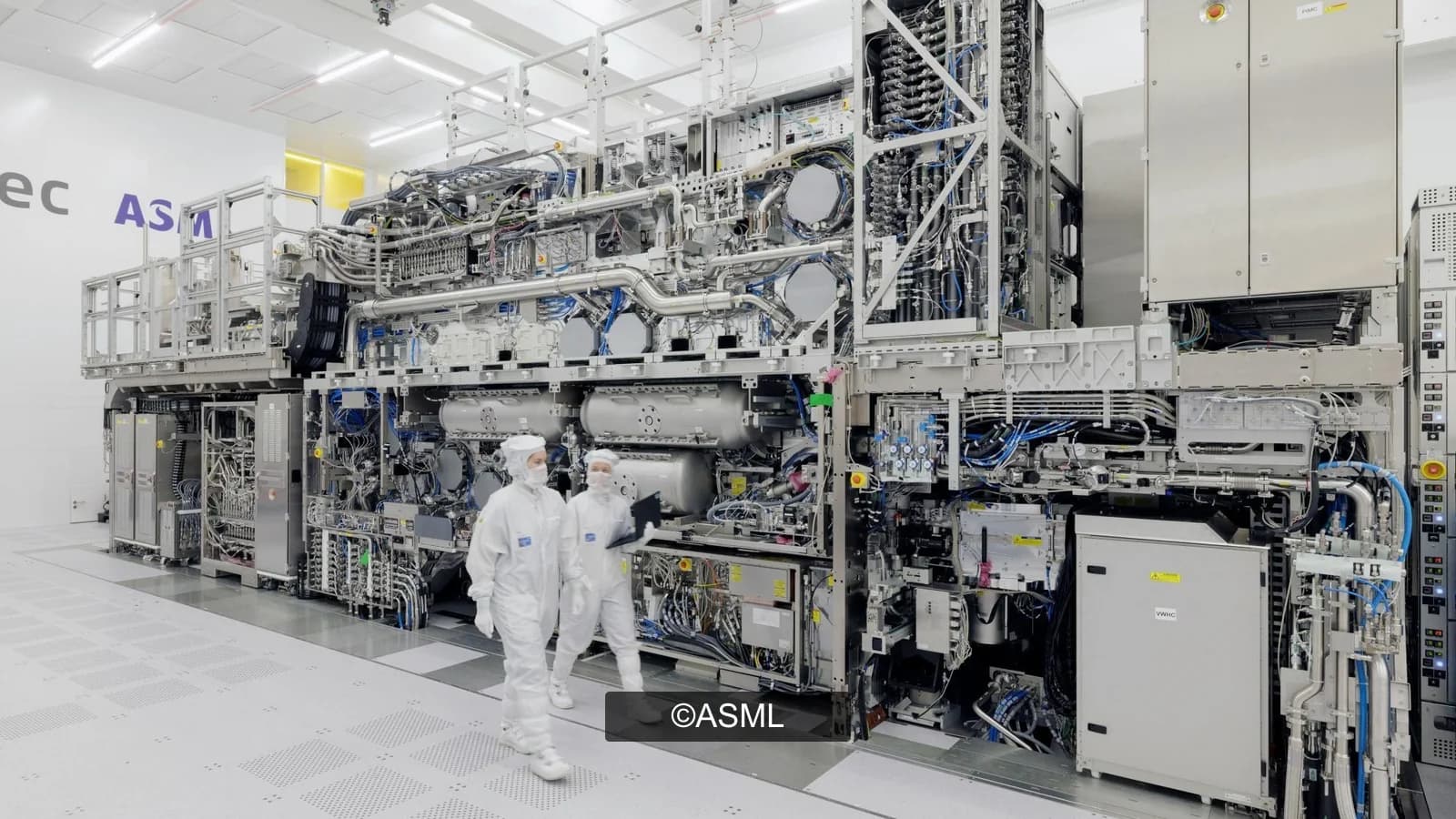
ASML Says Planned Supply Will Fall Short in 2027 and 2028
ASML says its planned supply cannot fully meet customers' demand in 2027 and 2028, despite substantial current earnings. NVIDIA's new simulation tools may shorten engineering work, but selected-task speedups do not establish additional factory output. A survey of semiconductor professionals points to staffing constraints, while US inflation adds a separate financial consideration. This edition examines what each record actually measures: equipment capacity, reported profit, computation time and consumer prices. The useful next evidence is a firmer manufacturing commitment and validated performance in real workflows, not an assumption that software has already closed the supply gap.
GlobalFoundries Targets 2028 for US AI-Packaging Components
GlobalFoundries has agreed to make AI-packaging components for TSMC in New York, but the announcement does not mean new capacity is available today. Fresh revenue figures from TSMC and preliminary earnings guidance from Samsung describe a different stage of the semiconductor business: activity already recorded. Meanwhile, NVIDIA and the US Department of Energy have announced new support for AI research. This edition separates manufacturing commitments, reported business and research funding. None is a substitute for the others, and they cannot be added into a single measure of AI demand. The useful questions concern delivery dates, the meaning of each financial figure and the results that funded projects must still demonstrate.
Applied Digital’s AI Fit-Out Revenue Runs Nearly Three Times Base Rent
Applied Digital reported $183.5 million of tenant fit-out revenue against $65.8 million of base rent in its AI-hosting business. That composition explains why rapid data-center sales growth cannot automatically be read as growth in recurring rental income. A large accounting loss, a much smaller adjusted loss and positive operating cash flow also answer different questions. This edition unpacks those distinctions before examining the newly released Fed minutes, ChatGPT's interactive-interface rollout and Haiku 5.5's lower prices. The question is how revenue from constructing infrastructure becomes durable income from using it—a transition that still depends on delivery, financing costs and actual consumption.