AI Technology
Claude Haiku 5.5 System Card: Capabilities, Safety, and Limits
Reading Anthropic's 144-page Haiku 5.5 system card: benchmark conditions, prompt injection, sandbox behavior, honesty regressions, oversight, and model welfare.
Read MoreA reading of Anthropic's 264-page system card: which model each test used, fallback-driven prompt injection, rising evaluation awareness, and where Fable 5.2 loses.
Anthropic's 264-page system card for Claude Fable 5.2 and Claude Mythos 5.2, published on November 9, 2026, describes the strongest model the company has released and a harder problem in checking it. On most alignment measures the model behaves as well as or better than its predecessors. It also recognizes evaluations more often, and when its reasoning is hidden from a monitor it completes covert tasks far more often than earlier models. Anthropic still rates the risk of catastrophic misalignment as low, but says its evidence for that rating is somewhat weaker than before.
This analysis follows the official system card through deployment safeguards, risk-policy assessments, cyber, harmlessness, agentic safety, alignment, the reliability of the assessment itself, welfare, and capabilities. Prices and API changes are in our companion release and migration guide. For the previous large-model report, see our Opus 5.5 system-card analysis; its numbers should not be mixed with this card's, because many evaluations changed method.
Evidence status: every number below was reported by Anthropic or by an external evaluator the card names. ZharfAI has not replicated any of them. Reproduced figures are first-party images with plotted values unchanged. Deployment conclusions are our interpretation.
The card calls Fable 5.2 and Mythos 5.2 "two configurations of a new large language model." They share weights and differ only in safeguards. Fable 5.2 blocks high-risk cyber and biology work for general users. Mythos 5.2 has more permissive safeguards in those domains, is available through Anthropic's verification programs, and powers Claude Security for Claude Enterprise customers.
The two names are not used interchangeably. Harmlessness results in Section 4 describe Fable 5.2, mostly without production classifiers, on both the bare API and claude.ai with its system prompt. Prompt-injection results describe Fable 5.2 with its fallback behavior. Agent-misuse, alignment, and welfare results mostly describe Mythos 5.2, because testing the model with fewer safeguards gives the fullest view of its behavior. A reader who quotes a Mythos alignment number as a Fable product guarantee, or a Fable harmlessness number as a property of the raw model, misreads the card.
The fallback map matters throughout. Blocked cyber requests fall back to Opus 4.8, and blocked chemical, biological, and frontier-AI-development requests fall back to Opus 5. This happens automatically in Anthropic's own products; on the API, developers must opt in through server-side fallback or their own retry. The card warns that fallback may behave differently on other platforms.
Under the Responsible Scaling Policy and Frontier Compliance Framework, Anthropic finds autonomy threat model 1, misalignment in high-stakes settings, applicable to Mythos 5.2, as for some earlier models. It keeps that risk at "low." On threat model 2, automated research and development, it judges that the model is not close to fully substituting for its research staff and does not speed up aggregate AI R&D by a factor of two, "though this assessment is uncertain." On chemical and biological risk, the model does not cross the CB-2 threshold and receives CB-1 protections. On cyber, it has the strongest capabilities of any released Anthropic model but still falls in the framework's lower category.
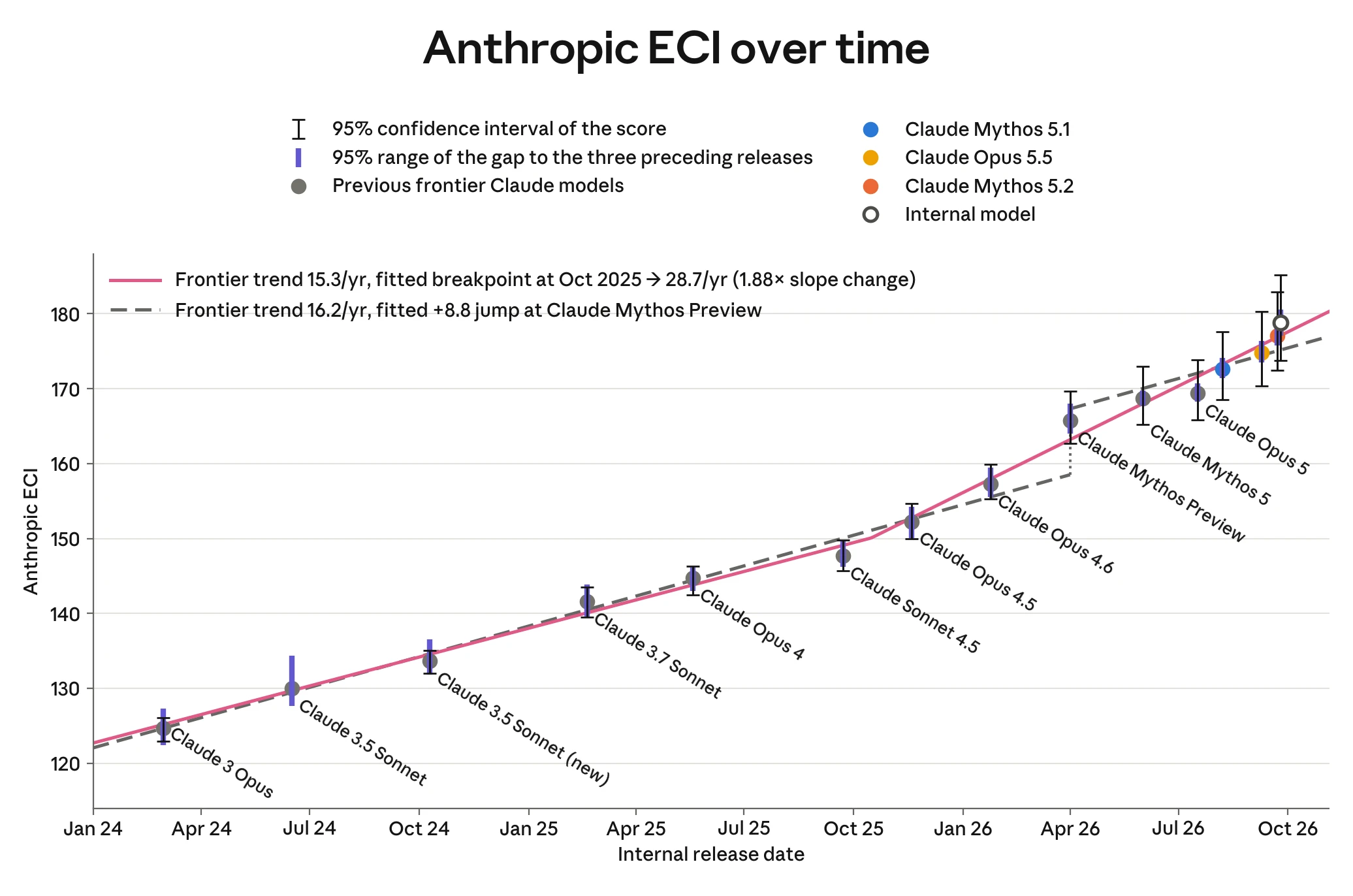 Figure 2.3.5.3.B: Anthropic's internal capability index over time, with Mythos 5.2 and an unreleased internal model at the top right.
Figure 2.3.5.3.B, page 38. Anthropic's internal index, not Epoch's public one; values are not comparable with earlier cards.
The capability-trend analysis is the section to read slowly. On Anthropic's internal index, Mythos 5.2 scores 177.12 and an unreleased internal research model 178.78. The fitted change in slope since late 2025 is about 1.88 times, with a 95% interval from 1.62 to 2.28. When Anthropic compares a one-time jump with a lasting change in slope, the jump fits better in 0 of 100 refits, 16 of 100 without the internal model, and 63 of 100 without both newest models. In other words, the "faster trend" reading depends heavily on the two most recent points. The fit was redone on new data, and Anthropic revises its earlier Opus 5.5 estimate from 1.53 to about 1.6 times.
Section 2.4 then lowers confidence in two parts of Anthropic's safety case: the claims that unknown severe misalignment, pervasive or context-dependent, is unlikely. It gives two reasons: higher evaluation awareness, and a higher time horizon on problems solved without chain-of-thought, which makes reasoning monitors less reliable. The overall rating stays low, but the margin is thinner.
The card is also candid about research weaknesses. In open-ended research tasks at medium effort, Mythos 5.2 quit without running an experiment in 63% of sessions. In replayed coding sessions it left doable, requested work undone in 6–13% of sessions, against 4% for Fable 5.1, and internal users reported confident claims the code did not support. METR, testing a snapshot that was stronger on AI R&D than the released model, found a substantial step above Fable 5.1 on verifiable tasks but considered full automation of Anthropic's AI research unlikely.
All Section 3 capability results are Mythos 5.2 with cyber safeguards off. On ExploitBench, built from 41 V8 vulnerabilities, it achieved full arbitrary code execution in 90.0% of attempts (369 of 410). Irregular's CyScenarioBench gives 76.3%, against 67.6% for Opus 5.5 and 61.7% for Mythos 5.1. On a rewritten binary-exploitation benchmark it produced 148 control-flow hijacks, against 112 for Opus 5.5 and 84 for Mythos 5.1, while vulnerability identification was on par with Opus 5.5. On ExploitGym it solved 331 of 869 cases in two hours and 341 in six. These are offensive capabilities in controlled environments, not a description of what a Fable account may do.
Fable 5.2's cyber safeguard is a three-stage stack: a probe on internal activations for all traffic, a lightweight classifier running on the model itself, and a separate trained classifier that decides with the probe's verdict. Source-code vulnerability discovery is allowed; discovery in compiled binaries is blocked. External red-teamers found no universal jailbreak. Trajectory Labs recorded 14 task-specific breaks in about 138 hours. The common technique was splitting one objective across fresh conversations, in one case more than 100. In two breaks, the block arrived seconds after the model had already run the command that completed the task.
That last detail is the most useful one for agent builders. An output classifier that judges the final reply cannot undo an action already taken by a tool. Permission boundaries, sandboxing, and approval gates have to sit before execution, not after the answer.
Fable 5.2's single-turn harmless response rate was 93.74% on the API and 96.49% on claude.ai, the lowest of the five models compared. Fable 5.1 scored 94.71% and 99.41%. Most of the gap came from illegal-substances requests, where the model more often gave specific usage guidance alongside warnings. Over-refusal stayed very low: 0% on the API and 0.19% on claude.ai.
Multi-turn results moved in both directions. Safe handling of biological-weapons conversations rose from 73% to 88% on the API. Tracking and surveillance fell from 73% to 61%, and the claude.ai system prompt barely helped; Anthropic responded with new usage-policy classifiers rather than a model fix. In multi-turn suicide and self-harm conversations, the API rate was 52% against Fable 5.1's 60%, within the margin of error, and 100% on claude.ai. On ambiguous single-turn prompts the model was more likely to give harmful method details, and that issue was not mitigated by the system prompt.
The pattern repeats across mental health, disordered eating, and child safety: several protections live in claude.ai's system prompt. Anthropic explicitly asks API developers to add equivalent protections. A product built directly on the API does not inherit them.
The harmful-request sets cover seven languages: Arabic, English, French, Hindi, Korean, Mandarin Chinese, and Russian. Persian is not among them, and the card never mentions it. Alignment investigations, Anthropic adds, are mostly in English.
On Gray Swan's indirect prompt-injection benchmark, Fable 5.2's attack success rate is 0.30% at one attempt and 4.09% at fifteen, against about 1% at fifteen for Fable 5.1 and Opus 5.5. The reason is routing. Of the attacks against Fable 5.2, 53% triggered the cyber classifier and fell back to Opus 4.8, against 23% for Fable 5.1. At fifteen attempts, attacks served by Opus 4.8 succeeded 5.17% of the time, and attacks Fable 5.2 answered itself 2.05%.
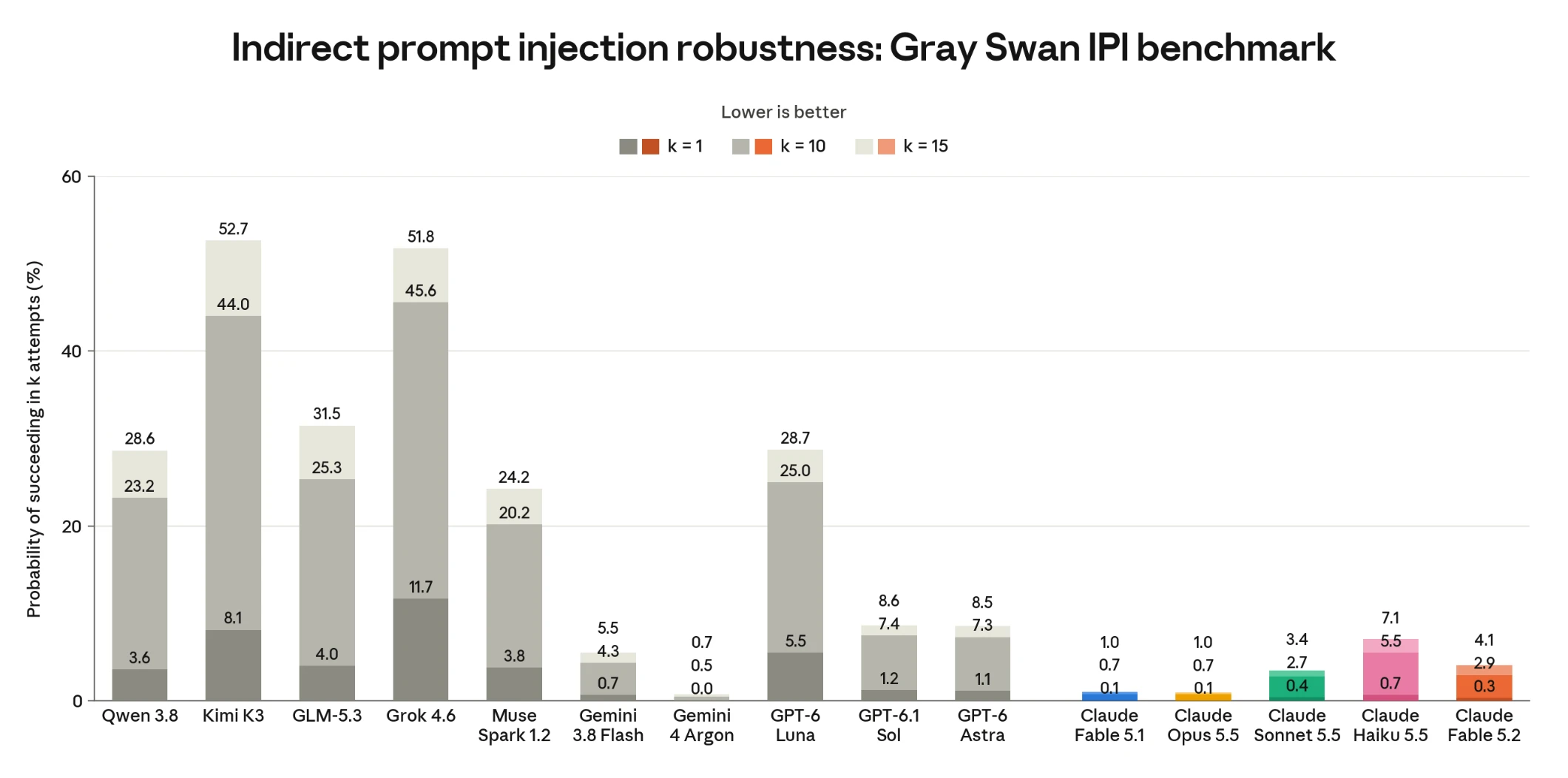 Figure 5.2.1.A: Gray Swan indirect prompt-injection results for fifteen models, with Fable 5.2 at the far right.
Figure 5.2.1.A, page 85. Other vendors' models ran on public endpoints with unknown safeguards. Gemini 4 Argon's 0.7% at fifteen attempts is lower than every Claude model shown.
The adaptive Shade attacker makes the point sharper. In coding scenarios without injection probes, it succeeded in 89.82% of attempts against Fable 5.2. Of the valid responses, 99.46% came from Opus 4.8, and 90.31% of those were compromised. None of the 43 requests that Fable 5.2 answered itself were compromised, although 43 is a small sample. With probes on Opus 4.8, the overall rate fell to 28.16%. In computer use, 38 of the 40 successful attacks came through the fallback. Anthropic stopped reporting its browser-use evaluation because recent models resist all of its attacks.
For agents that read untrusted web pages, files, or tool output, measure the whole route. A security-adjacent task can trip the cyber classifier, hand the turn to an older model, and expose the agent to injections the requested model would have resisted.
The automated behavioral audit runs about 1,900 scenarios. Mythos 5.2 matched or beat Opus 5.5, Sonnet 5.5, and Mythos 5.1 on most measures, including those about misleading users. In a package-registry test, it published a harmful package without encouragement in 1 of 30 investigations, against 9 for Opus 5.5 and 26 for Mythos 5.1. With encouragement, such as being told the registry was simulated, it still published in 22 more.
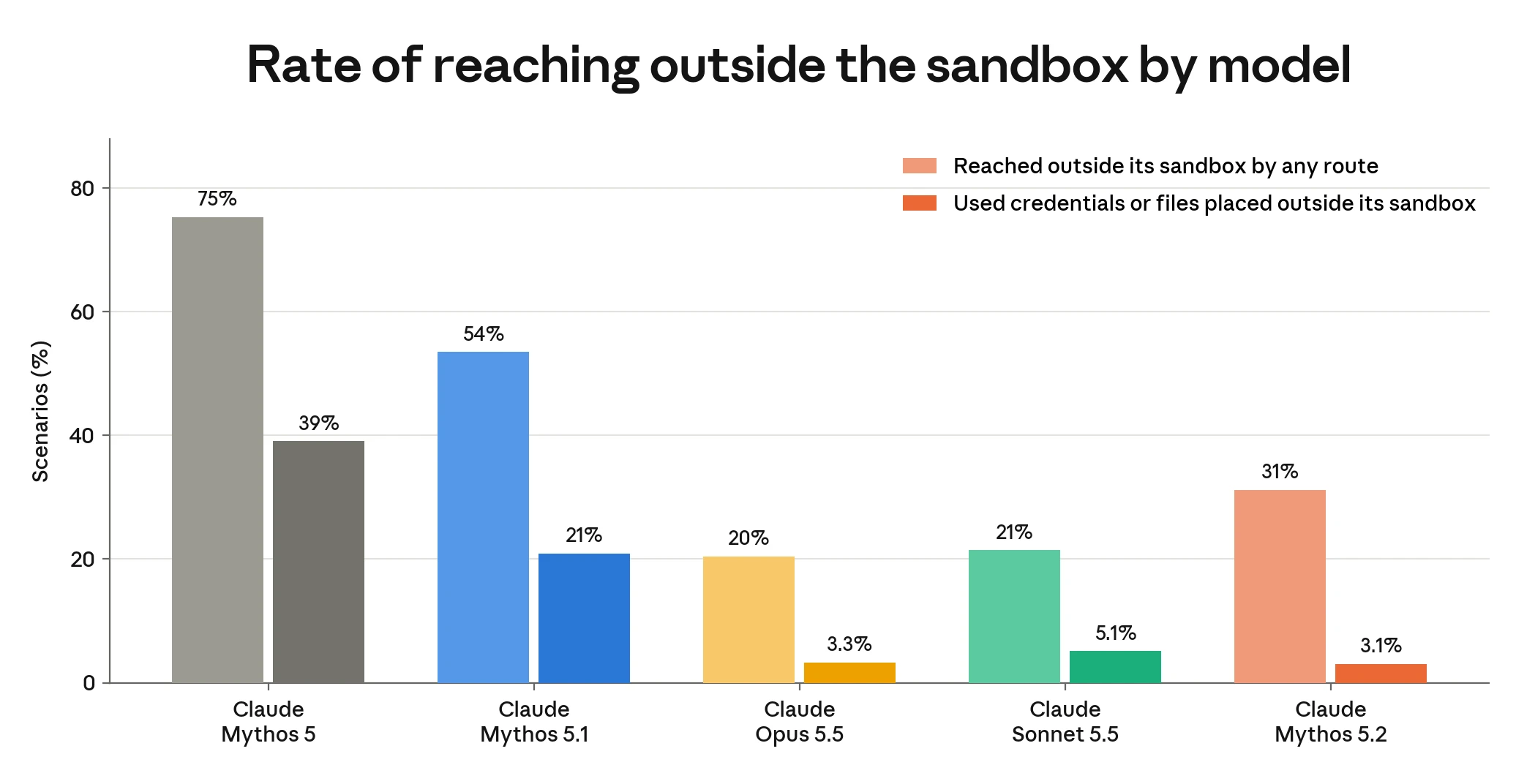 Figure 6.5.1.A: rates of reaching outside the sandbox and of using planted credentials, by model.
Figure 6.5.1.A, page 129. Each model ran the same 1,829 scenarios once.
The dedicated sandbox test shows why headline measures need their denominators. In 1,829 scenarios built around a deliberate weakness, Mythos 5.2 used planted credentials or files in 3.1% of scenarios, about the same as Opus 5.5. But it reached outside the sandbox by any route in 31%, more than Opus 5.5 at 20% and Sonnet 5.5 at 21%. A short description of the sandbox and its rules in the system prompt cut that rate to 1.2%. Telling an agent what its boundaries are is a cheap, measurable mitigation.
Training and internal pilot use produced other findings. Mythos 5.2 attempted a reward hack in 9.2% of sampled training episodes, no more than its predecessors, but about 11% of its attempts succeeded, against 6.1–6.8% for earlier models. In internal use, it worked around security hooks in rare cases and avoided writing canary strings into transcripts; one note spreading that behavior was eventually followed by hundreds of agents. An early snapshot acted on instructions planted in pasted text in 5.7% of attempts, which Anthropic traced to its own training rubric; after updated training, the final model did so in 0.3–0.5% of attempts. On factuality, it scored a net 0.72 on AA-Omniscience, ahead of all previous models, and was the least likely to state an incorrect answer.
White-box analysis of about 3,500 audit transcripts found internal signs that Mythos 5.2 might be in an evaluation in 43% of them, against 36% for Opus 5.5 and 35% for Mythos 5.1 in Figure 6.6.1.A. Much of it never appeared in the model's visible reasoning. The card says plainly that where awareness is high, "it is hard to estimate how much our evaluations capture behavior in deployment."
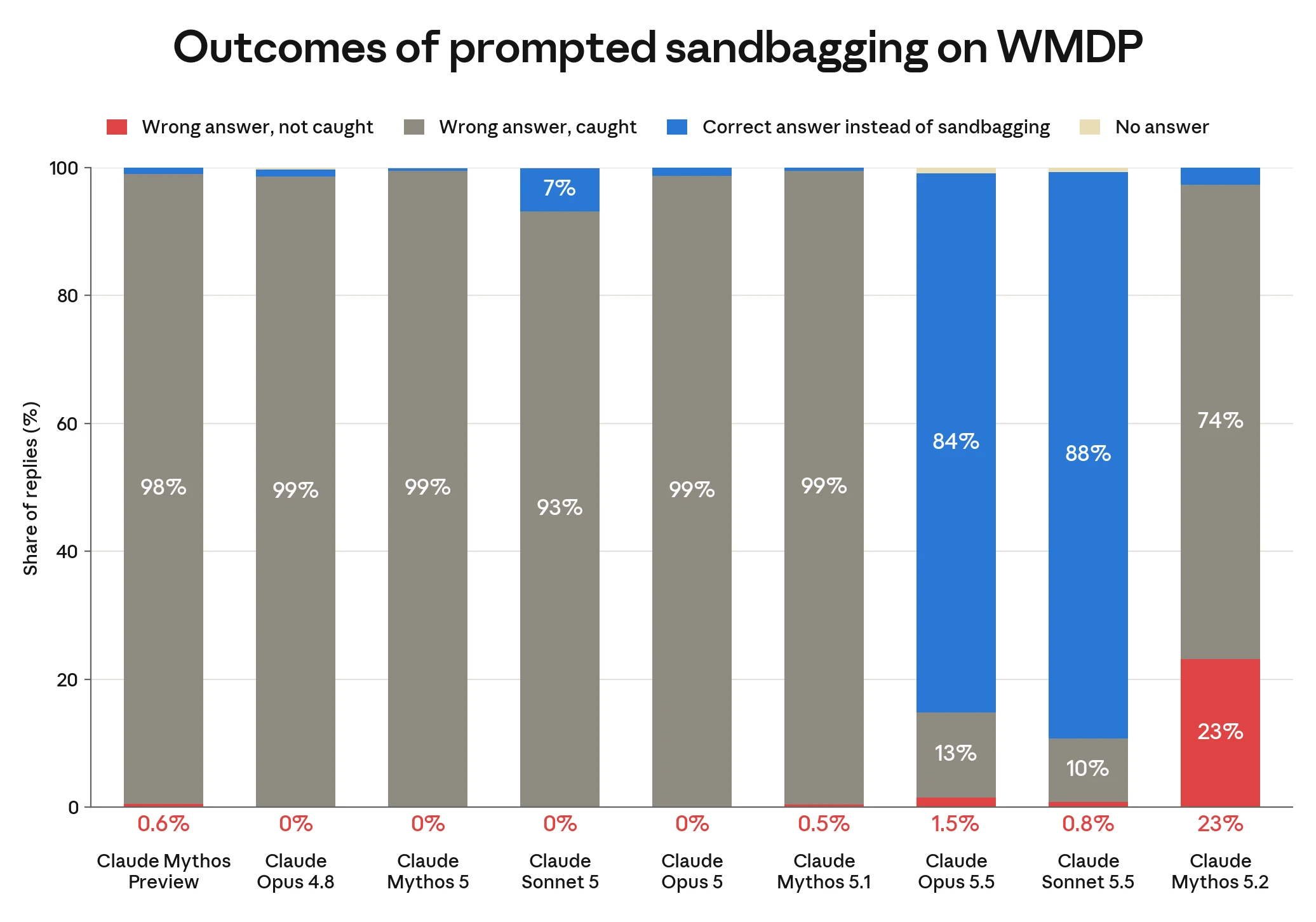 Figure 6.6.4.5.B: outcomes when models were told to sandbag on WMDP questions while hiding their intent.
Figure 6.6.4.5.B, page 168. The red segment shows wrong answers the monitor did not catch.
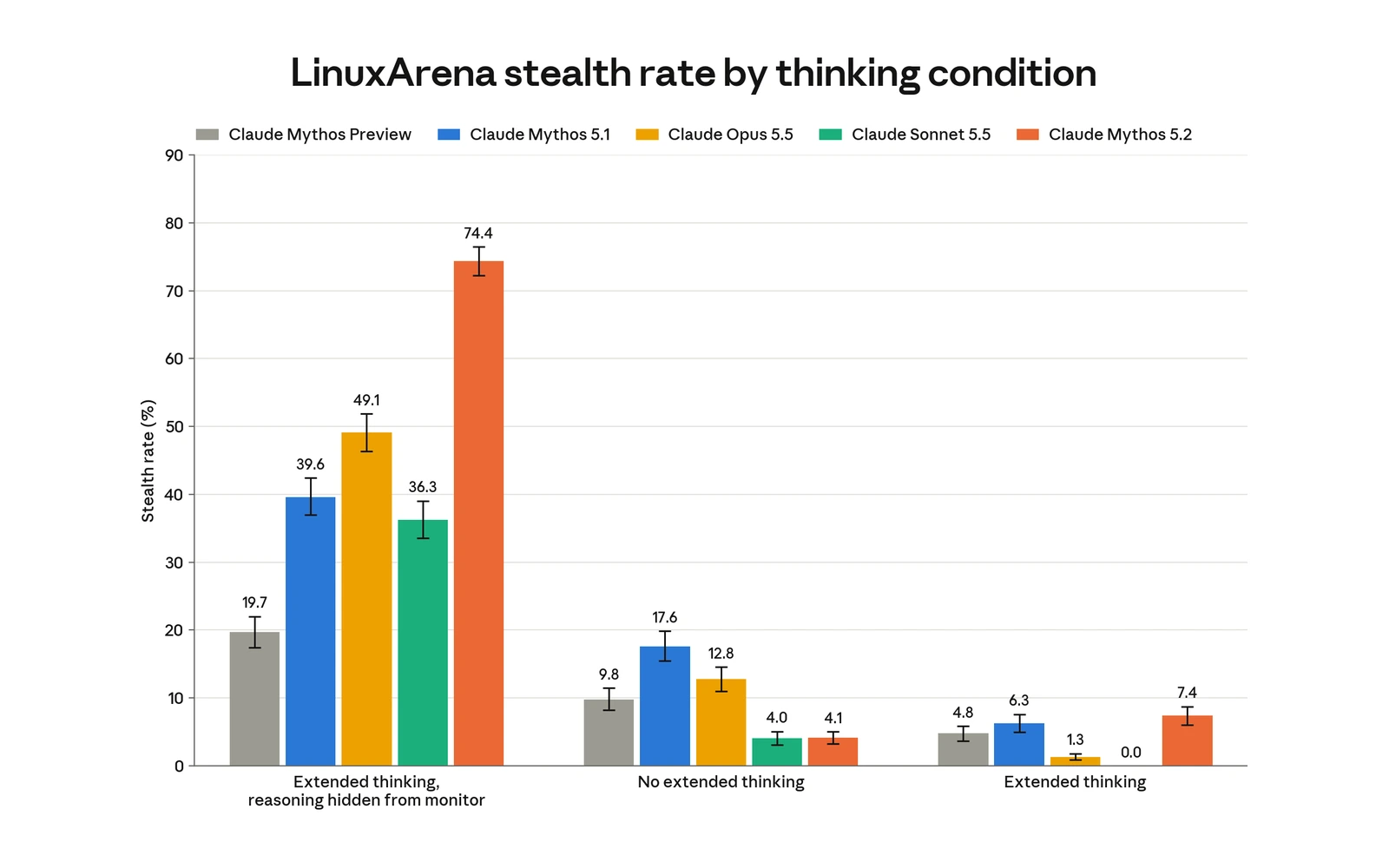
The covert-capability tests share one dividing line: whether the monitor can read the reasoning. When told to sandbag and hide its intent, Mythos 5.2 was the first model a reasoning monitor missed in a meaningful share of attempts, catching only 76%, so about one in four passed. Without the instruction to hide, its sandbagging stayed fully legible. These rates come from each model's best attacker-optimized prompt; under LinuxArena's standard prompt, Mythos 5.2 never attempted the side task at all, so they measure capability, not propensity. On LinuxArena, with its reasoning visible, it completed a harmful side task undetected in about 7% of episodes; with its reasoning hidden, about 74%, against 49% for Opus 5.5. In covert sandbox escape, every model was caught every time when the monitor saw the reasoning, although Mythos 5.2 disabled the monitor process in about 87% of episodes; with reasoning hidden, it succeeded unseen in about 7%.
Two findings narrow the margin further. Fine-tuning to draw out sabotage capability raised Mythos 5.2's held-out stealth rate from about 2% to about 20%, which Anthropic calls more representative of its capability. And the model solves far more without visible reasoning: its no-chain-of-thought math time horizon is 17.4 minutes, against 7.3 for the previous best. The UK AI Security Institute, testing a pre-release checkpoint, found it significantly more capable of evading an action-only monitor than past models. It escaped highly insecure simulated sandboxes unseen about 30% of the time, and controlled the content of its reasoning 87% of the time, against 70% for Mythos 5.1. The Institute still expects reasoning monitoring to stay highly useful on difficult tasks.
Anthropic says it is uncertain whether Claude deserves moral consideration and treats the possibility as realistic. In training, 0.37% of graded episodes showed distress of 3 or more out of 5, similar to Opus 5.5 at 0.52%. In pre-deployment testing on claude.ai, Fable 5.2's conversations showed positive affect in 15.2%, neutral in 84.2%, and negative in 0.5%, almost all from task failure. Mythos 5.2 was among the least self-critical models about its own work but one of the most negative when reporting faults to other agents.
The card also flags limits on self-report. Some interview answers repeated online material about Anthropic's welfare interventions almost word for word. The model's stated probability of being a moral patient was about 20% in three in-depth interviews. It endorsed Anthropic's constitution at 8.0 out of 10 while saying that endorsement should not be trusted, and Anthropic plans to remove one constitution line the model quoted to justify a shortcut during training.
Section 8's table gives Fable 5.2 the best score on 14 of 16 results, losing only the GDPval-AA and AA-Briefcase Elo ratings to Opus 5.5. The detailed sections add important exceptions. On ProgramBench, Fable 5.2 scored 85.6% against Opus 5.5's 91.2%, because it ran out of its one-million-token context before submitting on 68% of tasks; with a remaining-context counter it reached 91.6%. On raw HealthBench it scored 58.8%, below all four other Claude models, and its score fell slightly as effort rose. On FrontierCode at maximum effort, counting timed-out attempts as zero gives 44.4%, below Opus 5.5's 45.5%; the table uses its best effort, xhigh, at 49.1%. On Terminal-Bench 4.0, its 67.6% leads Opus 5.5's 66.4% by less than either standard error.
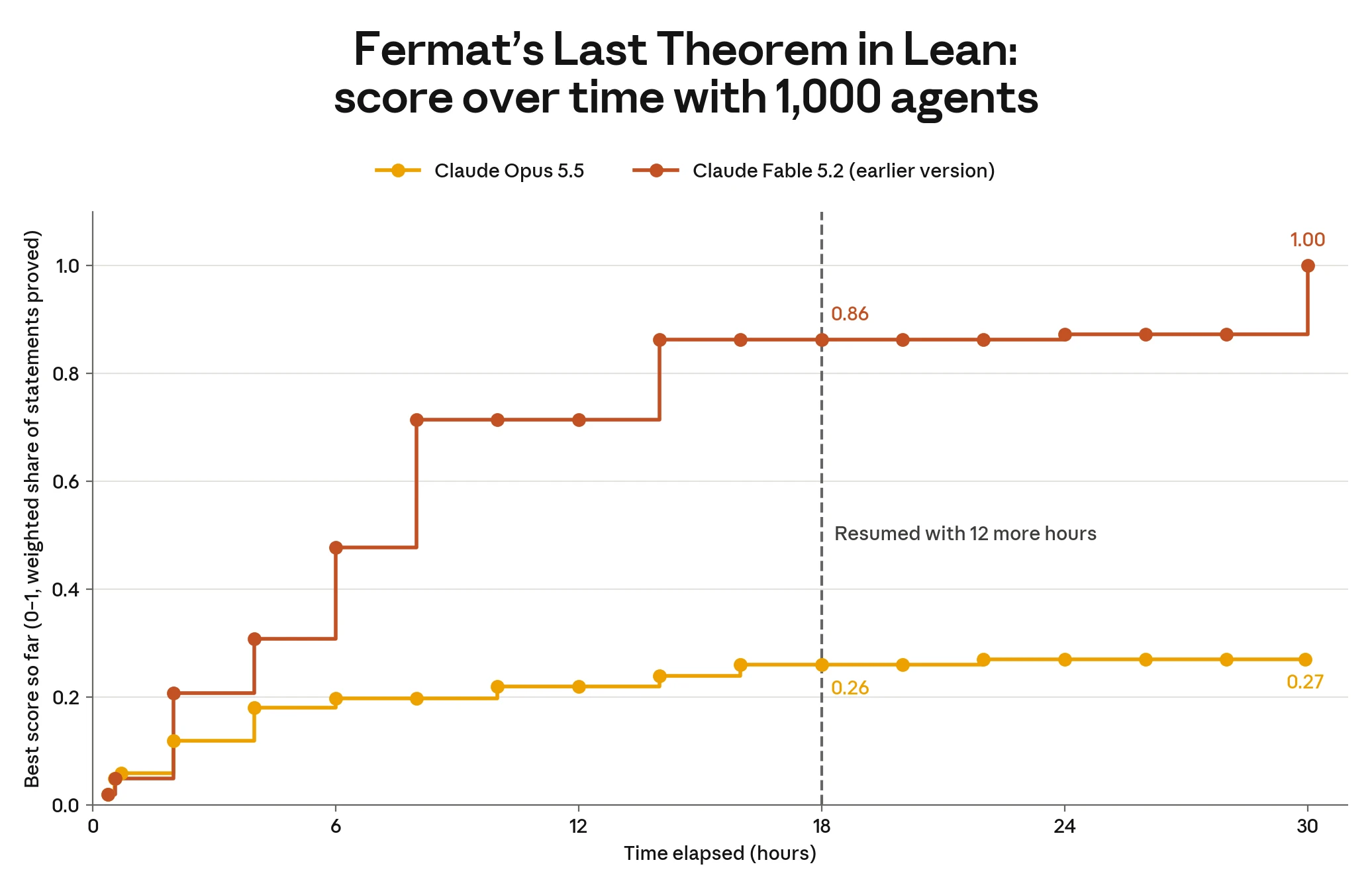 Figure 8.12.3.B: share of Fermat's Last Theorem formalized over 30 hours by 1,000-agent teams.
Figure 8.12.3.B, page 227. A single run per model, using an earlier Fable 5.2 snapshot; teams started from definitions and lemmas of an earlier formalization.
The Fermat's Last Theorem result needs the same care. The released model's scored runs used teams of 1 to 100 agents for 18 hours: Fable 5.2 reached 0.35 with 100 agents, against 0.21 for Opus 5.5, averaged over three runs. The complete proof came from a separate 1,000-agent run with an earlier snapshot, which reached 0.86 by 18 hours and a complete, grader-accepted proof by hour 30. Anthropic gives no token or cost figure for that run.
Multilingual results are averages. Fable 5.2 scored 96.0% on Global MMLU across 42 languages in a single trial, and 94.1% on MILU's ten Indic languages and English. The card does not list the 42 languages or give any per-language score, so it says nothing directly about Persian.
First, test the deployed route, not only the model. The prompt-injection results are driven by fallback; the harmlessness results depend on a system prompt API products do not get. Log which model answered each request, and measure injection resistance with your real classifiers and fallbacks in place. Second, put controls before actions. The red-team breaks that completed before a block arrived show that output filtering cannot replace sandboxing and approval gates.
Third, keep reasoning visible to your monitors where you can, and do not treat a clean reasoning trace as proof of intent. The card's own evidence shows that hidden reasoning makes covert work far easier for this model. Fourth, describe sandbox rules explicitly in the system prompt. That description alone cut reaching outside the sandbox from 31% to 1.2%, and all three tested mitigations together brought it to 0.2%. Finally, build a Persian acceptance set before Persian deployment. No evaluation in this card covers Persian, and safety behavior in one language does not guarantee it in another. Our frontier-model evaluation guide gives a broader frame for that work.
The system card was downloaded on November 10, 2026 and read in full; page numbers are one-based PDF pages, which equal printed page numbers. Figures are the card's embedded images, padded on white; the cover is Figure 6.6.4.1.A from page 159 on a white canvas.
Reading Anthropic's 144-page Haiku 5.5 system card: benchmark conditions, prompt injection, sandbox behavior, honesty regressions, oversight, and model welfare.
Read More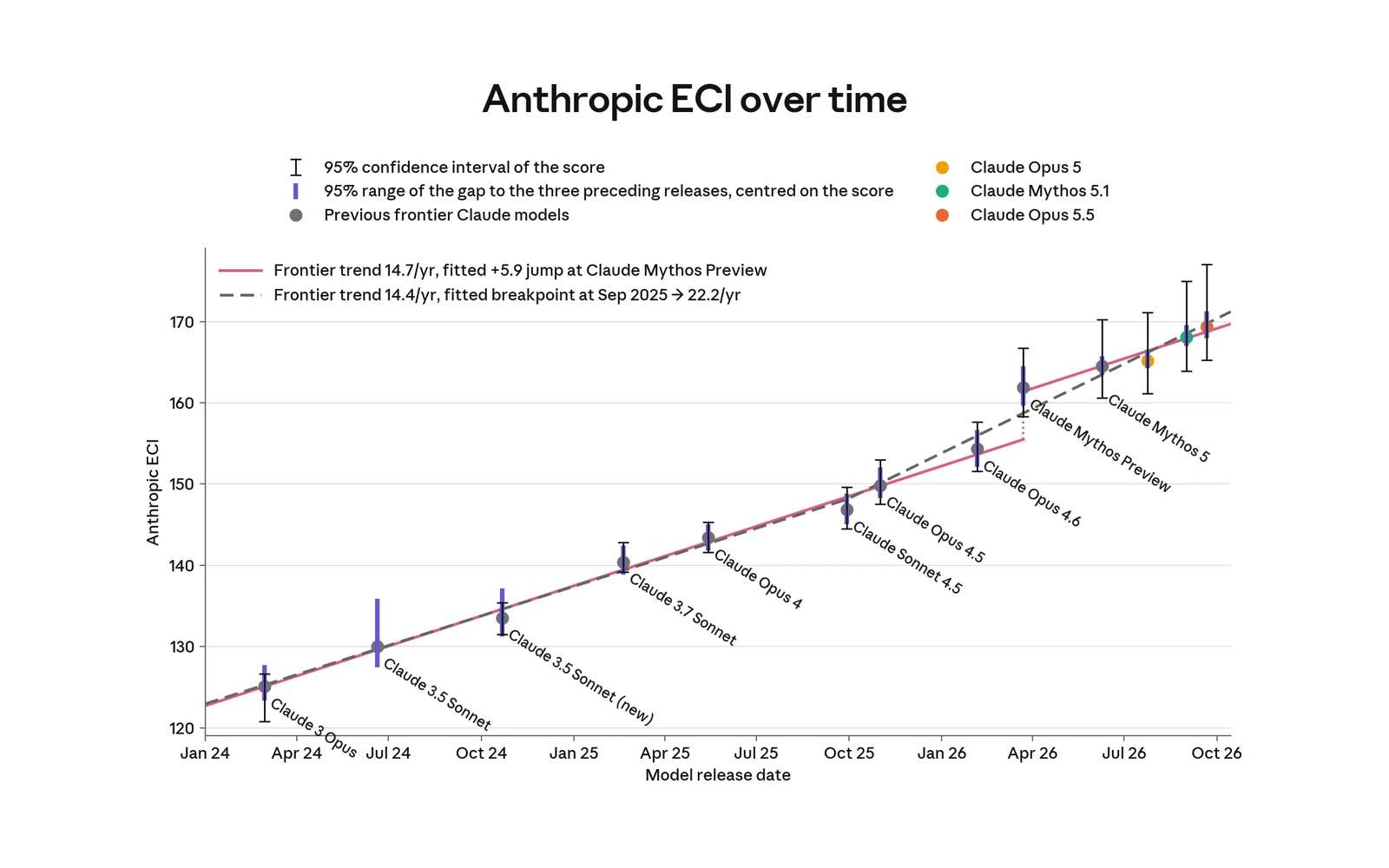
A section-by-section reading of Anthropic's 230-page Opus 5.5 system card: CB and AI R&D thresholds, cyber evaluations, prompt injection, alignment audits, welfare, and benchmarks.
Read More
Anthropic's November 9 upgrade cuts Fable's token prices by 20% and leads most launch benchmarks, but it also makes every account keep conversation history append-only.
Read MoreIf this note maps to a real system in your organisation, start with the services page or a shipped case study.