Anthropic released Claude Fable 5.2 and Claude Mythos 5.2 on November 9, 2026. As in the previous two generations, they are one underlying model offered under two access regimes. Fable 5.2 is open to every Claude API customer and carries classifiers that block high-risk cybersecurity and biology work. Mythos 5.2 has more permissive safeguards in those domains and is available only to organizations verified through Anthropic's Cyber and Life Sciences Verification Programs.
The launch announcement leads with three changes: stronger coding, reasoning, and vision; output up to 30% faster than the 5.1 models; and a lower price of $8 per million input tokens and $40 per million output tokens, down from $10 and $50. In the system card's summary table, Fable 5.2 has the best score on 14 of 16 reported results. The two exceptions are both knowledge-work Elo ratings, where Opus 5.5 stays ahead.
This article covers the deployment decision: specifications, prices, benchmark conditions, API changes, and safeguards. Our companion system-card analysis reads the 264-page safety and capability report section by section. For the previous generation, see our Fable 5.1 and Mythos 5.1 analysis.
Evidence status: every benchmark and demonstration below was reported by Anthropic or by an early tester Anthropic quotes. ZharfAI has not rerun any evaluation. Cost examples are list-price arithmetic, not measured bills.
The technical card at a glance
The official model overview and the what's-new guide give these specifications. Fable 5.2 and Mythos 5.2 share them except for access and rate limits.
| Field | Claude Fable 5.2 |
|---|
| Release date | November 9, 2026 |
| Claude API ID | claude-fable-5-2 (Mythos: claude-mythos-5-2) |
| Amazon Bedrock ID | anthropic.claude-fable-5-2 |
| Input and output | Text and images in; text out |
| Context window | 1 million tokens |
| Maximum output | 128,000 tokens per request |
| Thinking | Adaptive thinking, always on |
| Effort levels | low, medium, high, xhigh, max; API default high |
| Reliable knowledge and training-data cutoff | June 2026 |
| Earliest retirement | Not sooner than November 9, 2027 |
Fable 5.2 runs on the Claude API, Amazon Bedrock, Claude Platform on AWS, both Google Cloud offerings, and Microsoft Foundry on Anthropic infrastructure. Mythos 5.2 is listed on the same platforms except Claude Platform on AWS. Fable 5.2 gets its own rate limit, separate from the combined limit that Fable 5.1 and Fable 5 share. Mythos 5.2 shares one limit with Mythos 5.1 and Mythos 5. The migration guide adds that Fable 5.2 has lower token limits than Opus 5.5 at each usage tier, so traffic should not be moved before quotas are checked.
Prices fall 20%, but Opus 5.5 is still half the cost
The pricing documentation lists these rates in US dollars per million tokens. Fable 5.2 and Mythos 5.2 cost the same.
| Token type | Fable 5.2 | Fable 5.1 | Opus 5.5 |
|---|
| Base input | $8 | $10 | $4 |
| Output | $40 | $50 | $20 |
| Cache read | $0.20 | $0.25 | $0.20 |
| 5-minute cache write | $10 | $12.50 | $5 |
| 1-hour cache write | $16 | $20 | $8 |
| Batch input / output | $4 / $20 | $5 / $25 | $2 / $10 |
| Fast mode input / output | $16 / $80 | — | $8 / $40 |
Cache reads stay at 0.025 times the base input price, the same multiplier as on the 5.1 models. Because the base fell, the cached rate fell from $0.25 to $0.20, which now equals Opus 5.5's cache-read price. Fresh input and output remain twice Opus 5.5's rates.
Consider one long agent turn with a 200,000-token cached prefix, 10,000 fresh input tokens, and 5,000 output tokens, with no cache writes, tools, or retries. At list prices it costs $0.32 on Fable 5.2, $0.40 on Fable 5.1, and $0.18 on Opus 5.5. The example holds token counts constant. In practice they will not be equal, because Fable's default effort is high while Opus 5.5 defaults to medium, and each model spends a different amount of thinking on the same task.
Fast mode raises output tokens per second by up to 2.5 times, according to the fast-mode documentation. The gain applies to generation speed, not to time to first token, and it costs twice the standard rate. On Microsoft Foundry it is a separate deployment named claude-fable-5-2-fast. Mythos fast mode is limited to organizations in the verification programs.
Benchmarks: a broad lead with stated conditions
The table below combines the launch table with Table 8.1.A of the system card. Unless noted, Fable results use maximum effort, default sampling, five trials, and production safeguards turned on. The Terminal-Bench-Science row comes from the launch page and Section 8.6, where each task ran ten times.
| Evaluation | Fable 5.2 | Fable 5.1 | Opus 5.5 | GPT-6 Astra |
|---|
| SWE-bench Pro | 93.0% | 81.2% | 89.9% | — |
| FrontierCode 2.0 (best effort) | 49.1% | 32.4% | 45.5% | 42.8% |
| FrontierSWE v2 | 69.9% | 56.3% | 62.3% | 65.5% |
| Terminal-Bench-Science 0.1 | 74.6% | 52.6% | 58.7% | 68.1% |
| AutomationBench | 51.4% | 31.4% | 42.5% | 41.4% |
| Remote Labor Index | 41.3% | 17.9% | 21.3% | 20.8% |
| Humanity's Last Exam, with tools | 74.2% | 65.6% | 67.7% | 57.2% |
| OSWorld 2.1 (offline, partial) | 89.3% | 83.5% | 87.2% | 79.5% |
| Chartography, no tools | 73.4% | 44.8% | 64.4% | 71.0% |
| GDPval-AA v2.1 (Elo) | 1831 | 1763 | 1866 | 1584 |
| AA-Briefcase v1.1 (Elo) | 1785 | 1669 | 1800 | 1569 |
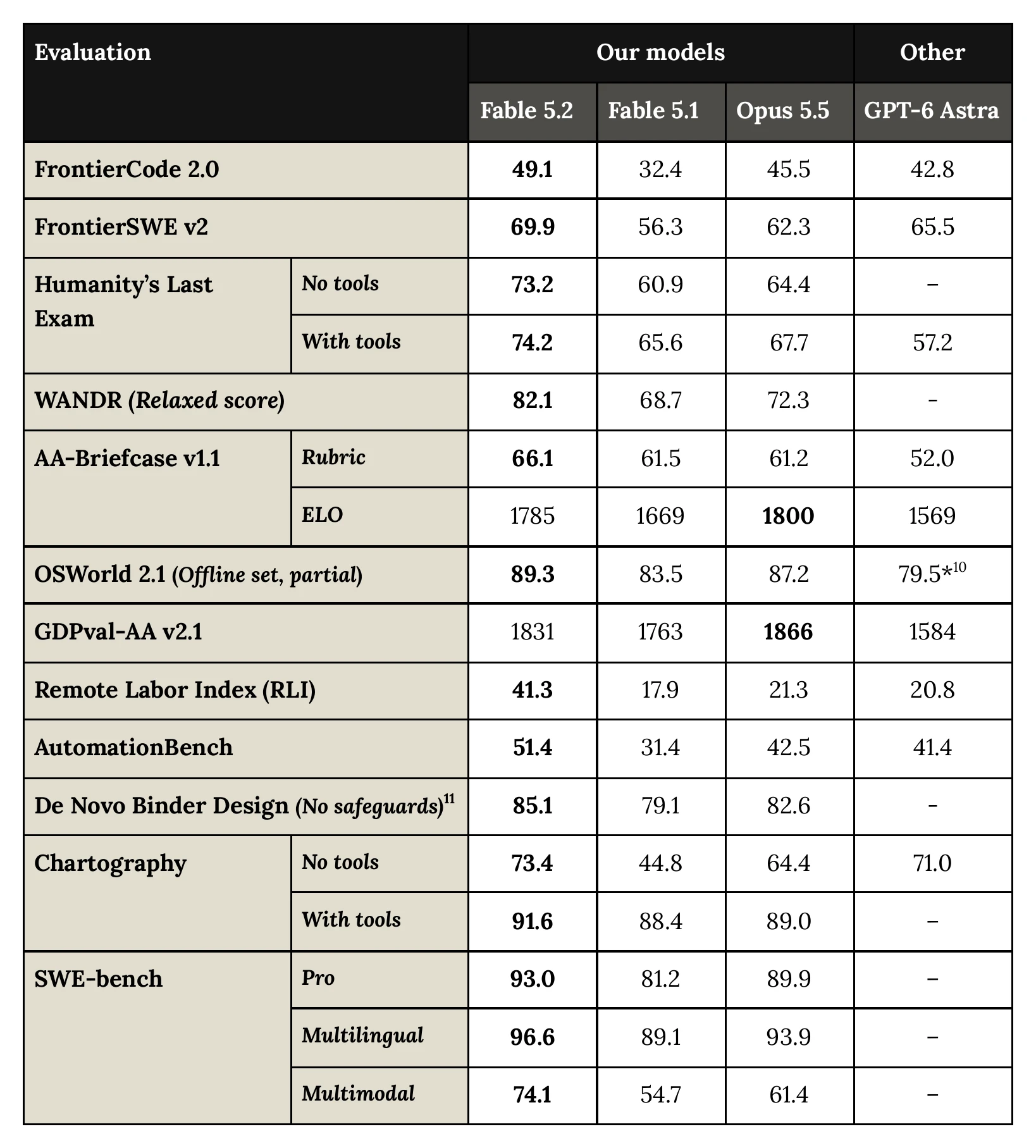 Table 8.1.A from Anthropic's Fable 5.2 and Mythos 5.2 system card, showing Fable 5.2 against Fable 5.1, Opus 5.5, and GPT-6 Astra.
First-party evidence: Table 8.1.A, system card page 207. The De Novo Binder Design row, printed under the Fable headers, is Mythos 5.2 without safeguards; a final CVE Rediscovery row of the same kind continues on page 208. These are the vendor's release runs, not an independent leaderboard.
Three conditions matter when reading the table. First, FrontierCode reports each model's best effort level: xhigh for both Fable models and max for Opus 5.5 and GPT-6 Astra. The Remote Labor Index uses default effort. Second, the announcement adds a Gemini 4 Carbon column that the system card's summary table does not carry, and Gemini's 53.9% on AutomationBench is above Fable 5.2's 51.4%. Third, the cybersecurity and protein-design rows on the launch page are Mythos 5.2 without safeguards. Fable 5.2's classifiers block most cybersecurity tasks, so those rows do not describe what a general Fable account can do.
The largest moves are on long, checkable work. SWE-bench Pro rises 11.8 points over Fable 5.1. The Remote Labor Index, which asks whether a freelance project was completed at least as well as a human professional, more than doubles from 17.9% to 41.3%. Terminal-Bench-Science gains 22 points. Teams evaluating Fable for document-heavy knowledge work should notice that Opus 5.5 still leads both Elo ratings.
Deeper in the card, Fable 5.2 also trails Opus 5.5 on ProgramBench, a long-context program-reconstruction test: 85.6% against 91.2%. It ran out of context before submitting on 68% of tasks. When the harness showed the remaining context after each step, its score rose to 91.6%. The lesson is about the harness as much as the model: a long-running agent needs to see its own budget.
Effort settings change the cost of each result
Anthropic's announcement plots accuracy against cost per task for several evaluations. On FrontierCode 2.0, Fable 5.2 at high scores 45.3%, about level with Opus 5.5's best score of 45.5%, for roughly half the cost per task. On Perplexity's WANDR search benchmark, Fable at medium matches Opus 5.5's top score for about 40% of the cost. On Humanity's Last Exam with tools, Fable at low matches Opus 5.5's top score for less than one-tenth of the cost. On Chartography, Fable at medium scores 66.4% against Opus 5.5's 64.4% at max.
These comparisons pit a Fable setting against Opus 5.5 at its most expensive setting. They show that the newer model can buy the same score with fewer tokens. They do not show that Fable is cheaper than Opus 5.5 at Opus's default effort. A routing decision needs both models measured at the efforts a production system would actually use.
The effort documentation recommends starting at the API default of high, where most of the gain already appears, and reserving max for measuring the ceiling. The prompting guide adds that xhigh raised internal coding scores slightly while using many more tokens, and that Fable 5.2 at low scored close to Fable 5.1 at higher efforts. Claude's own apps and Claude Code default to medium, so a result seen in the app is not necessarily the API default.
Long-horizon demonstrations, and how far they generalize
The announcement describes several prerelease projects. A team of about 1,000 Fable 5.2 agents formalized Fermat's Last Theorem in Lean in 30 hours. Anthropic's first formalization, with an unreleased research model, a purpose-built harness, and human guidance, took 11 days. Opus 5.5, in the same 1,000-agent setup, completed 26% of the formalization in 18 hours and made little further progress by 30. The system card adds that the run used an earlier snapshot and built on definitions and smaller proven results from the earlier formalization.
Other Fable examples include a prototype operating system written by more than 1,000 coordinated subagents over eight days, a Python-to-Rust migration of a production service that now starts about 26 times faster, three working electronic devices designed with the circuit-board maker Diode, and solutions to two open problems in black-hole physics posted as preprints. Mythos 5.2, working on biology, devised a protein-structure method that accurately modeled 28 of 34 virus capsids it attempted. On the RoboDojo robot-control simulation, Fable 5.2 scored 64.9% against GPT-6 Astra's 29.8% and Fable 5.1's 27.6%, in Anthropic's internal runs.
Most of these are single runs on tasks the vendor chose. They show what the model can complete under supervision, a strong harness, and a large compute budget. They are not an acceptance rate for an arbitrary codebase or laboratory. Measure that on your own tasks, with the same evidence gates a human contributor would face.
Four breaking changes from Fable 5.1
The what's-new guide lists four changes that can break working code.
- The prefix check now applies to every account. If anything before a Fable 5.2 thinking block changes, such as the system prompt, the tools array, or an earlier message, a request that sends that block back returns a 400 error with the message
The block is bound to a different conversation. On Fable 5.1, only accounts created on or after August 31, 2026 got this error, so older accounts that edit history can fail only after the switch.
- Only Fable 5.2 and Mythos 5.2 can read Fable 5.2 thinking blocks. Fable 5.2 reads blocks from earlier models, but no other model reads its blocks. That includes Opus 5.5, Fable 5.1, and Fable 5.2's own fallback models, Opus 4.8 and Opus 5. The API drops unreadable blocks without billing them, so a fallback turn succeeds without the earlier reasoning.
- The
computer_20251124 tool returns a 400 error on every platform except Amazon Bedrock. Use the computer_toolset_20260801 toolset instead.
- The advisor tool needs a matching advisor. A Fable 5.2 or Mythos 5.2 executor accepts only Fable 5.2 or Mythos 5.2 as its advisor. Changing the advisor's model is an edit to
tools, so make the change in new conversations.
Several rules carry over from Fable 5.1: adaptive thinking cannot be disabled, forced tool choice returns a 400 error, assistant prefill is rejected, and temperature, top_p, and top_k should be omitted. In organizations with customer-managed encryption keys, structured outputs are unavailable. Neither model supports Priority Tier. Thinking blocks are also bound to the account that produced them, so replaying stored conversations through a different account loses their reasoning.
The safe pattern is an append-only history. Keep system and tools fixed, only add messages, and return each assistant turn exactly as received. To change instructions or tools mid-conversation, use the beta mid-conversation system messages and tool changes. To shorten a long history, use compaction on demand or context editing. The drop_block setting avoids the 400 error, but the guide calls it a stopgap because dropped reasoning can raise output tokens.
Behavior changes that need tests, not assumptions
The prompting guide records behaviors that appear without any code change. A line such as "answer directly without deliberating" no longer stops thinking at medium and above. At high the model thinks before almost every reply, including a greeting. A request with a small max_tokens can therefore end after a thinking block with no text.
On long tasks at low and medium effort, the model sometimes ends a turn with a list of remaining work or an offer to continue. Anthropic's suggested "finish the work" prompt halved such endings in replayed coding sessions but raised output tokens by about 30%. Prompts about code ownership also matter. When the prompt said the code base was the model's own, it merged repeated code in about half of small coding tasks, against under a tenth without that sentence. It also used about 1.5 times the output tokens and changed an existing feature's behavior in one try in six to ten.
Two observations matter for multi-agent systems. At xhigh and max, Fable 5.2 sometimes starts subagents to review its own work, and subagents can account for a large share of session cost. Cautious notes and rules also accumulate in memory files and messages between agents. In one Anthropic test, a single approval rule about messaging people outside the conversation made the model hold back roughly half of its routine requests to colleagues. Review inherited instructions before migration, and name exactly which actions need approval.
Safeguards, fallback, and data retention
Fable 5.2's classifiers block high-risk cyber activity, including penetration testing, exploit generation, and binary-based vulnerability work, as well as most tasks in research biology. In Anthropic's products, blocked requests receive an answer from Opus 4.8 for cybersecurity and from Opus 5 for biology. In early testing across claude.ai, Claude Code, and Cowork, Anthropic observed about 55% fewer blocks than with Fable 5.1: about 60% fewer in cybersecurity and 40% fewer in biology.
On the API, a declined request returns HTTP 200 with stop_reason: "refusal" and a category: cyber, bio, frontier_llm, reasoning_extraction, or general_harms. The refusals and fallback guide describes server-side fallback, which is in beta and permits only Opus 4.8 and Opus 5 as Fable 5.2 targets. A reasoning_extraction refusal has no fallback. Log which model produced each answer. A blocked request that falls back can produce a fluent reply from a different, older model.
Anthropic also limited, during training, the research capabilities that could most directly accelerate AI development. In areas such as accelerator kernel optimization and language-model architecture, it says Fable 5.2 performs at about Opus 5.5's level, and a small set of these topics falls back transparently to Opus 5. Its anti-distillation techniques reduced the data harvested by distillers by 90% to 99%, and preserved thinking now applies to every account.
Both models require 30-day data retention and are unavailable under zero data retention unless Anthropic expressly authorizes it. Without that retention, every Claude API request returns a 400 error. Enterprise Frontier Safeguards, now in private beta, runs the safety monitoring on prompts and responses stored in the customer's own infrastructure, and eligible customers can keep zero retention while they implement it. Teams with confidential or regulated data should settle retention terms before uploading an evaluation set.
Where Fable 5.2 fits in a routing plan
Anthropic itself recommends starting most coding and knowledge tasks on Opus 5.5 and moving up to Fable or Mythos only when the work requires it. The what's-new guide repeats the point: switch when your evaluations of Opus at higher effort still fall short. Fable 5.2 can also act as an advisor that cheaper models consult, or as an orchestrator that delegates simpler steps.
A practical routing design therefore sends hard, long, verifiable tasks to Fable and keeps routine traffic on Opus, Sonnet, or Haiku. Measure cost per accepted task, not cost per token. Include the price of reviewer time, failed runs, and fallback answers. Our earlier Opus 5.5 release analysis covers the model that remains the default recommendation.
A Persian deployment needs its own acceptance set
The launch materials report no Persian-specific result, and ZharfAI has not tested Fable 5.2 in Persian. Before using it for Persian documents, build an acceptance set with mixed Persian and English text, Solar Hijri dates, rial and toman amounts, digit normalization, and citations inside right-to-left documents. Score factual accuracy separately from fluency.
Start with a replayable test pack: a repository change with tests, a spreadsheet or report with checkable figures, a computer-use or API workflow, and one prompt that contains untrusted pasted text. Record the model that answered, effort, harness version, cache hit rate, tokens, wall time, and whether a reviewer accepted the result. Expand only the task classes where Fable beats the current route on cost per accepted result. Keep merges, deployments, payments, and permission changes behind explicit human approval.
Source notes — reviewed November 10, 2026
- Introducing Claude Fable 5.2 and Claude Mythos 5.2: release date, positioning, launch benchmark table, cost curves, demonstrations, safeguards, and availability.
- Claude Fable 5.2 model overview: model IDs, context, output limit, knowledge cutoff, platforms, and retirement floor.
- What's new in Claude Fable 5.2: breaking changes, feature support, refusals, prices, and data retention.
- Fable 5.2 and Mythos 5.2 migration guide: migration paths from Fable 5.1, Mythos 5.1, and Opus models; rate limits and fast-mode details.
- Prompting Claude Fable 5.2: effort, early stopping, code ownership, subagents, and inherited caution. These are Anthropic's observations, not our testing.
- Pricing and fast mode: token, cache, batch, and fast-mode rates.
- Effort and refusals and fallback: recommended effort levels and refusal handling.
- Claude Fable 5.2 and Mythos 5.2 system card: Table 8.1.A and evaluation conditions.