TypeSafe AI opened early access to Jev, its first public model, on September 15, 2026; according to press reports, it dropped the waitlist on September 20. Jev is not a chatbot and not a new ChatGPT competitor. It never writes a sentence. You give it a block of information and a list of typed questions, and it returns a choice from options you defined, a score on a scale you defined, or the probability that a statement is true, each with a measure of how sure it is.
TypeSafe calls this a new class, the System One model, and its launch post makes large claims: up to 200 times faster and hundreds of times cheaper than frontier language models, and unable to make type errors. The fair one-line summary of TypeSafe's own evidence is narrower: on its published workflows, Jev is roughly as accurate as mid-tier frontier models at a small fraction of their cost and latency. It is not more accurate than the best of them.
Why build a model that does not write text?
Large language models (LLMs) were trained to produce text that people like to read. That made them excellent assistants. But most software does not need a paragraph; it needs a decision it can act on: which team gets this ticket, is this invoice a duplicate, does this message ask for a refund. Today a developer asks an LLM for JSON, parses the reply, validates it, and handles the cases where the model returned something else.
TypeSafe's argument, set out in its manifesto, is that this is the wrong shape for automation. Software is built from small, testable pieces with auditable branches. The company wants an AI component that behaves like one of those pieces: fast, cheap, constrained, and honest about uncertainty. TypeSafe sums up the goal as "smart if-statements": ordinary code that can branch on common sense and intent as easily as it branches on numbers.
Where the names come from
"System One" borrows from Daniel Kahneman's Thinking, Fast and Slow, which contrasts fast, intuitive System 1 judgments with slow, deliberate System 2 reasoning. Jev is meant for the first kind: the snap judgment a knowledgeable person makes in a second or two, given the right context. Long multi-step reasoning is explicitly out of scope.
"Jev" is named after the economist William Stanley Jevons, who observed that more efficient steam engines increased total coal consumption rather than reducing it. TypeSafe's bet is the same for intelligence: every tenfold fall in the cost of a decision should unlock far more uses than it replaces.
How a Jev call works
A request has two parts. The state is the material to judge, such as a customer message, an order record, and a refund policy, sent as text or as a JSON object. The questions are the judgments you want, each with a type and the allowed answers. Jev evaluates every question against the same state in parallel and returns structured answers, with no text to parse.
TypeSafe's own quick-start example sends a support message about a failing Stripe integration and asks three questions at once. The answer comes back as data: the ticket belongs to the technical team with probability 0.85 (billing 0.15) and a confidence of 0.78; frustration scores 1 on a three-level scale from calm to very angry; and the message is judged urgent with probability 1.0. Code can branch on those values immediately.
Because questions are evaluated independently and in parallel, adding more of them barely changes response time, and asking a question you may not need costs almost nothing.
Three kinds of question
| Type | What it asks | What comes back | Limits |
|---|
| Choice | Which of these options fits? | The chosen option, a probability for every option, confidence | Up to 255 options |
| Score | Where on this scale does it sit? | A position between your levels, probabilities per level, confidence | 2 to 10 levels |
| Noul | Is this statement true? | The probability of yes, from 0 to 1 | No separate confidence field |
The answer can only ever be one of the options or levels you supplied. That is the core of TypeSafe's "type-safe" promise: Jev cannot return a malformed value, an invented category, or a refusal in place of an answer.
Confidence: a model that can say "I'm not sure"
Every Choice and Score answer carries a confidence number derived from how concentrated the probabilities are. TypeSafe trains Jev so that its probabilities are calibrated: across many predictions, answers given 80% probability should be right about 80% of the time. That is a property of groups of answers, not a guarantee for any single one.
The practical use is routing by risk. TypeSafe's confidence guide shows a banking assistant that sends anything below 0.5 confidence to a human, lets a low-risk request such as showing an account balance through at moderate confidence, and treats a money transfer more strictly: above 0.9 it proceeds through a confirmation step, and below that it asks the user to verify the request before anything happens. The thresholds are yours, and they should differ with the cost of being wrong. Our guide to routing between models by cost and quality applies the same idea across whole model tiers.
How TypeSafe says it trained Jev
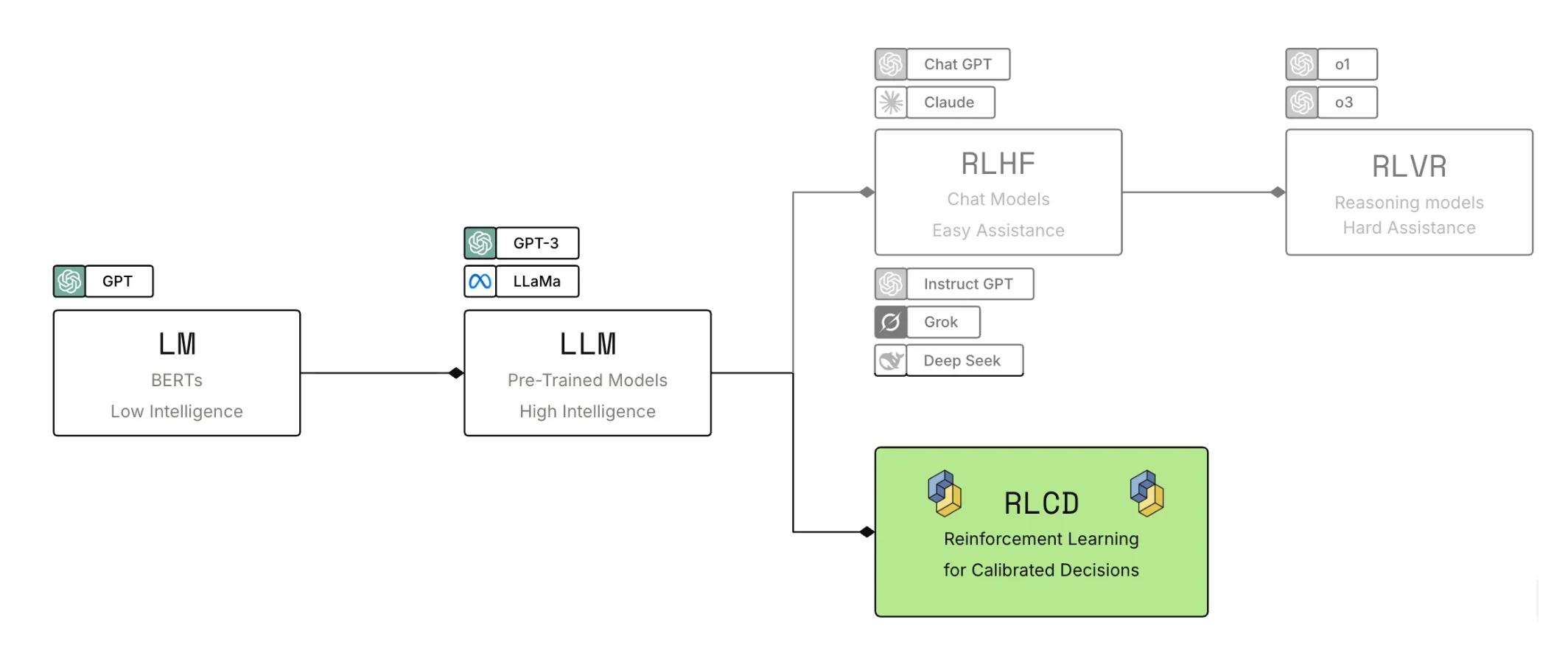 TypeSafe's diagram of post-training paths: RLHF produced chat models, RLVR produced reasoning models, and RLCD produces calibrated decision models.
First-party diagram from TypeSafe's documentation. It describes TypeSafe's framing of the field, not an independent history.
TypeSafe's chief executive, Diogo Almeida, worked at OpenAI on the reinforcement learning from human feedback (RLHF) behind InstructGPT and ChatGPT. The company argues that RLHF rewards answers people prefer, which encourages confident-sounding output, while the verifiable-reward training behind reasoning models suits tasks that can be checked automatically. Its alternative, Reinforcement Learning for Calibrated Decisions (RLCD), rewards honest probabilities on typed decisions. TypeSafe also cites a new architecture and a parallel sampler that scores all answers in one pass instead of writing token by token.
Readers should know the limits of this evidence. TypeSafe has not published a technical paper, model weights, or model size. It says it creates all of its training data itself and does not train on customer requests. None of the architecture claims can be checked from outside yet.
What the launch evidence shows
TypeSafe deliberately publishes no scores on public benchmarks. Instead it built workflow evaluations: four realistic automation tasks (security alerts, agent-trace review, invoice processing, and customer service), each decomposed into many small questions and code rules. The reference answers are the average of GPT-6 Astra and Claude Fable 5.1 at high thinking; every other model runs the same workflow at its default settings.
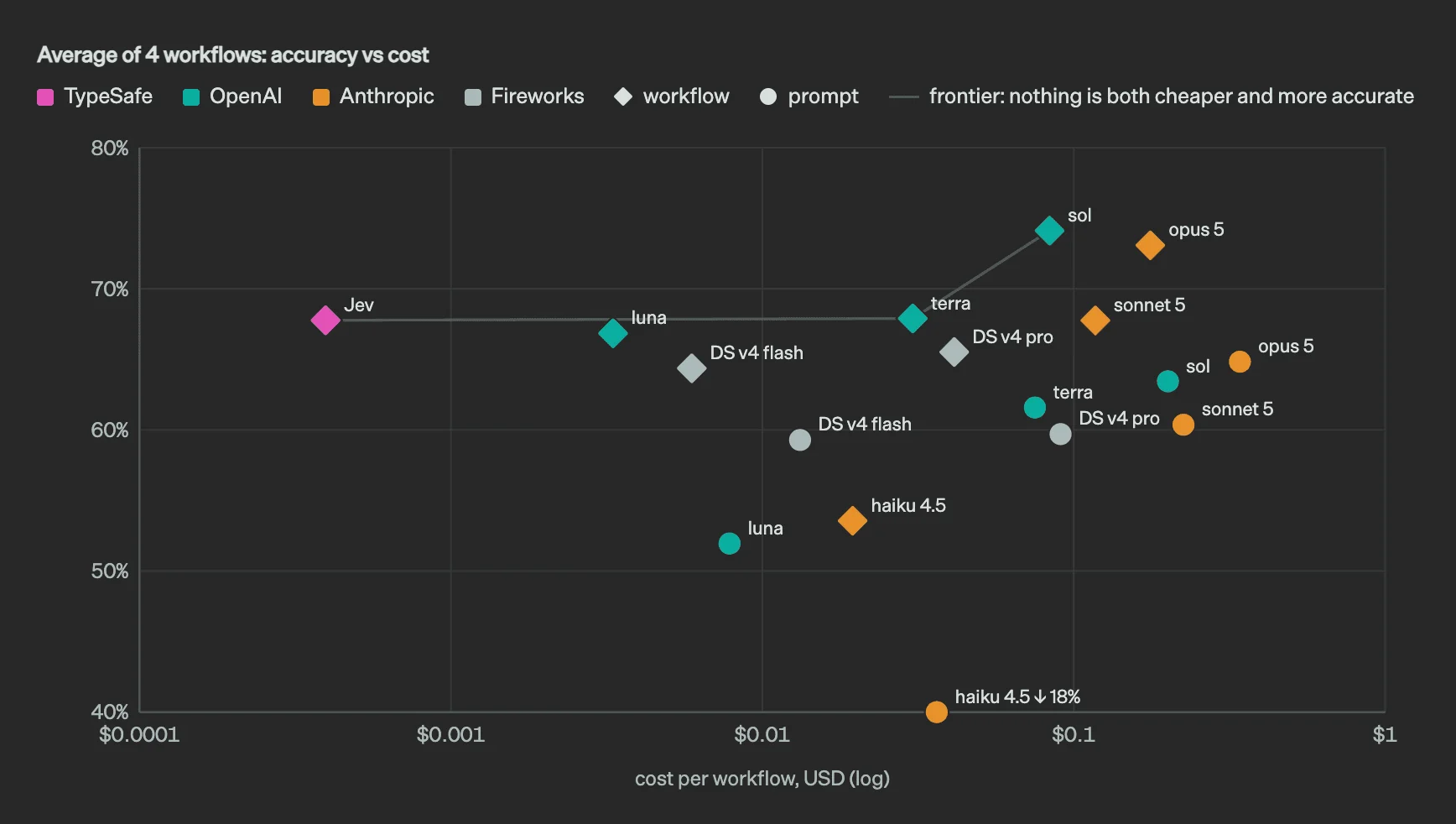 TypeSafe's chart of accuracy against cost per workflow, averaged over four workflows, with Jev at the far low-cost end.
First-party evidence from TypeSafe's launch post. Accuracy means agreement with the Astra and Fable 5.1 reference answers on TypeSafe's own workflows.
Read carefully, the chart says something more modest than the headlines. Jev lands at roughly 68% agreement, about level with GPT-5.6 Luna and Terra and Claude Sonnet 5 running the same workflow, and below GPT-5.6 Sol and Claude Opus 5 at around 73 to 74%. Its distinction is cost: well under a tenth of a cent per workflow, against about a third of a cent for Luna and tens of cents for the largest models. No point on the chart is both cheaper and more accurate than Jev, which is what TypeSafe means by owning the frontier.
The chart also carries a second lesson that applies to every model: each LLM scored higher running the decomposed workflow than when given the same policy as a single prompt.
TypeSafe's widely quoted figures, 193.6 times faster and 444.6 times cheaper, come from these workflows. The company itself says they are "on the higher end of real world gains," that its own team built the workflows, and that using OpenAI and Anthropic models as the reference biases the comparison toward them.
"Cannot hallucinate," read precisely
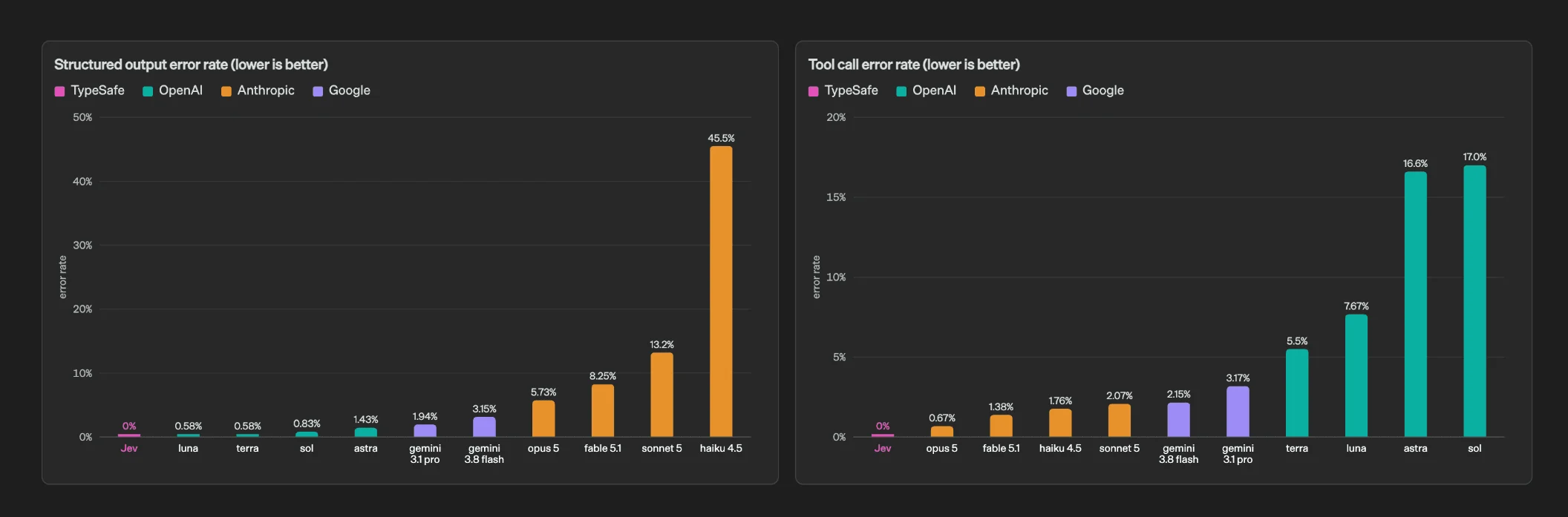 TypeSafe's charts of structured-output and tool-call error rates for several LLMs, with Jev shown at 0%.
First-party chart from TypeSafe's launch post. The LLM error rates come from OpenRouter traffic; TypeSafe states that Jev's 0% is not a measurement but a guarantee of its design.
The accurate version of the claim is that Jev cannot make a type error. Its output always matches the schema you defined, so software never receives something it cannot parse. That is valuable, and TypeSafe notes a single counter-example would disprove it.
It does not mean every answer is right. Jev can choose the wrong option, and TypeSafe's own list of known weaknesses for version 1.13 is candid: it reads instructions very literally, is unreliable at arithmetic, counting, and comparing dates, loses accuracy when the input is padded with irrelevant material, struggles with multi-step indirection, and can be steered by adversarial text placed in the input. The confidence score exists so that code can catch the uncertain cases. The German outlet heise adds a fair concern: Jev gives no explanation for its decisions, which matters more as automated systems decide more.
Price, speed, and limits
According to the model page, the current version is jev-1.13.0, reachable through the jev-latest alias.
| Item | Jev 1.13 |
|---|
| Input price | $0.042 per million tokens ($42 per billion) |
| Output price | Free |
| Typical response time | 70 to 500 milliseconds, measured from TypeSafe's West Coast base |
| Context | 64,000 tokens per request; 32,000 for the state plus the longest question |
| Rate limits | 250,000 tokens per second and 1,200 requests per minute, adjusting with demand |
| Input | Text only: strings, JSON objects, or arrays of text |
| Customization | No fine-tuning; the same weights serve every account |
For scale, Claude Opus 5.5 charges $4 per million input tokens, about 95 times Jev's rate, and Claude Fable 5.1 charges $10. TypeSafe says openly that it cannot prove its prices are not subsidized, although it expects them to fall.
Who built it and how developers reacted
TypeSafe was founded in 2024 in San Francisco by Diogo Almeida, Erik Gafni, and Sasha Sheng, and spent two years in stealth. It announced a $40 million seed round led by DCVC alongside the launch. TechCrunch reported that demand briefly overwhelmed the API, that Vercel was using Jev for safety-review classifiers and measured it at 5 to 18 times faster than GPT-5.6 Luna with better accuracy, and that the startup Bryo AI found it 10 to 20 times cheaper than Gemini for email classification. These are early, self-reported adopter results, not independent evaluations.
What this means for teams in Iran
Two facts come first. The model page states that English is Jev's primary training language and that other languages are "handled but not equally well"; TypeSafe names CJK scripts and publishes nothing about Persian. Any Persian workload would need its own test set before anyone relied on it.
Second, TypeSafe's Master Customer Agreement (section 16.12) requires every customer to represent that it is not located in, or a national of, a country under a US government embargo. Under those terms, companies and individuals in Iran cannot use the service.
The ideas are still worth adopting. Splitting a fuzzy business judgment into small typed questions, keeping arithmetic and control flow in code, and acting only when confidence clears a threshold set by the stakes are design choices that work with any model a team can legally use. Our guide to validating structured AI output against a contract covers how to enforce types when the model itself does not guarantee them, and the developer guide to Jev's design patterns walks through the full architecture.
Verdict
Jev is a genuinely different kind of AI product: a decision engine with a guaranteed output shape, calibrated probabilities, and a price low enough to put an AI judgment inside every branch of a program. Its launch evidence supports the speed and cost story strongly and the accuracy story moderately: mid-tier frontier quality, not top-tier.
It is not a replacement for a chat model, a coding assistant, or a reasoning model, and it does not explain itself. Its best use is as a fast first filter or router inside a system where code owns the logic and uncertain cases go to a person or a stronger model. For Iranian readers, the model itself is off-limits under its terms; the architecture is not.
Source notes — reviewed 2026
- TypeSafe's launch post, "Introducing System One Models & Jev" documents the release, the RLCD framing, the workflow and error-rate charts, and TypeSafe's own caveats.
- TypeSafe's workflow evaluation site describes the four workflows and the Astra and Fable 5.1 reference labels.
- Jev model documentation lists the version, price, context and rate limits, input types, language support, and data handling.
- Jev 1.13 known weaknesses records the model's documented failure modes and workarounds.
- TypeSafe's confidence guide explains calibration and risk-based thresholds.
- TechCrunch's September 18 report covers the founders, funding, demand, and early adopter results.
- heise's report on Jev raises the transparency concern and notes that the accuracy reference is proprietary.
- TypeSafe's Master Customer Agreement, section 16.12, sets the export and embargo conditions of use.